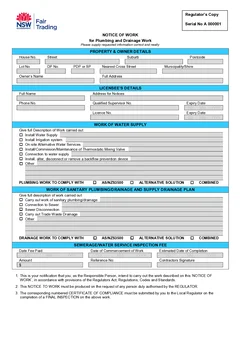
Tradie Forms: fill the NSW Combined Notice of Work and Certificate of Compliance on the official PDF layout, check the key fields, then store the finished document with the job record.
For NSW plumbers and drainers the paperwork trail matters as much as the pipework record. A job starts with a Notice of Work, finishes with a Certificate of Compliance, and needs copies for the owner, regulator, licensee, or local authority depending on where the work sits.
The Combined Notice brings those records into one form. It only helps if the finished document is complete, easy to match to the job, and stored where the business can find it later.
Use the NSW Combined Notice and Certificate template, browse NSW plumbing forms, or read the companion Combined Notice compliance guide.
What does the Combined Notice cover?
NSW Government guidance says plumbers may be required to submit or provide Notices of Work, Certificates of Compliance, and Sewer Service Diagrams for plumbing and drainage work to meet legislative requirements.
A Notice of Work outlines the plumbing and drainage work to be carried out and the person carrying it out. Plumbers and drainers must submit one before starting work - either through Building Commission NSW via MyInspections for work requiring inspection in listed metropolitan areas, or to the local plumbing regulator using the Combined Notice for the type of work the relevant local regulator requires to be inspected.
A Certificate of Compliance confirms the work complies with the Act, Regulation, Plumbing Code of Australia, and Deemed-to-Satisfy requirements of AS/NZS 3500, and identifies the plumber or drainer as the responsible person for that work.
Keep the notice and certificate tied to the same job
The first habit is simple: make the form easy to match to the work.
"Smith job" is not enough for a busy business. Use the job address, owner or builder name, licence details, work type, inspection details, and dates consistently across your booking, invoice, photos, sewer service diagram, and the finished document. If the office has to match a certificate to a job later, they should not be comparing half-filled PDFs against SMS threads.
Before you finish, check the work site address and property details, the owner or builder who arranged the work, the responsible licensee details, licence or certificate details, the work description, the dates for notice, commencement, completion, inspection, or certificate sections where applicable, and which copies are needed.
Notice of Work: what the record must answer
For record keeping, the notice should answer the practical questions - what work is planned, where, who is carrying it out, which regulator or local authority needs the notice, and what inspection path applies.
If those details are vague at the start, the certificate at the end is harder to line up. Keep a copy with the job record, and where scope changes, keep the updated paperwork and messages together. A plumber on site should never have to guess which version the office lodged.
Certificate of Compliance and the timing rules
NSW guidance says that at completion of all plumbing and drainage work, plumbers and drainers must complete a Certificate of Compliance and provide a copy to the person who arranged the work, which may be a property owner or builder.
It is submitted to Building Commission NSW at completion, or before arranging a final inspection through MyInspections for work requiring inspection in the listed metropolitan areas, or to the local plumbing regulator using the Combined Notice for work the relevant regulator requires to be inspected. Where work does not require an inspection, the guidance says the Combined Notice can be used and a copy does not need to go to Building Commission NSW or the local plumbing regulator.
On timing, the NSW Plumbing and Drainage Regulation 2017 sets the periods: 2 business days after work is completed, or 7 business days after completion where the work is not inspected by the plumbing regulator during the period it must be available for inspection. The copy period under section 15(2) is 7 business days after the person required to give the copy receives it.
Do not run those dates from memory. Where timing matters, check the current legislation and regulator guidance.
Sewer Service Diagram and supporting records
NSW regional inspections guidance says plumbers and drainers must submit a Sewer Service Diagram to the local plumbing regulator and provide a copy to the owner of the land or the owner's agent. The broader inspection documents guidance also lists diagrams as part of the inspection document set.
Not every job carries the same documents, but the finished form is far more useful sitting beside the records that explain the work: the sewer service diagram, inspection booking and outcome records, photos taken before covering work, test notes, product or fixture details, owner or builder correspondence, and any regulator or council reference numbers.
Attach those to the same job in your job software or shared storage. A clean document is good; a clean document you can find with its supporting material is better. The Combined Notice vs Sewer Service Diagram guide covers how the two relate.
Where does completion go wrong?
Step 1
Licensee copy
Your job record
Saved back to the job, not left in one person's sent folder.
Step 2
Owner copy
Person who arranged the work
Provided at completion, alongside any SSD that belongs with it.
Step 3
Regulator copy
The pathway for this site
Metro and local regulator pathways differ. Confirm before you send.
The form carries all three. Completing one path does not complete the others.
The document is never checked against the site. Before sending or lodging, confirm the work site, owner, licensee, dates, and work description appear where you expect them on the official layout.
Owner copy and regulator copy get confused. The form carries copies for licensee, owner, and regulator. Your process should say who gets what and when.
The certificate is lost outside the job record. Where it is sent by text, email, or portal upload, save a copy back to the job. The office should not be searching one person's phone.
Saved details go unchecked. They cut repeat typing; they do not remove the need to check responsible person, contractor, licence, contact, and address details.
Follow-up documents are forgotten. Where a sewer service diagram, inspection note, or council message belongs with the form, attach it while the job is fresh.
For the wider error list, see common Combined Notice mistakes.
A practical record-keeping routine
- Check the job address and owner or builder details
- Confirm the responsible licensee details
- Fill the notice or certificate sections that apply
- Check dates against the actual job events
- Store inspection records and photos with the job
- Add the Sewer Service Diagram where required
- Review the official layout
- Name the finished document clearly
- Provide the required copy to the person who arranged the work
- Submit or store the regulator copy where the current process requires it
The point is not extra admin. It is that the next person opening the job can see what was done, what was handed over, and where the finished document went.
Who asks for these records later
The Combined Notice file is usually opened by someone other than the plumber who created it.
A conveyancer during a sale, a subsequent plumber working on the same property, an insurer after a failure, or an owner who has lost their copy. Each wants the document quickly and none of them will accept a description of what was done.
That is the case for keeping your own copy rather than relying on the regulator or the owner holding one. It is also the case for filing by property, because property is how every one of those people will search.
When the job spans a long period
Larger jobs create a gap between the notice and the certificate that can run for months.
Details drift across that gap. Licence renewals, changes to the responsible person, and scope variations all happen mid-job, and the certificate gets completed from the details captured at the start. Build the certificate from the current job record on the day it is completed rather than from the notice.
Where the scope changed materially, that should already have been reflected before completion rather than appearing for the first time on the certificate.
Next steps
Start the NSW Combined Notice and Certificate, or browse NSW plumbing forms. Working interstate? The plumbing forms hub lists the lot.
For the main completion walkthrough read the Combined Notice compliance guide, and for submission timing see when to submit the Combined Notice.
Tradie Forms maps your entries onto the official PDF layout. It does not decide whether your work requires inspection, replace the regulator's process, or lodge the document for you.
Official references
For current requirements, check the NSW plumbing inspection documents guidance, the Combined Notice of Work and Certificate of Compliance form page, the NSW regional plumbing and drainage inspections guidance, and the NSW Plumbing and Drainage Regulation 2017.