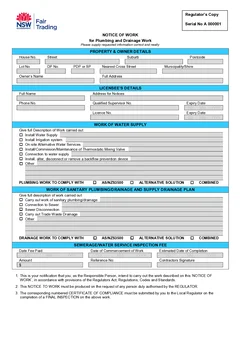
Tradie Forms: complete the NSW Combined Notice of Work and Certificate of Compliance on the official layout. Fill the property, owner, licensee, work type, fee, dates, and certification sections at the job, then preview and download the finished PDF for the right copies.
NSW plumbing and drainage jobs can finish physically before the paperwork is ready. The fixture is in, the drain is tested, the customer wants the job closed, and the office still needs the notice and certificate details.
That gap causes the usual rework. The owner address is missing. The licence expiry date is out of date. The certificate copy does not match the notice copy. A drainage job needs a sewer service diagram, but the closeout pack is split across photos and emails.
The Combined Notice of Work and Certificate of Compliance is built for that completion moment. It brings the notice, work details, licensee details, and certificate copies into one document. Tradie Forms turns that official layout into sections you work through one at a time so a NSW plumber or drainer can finish the form while the job is still fresh.
What is the NSW Combined Notice?
Building Commission NSW publishes the Combined Notice of Work and Certificate of Compliance form for plumbing and drainage. The NSW Government page says the form includes copies for the licensee, owner, and regulator.
The wider NSW plumbing inspection documents explain the two main pieces:
- A Notice of Work outlines plumbing and drainage work to be carried out and the person carrying out the work.
- A Certificate of Compliance confirms the work complies with the Act, Regulation, Plumbing Code of Australia, and Deemed-to-Satisfy requirements of AS/NZS 3500, and identifies the plumber or drainer as the responsible person for that work.
The form is not a magic compliance stamp. It is the official paperwork layout for recording the work, who did it, who receives copies, and what was certified. The licensed plumber or drainer still needs to check the work, the declaration, and the finished PDF.
Use the NSW Government combined form page, the plumbing inspection documents guidance, and the regional inspections guidance as official references.
Notice first, certificate at completion
The NSW guidance says plumbers and drainers must submit a Notice of Work before starting work. For work requiring inspection in Sydney, the Illawarra, Blue Mountains, Newcastle, and Hunter, the guidance points to Building Commission NSW via MyInspections. For local plumbing regulator areas, it points to the Combined Notice of Work and Certificate of Compliance for the type of work the relevant local plumbing regulator requires to be inspected.
At completion, the Certificate of Compliance side matters. NSW guidance says plumbers and drainers must complete a CoC at the completion of all plumbing and drainage work, provide a copy to the person who arranged the work, and submit it through the relevant pathway where required.
That means the same combined document may touch two different job moments:
- Before work begins, as the notice of work
- At completion or final inspection, as the certificate record
Do not leave the whole document until the end if the notice was needed before starting. Use the form as part of the job flow, not an afterthought.
Which NSW inspection pathway applies?
NSW plumbing inspection pathways depend on location and work type. The NSW regional inspections page says regional inspection and enforcement are delegated to local councils and authorities, and that the information on that page applies outside the Sydney, Illawarra, Blue Mountains, and Newcastle areas.
For regional NSW, the guidance says plumbers and drainers must submit documents at specific stages of the work, including the Notice of Work before work begins, Certificate of Compliance on completion of the final inspection to the local plumbing regulator and the person for whom the work was carried out, and a Sewer Service Diagram to the local plumbing regulator and owner or owner's agent.
For metropolitan and listed areas, MyInspections may be part of the process for work requiring inspection. Local regulator requirements can also matter. Before sending the form, check the pathway for the site, not just the pathway your last job used.
Details to collect before you leave
The combined notice is easier when you gather the closeout details before the customer leaves and before the trench, wall, or plant room disappears from view.
Property and owner details
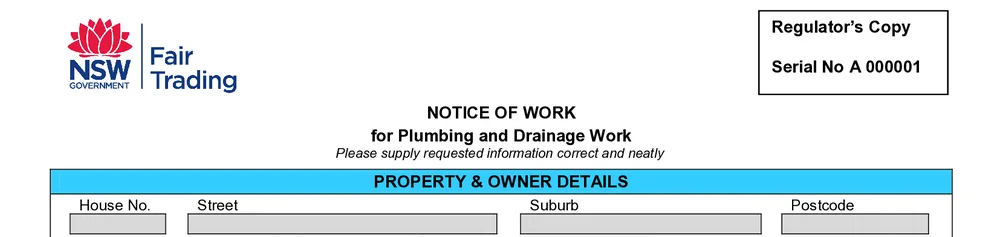
Start with the property address and owner details. Include the house number, street, suburb, postcode, lot and DP or strata details where relevant, nearest cross street, and municipality or shire.
For apartments, shopping centres, rural blocks, and new subdivisions, the basic street address may not be enough. Match the site details to the approval, council record, or work order. If the owner is a company, strata body, builder, or managing agent, enter the legal or business name that belongs on the paperwork.
Licensee details
The licensee block should identify the plumber or drainer carrying out the work. Check the full name, address for notices, phone number, qualified supervisor number, licence number, and expiry dates.
Saved licence details help, but they are only useful if they are current. Review them when a licence renews, a supervisor changes, or the business address has moved.
Water supply work
The water supply section should match the work actually carried out. The official layout includes options such as water supply installation, irrigation, on-site alternative water services, thermostatic mixing valve work, connection to water supply, backflow prevention device work, and other water supply work.
Use the description field to write something a regulator, customer, or office admin can understand later. "Bathroom" is weak. "Alter hot and cold water supply to ensuite fixtures" is better.
Sanitary plumbing and drainage work
The sanitary plumbing and drainage section covers the drainage side of the job. It can include sanitary plumbing or drainage work, sewer connection, sewer disconnection, trade waste drainage, or other relevant work depending on the site.
If the work required a sewer service diagram, keep that document with the same job record. NSW guidance treats SSDs as a separate document that may need to be provided to the relevant regulator and owner.
Inspection fee, dates, and reference number
The combined form includes fee, date paid, commencement date, estimated completion date, amount, and reference number fields. These details help match the notice and certificate to the regulator's record.
Do not let the office recreate those from bank records later if they are known on the job. Put the reference into the form and job record while it is still easy to find.
Certificate details
The certificate section is the serious part. It records the contractor's certification about the authorised work, testing, relevant standards, and completion date. Read the declaration before signing. If there was identified pre-existing defective plumbing or drainage work and a written notice was required under the legislation, do not skip that field.
Tradie Forms can map entries onto the official PDF layout, but it does not decide whether the work is compliant. That responsibility stays with the licensed person issuing the certificate.
Common mistakes with the combined notice
The wrong regulator pathway is assumed
The NSW pathway depends on location and work type. A process that worked for one council or metro job may not apply to the next. Check the current NSW guidance and local regulator instructions before relying on habit.
Notice details are completed after work starts
If a Notice of Work is required before starting work, filling it out at completion is too late for that job flow. Prepare the notice side before the work starts and keep the same document ready for certificate closeout.
Certificate copies do not match
The combined form includes copies for different parties. If a detail is corrected on one copy but not another, the record becomes messy. Fill once, preview the full PDF, and confirm the repeated details land correctly.
Work descriptions are too vague
Describe the water supply, sanitary plumbing, and drainage work clearly. A short but specific description helps the customer, regulator, and next tradesperson understand what was done.
SSD is forgotten
A Certificate of Compliance does not replace a Sewer Service Diagram where one is required. If drainage work needs an SSD, keep it in the same site pack as the combined notice and certificate.
How Tradie Forms helps
Tradie Forms turns the NSW Combined Notice of Work and Certificate of Compliance into sections you work through one at a time for the property, owner, licensee, water supply, drainage, inspection fee, dates, and certificate.
You can:
- Reuse saved licensee details instead of retyping the same licence block
- Use address search for NSW sites and owner addresses
- Catch missing required fields before download
- Preview the official PDF layout, including the repeated certificate copies
- Download the finished PDF for the owner, licensee, regulator pathway, and job record
- Attach or store the PDF with the job so the office can close the loop without chasing site notes
Tradie Forms maps entries onto the official NSW combined form layout. It is not affiliated with Building Commission NSW or any local regulator. The licensed plumber or drainer remains responsible for checking the work, the pathway, and the downloaded PDF.
A better on-site closeout habit
Use the combined form as part of the job, not as a separate admin task:
- Confirm the regulator pathway for the site.
- Prepare the Notice of Work details before the work starts where required.
- Save or check the licensee details before the first download.
- Record water supply, sanitary plumbing, or drainage work clearly.
- Add fee, commencement, completion, and reference details as soon as they are known.
- Complete the certificate after testing and final work checks.
- Preview the official PDF layout.
- Keep the PDF with SSDs, inspection notes, photos, and completion emails.
That habit keeps the paperwork tied to the job-site reality. It also helps the office send clean copies without ringing the plumber after hours.
Next steps
Start the NSW Combined Notice of Work and Certificate of Compliance at the job, or browse NSW plumber forms for live NSW plumbing and drainage paperwork. The plumbing forms hub has the national set if you work across borders.
Check when to submit the Combined Notice before work starts, then use the record-keeping and handover guide when the copies move between the licensee, owner and regulator. For drainage work, the Combined Notice and sewer service diagram guide keeps the two records separate.
If your business works across states, related plumbing paperwork includes QLD Form 5 testing or commissioning reports and TAS Form 71B standard of work certificates.
Official references
For current requirements, check the NSW Government combined form page, the NSW plumbing inspection documents guidance, the NSW regional inspections guidance, and the NSW Plumbing and Drainage Regulation 2017.