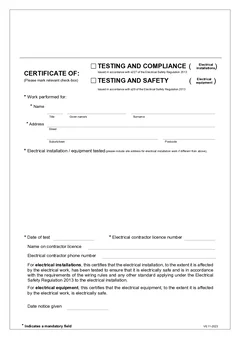
"Do we need a CoTC for this job?" is the question that shows up at the end of a call-out, not the start. The board is back together, the customer is waiting for the invoice, and someone in the office asks whether this job needs a certificate of testing and compliance or a certificate of testing and safety.
In Queensland, the answer is not a vibe. WorkSafe Queensland and Business Queensland set out when certificates are required, which type applies, who issues them, and who keeps a copy. This guide turns that into plain job language so electricians can decide before the ute leaves the driveway.
Use it with the QLD CoTC on-site guide when you are filling the form, and with common QLD CoTC mistakes before download. Browse QLD electrical forms for the wider set.
The short answer
For electrical installation work, Queensland points to a certificate of testing and compliance. WorkSafe Queensland says the electrical contractor must provide that certificate to the person for whom the work was done every time an electrical installation on which electrical work was performed is connected to a source of electricity.
For work on electrical equipment, Queensland points to a certificate of testing and safety.
Both certificates need the same core facts: who the work was for, what was tested, the test date, the contractor licence number, and a suitable certification statement. The statement wording changes with the certificate type.
If you only remember one decision rule: match the certificate to the thing you worked on and tested, then issue it as soon as practical after testing or completion.
CoTC or certificate of testing and safety?
Queensland sparkies often say "certificate of test" for both. The paperwork is not the same, and the split is a single tick at the top of the certificate.

Certificate of testing and compliance
Use this path when the job is electrical installation work. WorkSafe Queensland and Business Queensland both describe the certification statement for installations as certifying that the electrical installation, to the extent it is affected by the electrical work, has been tested to ensure it is electrically safe and is in accordance with the wiring rules and any other standard applying under the Electrical Safety Regulation 2013.
Common installation jobs that usually sit in this bucket:
- New circuits and final subcircuits
- Switchboard replacements or alterations
- Fixed wiring changes that form part of the installation
- Lighting, GPO, or power work that is part of the fixed installation
- EV charger circuits, solar-related installation work, and other fixed electrical installation work where testing and compliance with the wiring rules matter
Certificate of testing and safety
Use this path when the job is electrical equipment work. The certification statement for equipment certifies that the electrical equipment, to the extent it is affected by the electrical work, has been tested to ensure it is electrically safe.
Common equipment-focused jobs:
- Repair of an appliance or piece of electrical equipment
- Work limited to the equipment itself rather than the fixed installation
- Equipment testing and safety certification after repair or service
Mixed jobs
Some call-outs involve both fixed installation work and equipment work. Do not invent a hybrid certificate type. Check what was tested, what the customer needs evidence for, and what WorkSafe Queensland requires for each part. If the installation was connected or reconnected after installation work, the CoTC path is the one WorkSafe describes for that connection moment.
When in doubt, open the current WorkSafe Queensland issuing certificates guidance and the Business Queensland safety duties page rather than copying last month's PDF wording.
The trigger in plain job terms
WorkSafe Queensland's FAQ language is practical: for electrical installations, provide a certificate of testing and compliance every time an electrical installation on which electrical work was performed is connected to a source of electricity.
That trigger has a few field consequences.
1. The work is on an electrical installation
If you altered, extended, or otherwise performed electrical work on the installation, the certificate is about that installation work and the testing that supports the compliance statement.
2. The installation is connected to a source of electricity
The connection moment is the regulatory hook WorkSafe describes. That is why finishing the certificate after testing and before you leave site is the clean habit. Waiting until the office catches up later makes it easier to miss the notice date, the person who engaged you, or the real work description.
3. The certificate goes to the person the work was done for
WorkSafe Queensland explains that this is usually the person or organisation that engaged the licensed electrical contractor, and usually the person or organisation you would invoice. A builder, owner, property manager, or body corporate can all sit in that role depending on who engaged you.
4. You keep your own copy
Business Queensland says electrical contractors must keep a copy of these certificates for five years. WorkSafe Queensland's guidance also treats the contractor copy as part of the duty after the certificate is issued. Record keeping is covered in more detail in QLD CoTC record keeping for five years.
Who must issue the certificate
WorkSafe Queensland says the electrical contractor performing the electrical work issues the certificate of testing and compliance or the certificate of testing and safety. That includes situations where workers complete the work on behalf of the electrical contractor under the contractor licence number.
Practical checks before you put a name and licence number on the PDF:
- Which electrical contractor licence covers the work
- Whether a subcontractor or employed sparky completed the testing under that licence
- Whether the customer was engaged by your business or by another party
- Whether the saved licence details in your phone or job system are still current
Tradie Forms can reuse saved contractor details so you are not retyping the licence block on every job. It does not choose the responsible contractor for you. That call stays with the licensed business.
What the certificate must include
Business Queensland lists the minimum certificate content:
- Name and address of the person for whom the work was performed
- Details of the electrical equipment or electrical installation tested
- The day the equipment or installation was tested
- The electrical contractor licence number under which it was tested
- A suitable certification statement
The WorkSafe example certificate also includes practical fields such as the installation or equipment description, contractor phone details, date notice was given, and signature or authorised details.
If any of those pieces are missing, the certificate is harder for the customer, builder, insurer, or office to use later. That is a different problem from choosing the wrong certificate type, but it shows up on the same job.
Job types that usually need a clear CoTC decision
These are not a substitute for the official rules. They are the everyday situations where Queensland crews ask the question.
Domestic switchboard and circuit work
A switchboard upgrade, new circuit, RCD work tied to the installation, or fixed wiring alteration is usually installation work. Expect a certificate of testing and compliance path when the installation is connected after the work.
New builds and renovations
Builder-run jobs still need the right person named on the certificate. WorkSafe Queensland's guidance about who engaged the contractor matters here. The CoTC is still about the tested installation work, not a general completion certificate for the whole build.
Commercial tenancies and strata
The customer block may be a builder, strata manager, body corporate, or tenant depending on who engaged you. The installation address may differ from the bill-to address. The certificate is still required when the WorkSafe trigger applies; the risk is putting the wrong party in the customer fields.
Solar, battery, and EV-related electrical work
These jobs often mix product paperwork, network or installer documentation, and electrical installation certification. Do not assume product or commissioning paperwork replaces the Queensland certificate obligations for the electrical installation work you performed. Check the installation work path and issue the right certificate for what you tested.
Equipment repair call-outs
If the job is equipment work, the certificate of testing and safety path is the one Queensland guidance describes. Using installation wording for pure equipment work, or equipment wording for installation work, is a common mix-up covered in the common mistakes guide.
Emergency after-hours work
After-hours repairs still need accurate testing and the right certificate when the trigger applies. The late finish is not a reason to skip the certificate. Finish the PDF while the notes are fresh, even if the customer receives it by email before breakfast.
When people over-certify or under-certify
Two opposite mistakes show up in the field.
Over-certifying
Some crews issue a broad installation certificate for a narrow piece of work, or write a description so wide it looks like the whole house was certified. That confuses later readers and can create arguments about scope. The certificate should describe the work tested to the extent affected by the electrical work.
Under-certifying
Other crews treat the certificate as optional for small installation jobs because the customer did not ask. Queensland's guidance does not make the certificate optional just because the invoice is small. If the installation work trigger applies, the certificate is part of the job.
The safe habit is simple: decide the certificate type from the work and the official guidance, then complete it while the test gear is still out.
Timing: as soon as possible after testing or completion
Business Queensland says a certificate must be given as soon as possible after you or your employees have tested or completed an electrical installation. That is the practical reason on-site completion wins.
Waiting creates the usual mess:
- Test date gets mixed up with the invoice date
- Customer name comes from the site contact instead of the person who engaged you
- Work description shrinks to "electrical work completed"
- Notice date is left blank
- The PDF sits in one person's downloads folder instead of the job record
If the job spans multiple visits, do not invent a single certificate from a rough-in memory. Complete the certificate for the testing and connection moment you are certifying, with the real test date and a clear description of the work tested.
How this differs from NSW CCEW talk
Electricians who work both sides of the border often ask whether a QLD CoTC is "the same as a NSW CCEW". It is not. Different state, different legislation, different certificate name, different copy and submission habits.
From 1 July 2026, NSW requires CCEW submission through the BCNSW eCert portal for NSW electrical compliance. That portal path is not a Queensland CoTC process. If you need the comparison, read QLD CoTC vs NSW CCEW. Do not use a NSW form for Queensland work, and do not treat a Queensland certificate as a substitute for NSW obligations.
A practical decision checklist on site
Before you pack up, answer these questions out loud:
- Was this electrical installation work, electrical equipment work, or both?
- If installation work, is the installation connected to a source of electricity after the work?
- Who engaged the electrical contractor, and is that who belongs in the customer block?
- What exact work was tested, and can a stranger understand it from the description?
- What is the real test date?
- Which contractor licence covers the work?
- Has the customer received or been sent the certificate as soon as practical?
- Has the finished PDF been stored with the job for the five-year keep period?
If any answer is fuzzy, fix it before download. The certificate is short. The rework later is not.
What the customer is really asking for
Customers and builders rarely use the full formal name. They ask for "the electrical cert", "the COC", or "something for the insurance". Your job is to translate that request into the right Queensland document for the work performed.
Useful clarifying questions:
- Was the work on the fixed installation, on equipment, or both?
- Who engaged the electrical contractor?
- Is the certificate needed for handover, sale, warranty, or inspection support?
- Do they need it before you leave site, or is email the same day enough?
Those questions stop you from issuing the wrong certificate type just because someone used a generic label.
Related reading and next steps
Start the QLD certificate of testing and compliance when you need to complete the official layout on site. Browse QLD electrical forms for more Queensland electrical paperwork as coverage expands.
Related resource articles:
- QLD CoTC on-site guide
- Common QLD CoTC mistakes
- QLD CoTC record keeping for five years
- QLD CoTC vs NSW CCEW
Official references
For current requirements, check WorkSafe Queensland's issuing certificates of compliance guidance, Business Queensland electrical contractor safety duties, the WorkSafe certificate of testing or compliance form, and the Electrical Safety Regulation 2013.