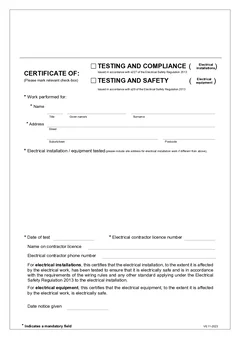
The certificate is easy to treat as a one-time send. Customer wants the PDF, you email it, the job is paid, and everyone moves on. Six months later the owner sells, the insurer asks for evidence, or the office cannot find which version left the business.
Queensland does not treat the CoTC as a disposable attachment. Business Queensland says electrical contractors must keep a copy of these certificates for five years. WorkSafe Queensland's guidance also reminds contractors to keep their own copy after the certificate is given to the person for whom the work was performed.
This is a checklist for the five-year file: what to keep, where it lives, and who gets which copy. For filling the form, use the QLD CoTC on-site guide. For when a certificate is required, use when a QLD CoTC is required. Browse QLD electrical forms.
Who is the CoTC file actually for?
1. The person the work was done for (handover copy)
WorkSafe Queensland says the certificate must go to the person for whom the work was performed. That is usually the party that engaged the licensed electrical contractor, and usually the party you invoice.
On multi-party jobs, confirm before you hit send:
- Owner-occupier
- Investor owner via agent
- Builder
- Body corporate or strata manager
- Facilities manager
A tenant or site supervisor may need a courtesy copy. They are not automatically the person the certificate was issued for. Put the right party in the customer block, and note the decision on the job if the site is messy.
Finish the PDF before you leave where you can, or send it from the business process (not only a personal phone account). Save the sent message or portal receipt with the job.
2. The licensed electrical contractor (five-year copy)
The contractor under whose licence number the certificate was issued keeps the copy. Customer handover and contractor storage are separate duties that happen in the same moment. If the customer deletes the email, you still need your file.
A useful contractor copy is complete, the same version the customer received (or clearly versioned if corrected), searchable by site, customer, date, and job number, stored where the business controls it, and backed up so one phone loss does not wipe the record.
3. Later askers (sale, insurer, call-back, investigation)
In five years a certificate can be asked for by the original customer or a later owner, a builder closing a defect period, an insurer, a property manager, your own office on warranty, or a regulator process. If the only copy lives in one sparky's downloads folder, the business has luck, not a system.
Checklist: what to keep in the pack
Keep the CoTC as the completion certificate. Keep supporting material beside it, not stuffed into the certification statement.
Typical pack:
- Finished CoTC or certificate of testing and safety PDF
- Test notes, tester downloads, or photos of readings where your process keeps them
- Switchboard and installation photos that identify the work
- Scope confirmation, variation messages, or customer approval notes
- Defect or remedial notes if other work on site was incomplete
- Invoice or job number used by the office
- Notice date and send method
- Any corrected PDF if the first download needed a fix
Do not turn the certificate itself into a full test log. The certificate needs the required details and certification statement. Supporting detail can live beside it.
Where should the file live?
Pick one primary system and make it mandatory. Two half-used systems are worse than one boring system everyone follows.
Good homes:
- Attach the PDF to the job in your job system of record
- Shared drive with the same naming pattern
- Both, if the office wants the job card and a long-term archive folder
Weak homes:
- Chat threads only
- Camera roll photos that cut off the signature or licence block
- Paper books that stay in one ute
- Scans saved only on a home computer
If you must capture paper, convert it to a clean PDF the same day, name it properly, and store it in the business system. Then treat that PDF as the working record.
Checklist: how to name it so year four still finds it
Use a boring pattern: YYYY-MM-DD_customer-or-builder_suburb_cotc.pdf.
Write a short, specific work description at issue time. "Electrical work completed at site" makes search painful when the suburb has three similar jobs.
Checklist: corrections and re-issues
When you re-issue:
- Fix the source details, not only the PDF filename
- Download a clean corrected certificate
- Give the corrected copy to the person the work was done for if they already received the first one
- Store both versions or clearly mark which version is current
- Note the reason for the correction on the job record
Do not leave two competing "final" PDFs with no explanation. WorkSafe Queensland's 2023 certificate amendment guidance is a useful reminder that certificates sit in a longer compliance conversation. The practical habit stays the same: keep clean copies and know where they are.
Checklist: multi-crew and multi-licence businesses
Build these into the keep process:
- Saved licence details are reviewed after renewals
- The certificate names the contractor licence under which the work was tested
- Employees and subcontractors know which entity's details to use
- The office can filter certificates by crew, suburb, or job number
- Departing staff do not take the only local copies with them
If a worker leaves, the five-year archive must still live with the business.
End-of-job routine (short enough to survive a busy week)
- Choose the right certificate type for installation or equipment work
- Fill the form while test gear and job notes are still in front of you
- Check customer, address, work tested, test date, licence, and notice date
- Preview the official PDF layout
- Download the finished PDF
- Give or send the copy to the person the work was done for
- Attach the same PDF to the job record with a clear file name
- Store supporting test notes and photos with that job
- Confirm the office can open the file without ringing the sparky
- Leave the record alone unless a genuine correction is needed later
A clean closeout pack often also includes invoice or progress claim reference, customer send confirmation, and any builder portal upload receipt. When the certificate is complete before you leave site, the office can attach it the same day.
Kill these failures early
- Only the customer has the PDF. You still need the contractor copy.
- The cert is in a chat thread. Move it into the job system the same day.
- Draft and final are mixed. Store the finished download; label drafts as drafts.
- No link between invoice and certificate. Job number or customer name should connect payment, warranty, and certificate requests.
What a five-year file has to survive
The retention period is long enough that the file will outlive staff, phones, and probably at least one system change.
That is the practical design constraint. A filing habit that depends on one person's memory, one device, or one app subscription will not make it to year five. Records stored under the customer and job, in a place the business controls, will.
Test it occasionally by picking a job from a year ago and finding its certificate. If it takes more than a minute, the system is not going to work at year four.
When the business changes
Sole traders incorporate, businesses get sold, and licences move. Each of those is a point where certificate history commonly gets lost.
The obligation follows the work rather than the current business structure, so the file needs to move with it. Planning for that at the time of the change is much easier than reconstructing five years of certificates afterwards.
How the form helps without overclaiming
The QLD certificate of testing and compliance maps entries onto the official Queensland layout and helps catch missing fields before download. Tradie Forms does not replace your duty to decide when a certificate is required, check the PDF, give the customer copy, or keep the contractor copy for five years. Treat the downloaded PDF as the artefact your record system must hold.
Related reading: Common QLD CoTC mistakes, QLD CoTC vs NSW CCEW.
Official references
For current requirements, check WorkSafe Queensland's issuing certificates of compliance guidance, Business Queensland electrical contractor safety duties, the 2023 certificate amendment guidance, and the WorkSafe certificate of testing or compliance form.