A Victorian pest control licence belongs to the individual operator who uses pesticides in a pest control business. It is issued by the Victorian Department of Health under the Public Health and Wellbeing Act 2008. It is not a general trade licence for the business name.
That distinction matters on site. A customer may recognise the company on the ute, but the person carrying out the treatment needs the right licence status and authorisation for the work. The licence also connects to the records made after each pesticide application.
This guide covers who usually needs a pest control licence in Victoria, the technician and trainee licence types, the four current authorisations, how to check an operator, and the pesticide records that sit beside the licence.
Who needs a pest control licence in Victoria?
Anyone who uses pesticides, or permits another person to use pesticides, in the course of a pest control operator's business in Victoria must hold a valid licence unless the work falls within a stated exception. The Victorian Department of Health's pest control legislation guidance defines a pest control operator as a person who carries on, or presents themselves as carrying on, the business of controlling, destroying or repelling pests.
The stated exceptions cover pesticide use for horticulture, agriculture, water treatment and weed control. They also cover some pest-animal control away from commercial buildings, domestic premises and privately owned land beside domestic premises. A different Victorian licensing scheme may still apply to some of that work. For example, a business offering certain agricultural chemical services for a fee may need a commercial operator licence.
For an ordinary domestic or commercial treatment, the practical question is simple: who will actually apply the pesticide? The department licenses individuals who operate or work for a pest control business and apply pesticides to control insects or pest animals. A company registration, business name or supervisor's licence does not automatically cover every worker.
The licence is tied to the pesticide classes and pest-control work the person is qualified to perform. Operators must only use the pesticides or classes shown on their licence. Work involving native wildlife, firearms, arsenic, cyanide or agricultural chemicals can also bring in separate permits and laws, so a Victorian pest control licence should not be treated as blanket approval for every control method.
If the job falls outside routine household or commercial insect and rodent work, check the current regulator guidance before quoting or starting it. The VIC pest control page brings together the live forms and practical resources for common Victorian pest work, but the regulator remains the source for licence scope.
Licence types and authorisations
Health Victoria currently lists two pest control licence types: technician and trainee. Both are issued as photo ID, but they do not carry the same working conditions.
Fully qualified technician
A technician has completed the appropriate prescribed qualification for the authorisation sought. Health Victoria's licence application page says technician licences expire three years after they are granted.
The licence card shows the authorisations held by that technician, and a technician can only carry out the pesticide work covered by those authorisations. Holding a technician licence does not by itself mean the person can perform timber-pest work, fumigation and pest-animal work.
Trainee under supervision
A trainee is undertaking a prescribed course or units of competency and applies authorised pesticides under the supervision of an appropriately qualified technician with a valid licence.
Health Victoria's trainee licence guidance distinguishes direct and indirect supervision. A trainee initially works within the direct sight and hearing of the supervisor for the pest being treated. The department requires evidence of at least four satisfactory applications for that pest before it considers the trainee competent for indirect supervision.
Trainee licences expire 12 months after grant and are generally limited to three issues unless exceptional circumstances apply. The job record should name the supervisor and include their licence number where supervision applies.
The four licence authorisations
A technician or trainee licence may carry one or more authorisations. Health Victoria currently lists four:
- General, excluding timber pests: non-fumigant pesticides for pests such as insects and rodents, excluding pest animals and timber pests
- General, including timber pests: non-fumigant pesticides for general pests and timber pests, excluding pest animals
- Pest animal: pesticides formulated for pest animals in the domestic, adjoining private-land and commercial-building situations described by the department
- Fumigant: pesticides in the form of fumigants
Do not infer an authorisation from a job title or years in the industry. Check the licence card and current register entry against the work being booked. Health Victoria's licence application page lists the current qualification rules, application process, fees and expiry periods. Fees change, so use that page rather than an old application copy or a saved quote.
How do you check a pest control licence in Victoria?
Use the register, then the card. Health Victoria maintains a searchable register of current licensed pest control operators that shows the operator's name and licence expiry date for current Victorian licence holders. Search the person's name, not only the business name, because Victoria licenses the individual who applies the pesticide.
For a useful check, confirm:
- The operator's name matches the person who will do the treatment
- The licence appears as current and its expiry date has not passed
- The photo ID belongs to that operator
- The licence authorisation covers the proposed pest, pesticide class and treatment method
The public search confirms current holders, while the photo ID shows the licence details carried by the operator. If the search result, the card and the proposed scope do not line up, ask the operator to clarify before work begins. Health Victoria directs people who need more information than the register provides to contact the department.
For trainees, also confirm who the supervising technician is and that the supervisor holds the authorisation needed for the work. Supervision is a condition of the trainee licence, not an optional business arrangement.
Operators should run the same check inside their own business. Renewals, changed authorisations and trainee supervision all affect who is ready for a particular booking.
What records must licensed operators keep?
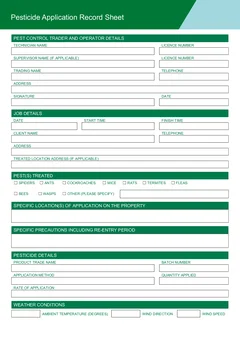
A current licence is only one part of the job. Health Victoria says pest control operators must keep certain records for every pesticide application on every job under the Public Health and Wellbeing Act 2008 and the Public Health and Wellbeing Regulations 2019.
The application record connects the licensed person to the treatment. It covers operator and supervisor details, client and site details, the pesticide trade name and batch number, pests treated, specific application locations, method, quantity and rate, precautions and re-entry advice, job times, outdoor weather where relevant, and sign-off.
Health Victoria says records must be kept at the business address for at least three years, and electronic records must be stored securely and remain available for inspection. A file left in a downloads folder, or a product photo without the matching job details, is not a strong filing system.
Read the on-site completion guide for the field-by-field rhythm, use the digital record-keeping workflow to decide how the PDF is named and stored, and check the common VIC pesticide record mistakes for the gaps that weaken a record.
Penalties and common licence slip-ups
Breaching a pest control licence condition is an offence. Health Victoria says its response can include a formal warning, infringement notice, prohibition or improvement notice, extra licence conditions, licence cancellation or prosecution. The response depends on the breach, so a single dollar figure would be misleading.
Licence holders also carry ongoing conditions. Health Victoria says they must follow the Act and Regulations, use only the pesticide classes on the licence, follow label directions, keep current safety data sheets, store chemicals lawfully, maintain vehicles and equipment, and notify the department of changes to personal or business details within the required period.
Tradie Forms turns the official Health Victoria pesticide application record into sections you work through one at a time for use at the property. Saved operator, licence and client details reduce repeat typing, missing-field checks help catch gaps, and the preview shows the official PDF layout before download. It does not decide whether a person is correctly licensed or whether a treatment is appropriate. The licensed operator remains responsible for the work, the licence scope, the product label and the finished PDF.
Next steps
Start the VIC pesticide application record while the product, batch and treated areas are still in front of you, or browse VIC pest control forms for the rest of the Victorian pest control templates. The pest control forms hub covers the other states.
For the Western Australian business registration inspection, see the WA pest management business inspection guide.
Official references
Check the Health Victoria pest control legislation page for who needs a licence, the licence applications page for qualifications, fees and expiry, the licensed pest control operator search to confirm a current holder, the licence conditions page for ongoing obligations, the record keeping for pest controllers page for the application record, and the Public Health and Wellbeing Act 2008 with the Public Health and Wellbeing Regulations 2019 for the legislation behind both.