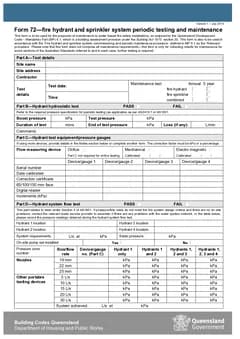
Tradie Forms: complete QLD Form 72 on the official Queensland PDF layout during the maintenance visit - test type, readings, outcomes, defects, licensee details and report number, before you leave the building.
QLD Form 72 is the fire hydrant and sprinkler system periodic testing and maintenance record under Queensland Development Code MP 6.1. It is the form that usually gets finished somewhere between the pump room, the booster, the block plan and the building manager's desk.
It carries dense reading tables: annual or five-year test details, hydrant hydrostatic results, gauge details, hydrant flow readings, pump booster readings, sprinkler hydrostatic and flow results, critical defects, corrective actions, system outcome and licensee sign-off.
Prepare the QLD Form 72 template, or browse QLD fire-safety forms.
What is QLD Form 72 used for?
Form 72 records maintenance of water-based fire safety installations as required by QDC MP 6.1. The official PDF says it is to be used in accordance with the fire hydrant and sprinkler system commissioning and periodic maintenance procedure.
The same PDF says the form does not comprise all maintenance requirements. It collects results for maintenance for some sections of the Australian Standards referred to, and further testing is required in each case.
That is a boundary worth respecting when the document is handed over. Tradie Forms maps your entries onto the official PDF layout. It does not decide whether maintenance is complete, whether the system passes, or whether every applicable requirement has been met. The fire protection contractor or licensee responsible for the work checks the form, the readings and the finished PDF.
When does Form 72 apply?
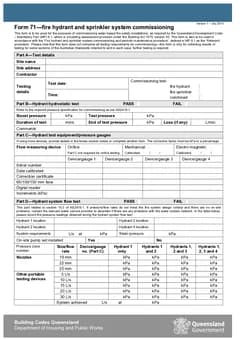
Use Form 72 for periodic testing and maintenance of existing water-based fire safety installations. It is not the commissioning form for a newly installed system or an extension - that is Form 71, and the Form 71 commissioning guide covers it.
On site, five quick questions usually settle it:
- Is this a periodic maintenance record for an existing installation?
- Are we recording annual or five-year test details?
- Are the hydrant, sprinkler or combined system readings ready?
- Are any critical defects or corrective actions documented?
- Is the licensee ready to sign after checking the PDF layout?
If the borderline cases are the problem - a fit-out that extends part of a system while the rest stays on schedule - the Form 71 and Form 72 comparison works through them.
What to collect before you leave the building
Before you pack up, make sure you have the site name and address, contractor name, test date and time, maintenance test type, and the hydrant, sprinkler or combined system selection. Then the readings: hydrant hydrostatic results, flow device and gauge details, hydrant flow readings and locations, pump appliance booster readings, sprinkler hydrostatic readings and sprinkler flow test point results.
Finish with the critical defect and repair details, the system pass or fail outcome, and the licensee name, signature, licence number and report number.
This is the practical argument for filling the form at the job. The numbers are right there, the building manager or occupier is usually nearby, and the pump room or test point locations can still be checked.
Hydrant test sections
Part B records the hydrant hydrostatic test. The official form refers to the required pressure specification for periodic testing as applicable under AS2419.1 or AS1851. Confirm the current requirement against the current edition of the applicable standard rather than working from a number you remember.
Part C records the flow measuring device or gauge details. Do not leave this blank if you used devices that need to be identified. Serial numbers, calibration dates, correction certificates and increments all help the record make sense later.
Part D records the hydrant system flow test: locations, system requirements, static pressure, pump set information, pressure zone, nozzle or device readings, and system achieved. Write locations so a future contractor can follow them. If the record says "Hydrant 1" and the building has several possible starting points, either store the block plan with the file or say where the hydrant is.
Booster and sprinkler sections
Part E records the pump appliance booster test, including system requirements, pump inlet and discharge pressures, boost pressure, calculated frictional loss and comments.
Part F records sprinkler hydrostatic test pressure and hold time. Part G records sprinkler flow test points and running test details. The official form notes that multiple test points may be required for some systems, and that a simulated running test may be required for certain older systems without a flow measuring device.
None of these are places for rough notes. If a reading does not meet the expected criteria, record what happened and keep the supporting detail in the job file.
Critical defects and corrective actions
Part H asks whether critical defects were identified, whether repairs or corrective actions were taken, and whether the system passed or failed. It is not a quick tick block.
If a critical defect is identified, the form says to give the owner or occupier a critical defect notice. If repairs or corrective actions were taken, attach the details, including the action and the date taken, as part of the licensee report.
Your Form 72 should agree with the rest of the job record. If the PDF says repairs were carried out, the job file should show what happened. If it says no action was required, that needs to match the test outcome and your notes.
Who gets the completed Form 72?
QDC MP 6.1 says an appropriately qualified person who carries out commissioning or maintenance of a water-based fire safety installation completes the relevant form and gives a copy within 10 business days after completing the work. For maintenance, that copy goes to the building occupier. MP 6.1 also says the person keeps a record of the form for at least five years.
Business Queensland guidance says building owners or occupiers must know whether their building has prescribed fire safety installations and must comply with MP 6.1, and that maintenance records sit within broader building fire safety obligations.
For the contractor, the completion is simple: give the occupier the finished PDF, keep your own copy, and attach it to the job record with any critical defect notice or repair details. The Form 72 maintenance records guide covers naming, filing and the five-year retention habit in more detail.
Common Form 72 mistakes
Treating it as a checklist only. The form records test results and sign-off. It does not replace the maintenance procedure or every applicable requirement.
Missing equipment details. If a reading depends on a device, identify the device.
Location labels that only make sense on the day. Write a location that survives without the block plan.
Annual and five-year mixed up. Check the maintenance schedule before you select the test type.
Defects with no follow-up record. Keep the notice, notes, photos or repair details with the job.
No copy kept. The building manager's inbox is not your record.
Recording defects so they get closed
The maintenance record is only as useful as what it says about the things that were not right.
A defect noted without an action leaves an open item in the building's file, and nobody reading it later can tell whether it was rectified that afternoon or is still outstanding. Record what was found, what was done, and where a rectification is someone else's to arrange, who it was referred to.
Where the fix is a return visit, file the second record alongside the first so the closure is visible. A building file showing defects raised and closed reads as a maintained system; one showing only defects reads as a neglected one.
Continuity across contractors
Fire safety systems outlast the contractors who maintain them, and the record is what carries forward.
If you take over a building, ask for the history rather than starting a fresh file. If you hand one over, provide the set. Both are small courtesies that keep the building's compliance trail intact, and both tend to be remembered when contracts come up for renewal.
Next steps
Prepare QLD Form 72 when the maintenance test details are ready. For commissioning work, use QLD Form 71, or browse QLD fire-safety forms. The fire safety forms hub has the national set for contractors working across borders.
Official references
Check the Business Queensland building forms page, the Queensland Form 72 PDF, the Business Queensland fire safety installations guidance, and QDC MP 6.1 before relying on this guide.