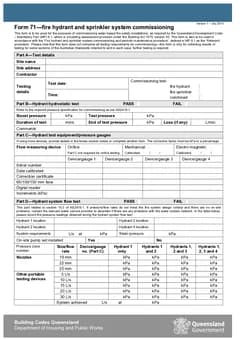
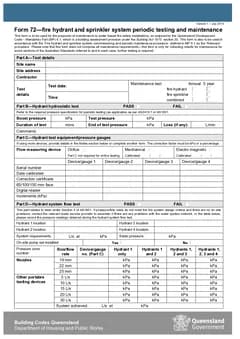
Tradie Forms: pick the right Queensland fire safety record before you start typing, then fill the official PDF layout on site and download it for the owner or occupier copy.
QLD Form 71 and QLD Form 72 look alike because they record many of the same hydrant and sprinkler readings. Both cover water-based fire safety installations, both sit under Queensland Development Code MP 6.1, and both have hydrostatic, flow, booster, sprinkler, compliance and signature sections.
They are still different forms, and picking the wrong one makes the job record harder to read months later when an owner, occupier, building manager or another contractor opens it.
Prepare QLD Form 71 or QLD Form 72, or browse QLD fire-safety forms.
Which form do you need?
Use Form 71 when you are recording commissioning for a new system or an extension to an existing system. Use Form 72 when you are recording periodic testing and maintenance for a system that already exists.
The official Form 71 PDF defines a commissioning test as a test required upon completion of a new system or extension to an existing system. The official Form 72 PDF defines a maintenance test as a test required under a maintenance standard such as AS1851.
That is the whole distinction. The fields overlap because the systems and readings overlap, but the job moment is different, and the job moment is what you choose on.
What the two forms have in common
Both sit under QDC MP 6.1, which covers commissioning and maintenance of fire safety installations. Business Queensland says MP 6.1 applies to Class 1b and Class 2 to 9 buildings, including existing buildings, and does not apply to Class 1a buildings or Class 10 buildings such as domestic sheds or garages.
Both are records for water-based fire safety installations, with fire hydrant, fire sprinkler or combined system options. Both ask for:
- Site name and address, and contractor details
- Test date and time
- Hydrant hydrostatic results
- Flow device and pressure gauge details
- Hydrant flow test readings and pump appliance booster readings
- Sprinkler hydrostatic and flow results
- Critical defect and repair details
- System pass or fail outcome
- Licensee name, signature, licence number and report number
Both also note that the form does not cover all testing or maintenance requirements. Each collects results for some sections of the relevant standards, and further testing is required in each case. That line is worth remembering when you hand the document over.
Where Form 71 fits
Form 71 is the commissioning record. Use it when the job is about bringing a new water-based fire safety installation, or an extension to an existing one, into service - a new hydrant system in a commercial building, a new sprinkler system, an extension to an existing system, or the initial flow and pressure results after installation work.
QDC MP 6.1 says the relevant form for commissioning should be given within 10 business days after completing the work to the building owner. Keep the finished PDF with the commissioning notes, drawings, block plans, gauge references, defect notices and corrective action records. The Form 71 commissioning guide works through each part of that form in order.
Where Form 72 fits
Form 72 is the periodic testing and maintenance record. Use it for annual hydrant testing, five-year hydrant or sprinkler maintenance testing, periodic flow testing on an existing installation, or any maintenance result that goes to a building occupier.
QDC MP 6.1 says the relevant form for maintenance should be given within 10 business days after completing the work to the building occupier. Keep the finished PDF with maintenance job notes, critical defect notices, repair records and the building's maintenance record. The Form 72 maintenance guide covers the test sections, and the maintenance records guide covers filing and retention.
Why does choosing the wrong form matter?
A commissioning job recorded on Form 72 reads as routine maintenance, when it was actually the first record for a new or extended system. A maintenance run recorded on Form 71 reads as though the system had just been commissioned, when it was only being tested on schedule.
Either way the confusion lands on someone else: the owner, the occupier, a body corporate, a building manager, or the next contractor trying to work out what the last visit actually was. It also sends the copy to the wrong party, because commissioning completions go to owners and maintenance completions go to occupiers.
The fix is small. Decide the form from the work done today, not the PDF you used last week, and decide before you start entering readings.
The field clue that usually settles it
If you are still unsure, look at the test details section.
If an annual or five-year option is staring back at you and the job is the first record for a brand new system, you are in the wrong form. If the job is a scheduled inspection run on an existing building, Form 72 fits.
Where a site has both - a tenancy fit-out that extends a sprinkler section while the rest of the building stays on its maintenance schedule - use both forms and keep the records separate.
Getting the completion right
Whichever form you are in, the same details decide whether the record holds up:
- Site and contractor. Use the building name and address the owner or occupier recognises. For multi-tenancy sites, add enough detail to match the record to the right building or area.
- Test type. Commissioning on Form 71; annual or five-year on Form 72. Do not leave this as a guessing game for the office.
- Readings. Enter pressures, flow rates, gauge numbers and test point locations while the system is still in front of you.
- Defects and corrective actions. Store the supporting notice, action, date and any photos so the finished PDF matches the rest of the job record.
- Signature and report number. Check the licence number, report number, system outcome and date before signing.
When you hand the document over, say what it is: the completed Form 71 or Form 72 mapped to the official PDF layout, with readings and outcomes entered by the responsible person. Do not tell an owner or occupier that the PDF alone proves every requirement has been met - the forms themselves say they do not cover everything. Tradie Forms is not affiliated with the Queensland Government and does not decide whether a system passes.
Getting the sequence right on a live building
Fire safety installations rarely sit still, which is what makes the handover between these records fiddly on an occupied site.
Work happens in stages, tenancies change, and systems get modified while the building is in use. The records need to show which system state each certificate relates to, because a certificate that cannot be tied to a point in time is difficult to rely on when the next contractor arrives.
The practical habit is to date and describe the system scope on every record, then keep them in sequence under one building reference. Anyone picking the building up later should be able to read forward through the file and see how the installation got to its current state.
When the building changes hands
Fire safety records are among the first things a new owner or manager asks for and among the most commonly missing.
If you service a building regularly, you are often the continuity that survives an ownership change. Handing over a clean set at that moment protects the building and usually keeps you on the maintenance contract, because the incoming manager has something to work from instead of starting cold.
Keep your own copies rather than relying on the building's file. Building files get lost in handovers far more often than contractor files do.
Next steps
Prepare QLD Form 71 for commissioning or QLD Form 72 for periodic maintenance. For the wider template set, browse QLD fire-safety forms. Fire safety forms for every state sit on the fire safety forms hub.
Official references
Check the Business Queensland building forms page, the Queensland Form 71 PDF, the Queensland Form 72 PDF, the Business Queensland fire safety installations guidance, and QDC MP 6.1 before relying on this guide.