Stage inspection day has a rhythm to it. You arrive, the builder wants you gone in twenty minutes, something is half finished, and there is a Form 16 that needs signing before anyone can move to the next stage. The pressure is always in the same direction, which is toward signing.
This is a run sheet for that day. It covers what to confirm before the certificate gets your name on it, and how to handle the part of the stage that is not ready.
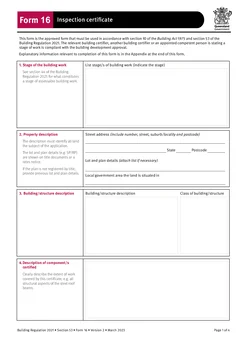
Complete the certificate on site in the QLD Form 16. For the field-by-field walkthrough, see the Form 16 inspection certificate on-site guide, and for filing, Form 16 stage inspection certificate records. For the wider set, browse QLD building forms.
Before you leave the office
Two minutes here saves an argument on site.
Check which stage you are attending. Business Queensland sets out the stages of a building inspection, and the stage named on the request should match the approval and the work that is actually in front of you. A request for a frame inspection on a job where the frame went up two stages ago is a signal to ask questions before driving out.
Check the approval documents you will be inspecting against. Certifying against a superseded set of plans is a quiet way to create a problem that surfaces months later. Confirm you have the current approved version.
Check that the aspect is yours. Business Queensland publishes guidance on competent persons, and the aspect you are being asked to certify has to sit inside your licence class or competency. This is the check most easily skipped on a busy day and the one with the most personal consequence.
On arrival
Before the inspection itself, settle three things with whoever met you.
Confirm the address and the specific building or unit, because on a multi-lot site the wrong lot number on a certificate is a genuine mess to unwind. Confirm what has changed since the last inspection or since the approval, particularly any variation that has not been formally documented. And confirm what is actually complete, rather than what the schedule says should be complete.
That last one sets up the rest of the day. If a third of the stage is not ready, it is better to know before you start than to discover it while writing the certificate.
The inspection itself
Work the stage in a consistent order and record as you go rather than afterwards.
Photograph what you inspect. A photo tied to the job and the date turns a certificate into something supportable, and it is the difference between remembering a detail and being able to show it. Photograph anything you are not certifying as well, because the boundary of what you covered matters as much as the content.
Note anything that is non-conforming while you are standing in front of it. A defect recalled in the ute is a defect described vaguely, and a vague defect is difficult for a builder to act on.
Keep track of the parts of the stage you could not access. Something covered, locked, or obstructed on the day is not something you inspected, and the certificate needs to reflect that.
What has to be right on the certificate
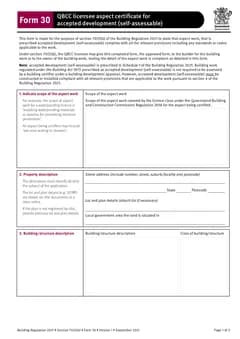
The Form 16 is the inspection certificate, aspect certificate, and QBCC licensee aspect certificate. What goes on it is a statement, so each field is worth a moment.
The property and approval references. Address, lot, and the approval or permit reference the inspection relates to. These are the fields that connect your certificate to the rest of the approval trail, and a wrong reference orphans it.
The description of the work inspected. This should describe what you actually looked at.
The stage or aspect. Named to match the approval and the inspection request, not paraphrased.
Your details and licence. Name, licence number, and class. The certificate is only as good as the authority behind it.
The date. The date of the inspection, not the date you got around to the paperwork.
When part of the stage is not ready
This is the moment the whole job is about.
The pressure to certify forward is real and it is always framed reasonably. The plumber is coming Thursday, the concrete is booked, it will be done by the time anyone looks. None of that changes what the certificate says, which is that you inspected and certified the work.
The workable answer is usually to certify what is complete and identify what is not, with a re-inspection arranged for the remainder. That keeps the job moving on the parts that are ready and keeps your name off the parts that are not.
Say it on site, to the person who can act on it, rather than only in the paperwork. A builder who finds out from the certificate that they need another inspection has lost a day they did not budget for, and that is where the friction comes from. Told at the time, it is a scheduling problem. Discovered later, it is a dispute.
What if the builder disputes the finding?
It happens, and usually not aggressively. The builder has a schedule, a concrete pour booked, and a genuine belief that what you are pointing at is minor.
Keep the conversation on the specific item rather than on whether you are being difficult. Show them the thing. Most disputes dissolve when both people are standing in front of the same detail, because builders are generally not arguing that the work is right, they are arguing about whether it needs to hold up the program.
Separate the two questions explicitly. Whether the work conforms is your call and it is not negotiable. Whether the program can be resequenced around a re-inspection is theirs, and you can be helpful about it. Offering a realistic re-inspection window is worth more than winning the argument.
If a builder asks you to certify on the understanding it will be fixed before anyone sees it, treat that as the end of the conversation rather than a proposal to weigh. Your licence sits behind the certificate, not theirs.
Should you certify an aspect outside your class?
No, and the pressure to do it is usually indirect rather than a straight request.
It arrives as convenience. You are already on site, the other trade's certifier cannot get there until Thursday, and the aspect looks fine to you. Business Queensland publishes guidance on competent persons, and the question is not whether you can assess the work adequately in a practical sense. It is whether you are the person entitled to certify it.
The same applies to certifying on someone else's behalf, or signing a certificate prepared by another person for work you did not attend. A certificate is a personal statement, and lending your licence to someone else's inspection is a bigger risk than the favour is worth.
Where an aspect falls outside your class, say who it needs to go to. A builder who gets a clear referral usually stops pushing, because the obstacle turns into a phone call rather than a delay with no solution.
Before you drive away
Four checks, standing at the ute.
- Does the work description on the certificate match what you actually inspected, including the limits?
- Is the stage or aspect named the same way it is named in the approval?
- Is everything incomplete or inaccessible recorded, with the re-inspection understood by the builder?
- Are your photos and notes tied to the job reference, not sitting loose on a phone?
If all four are yes, the certificate can be issued and filed. If any is no, it is a much shorter conversation now than after the next stage has been closed up over the top of it.
Filing it so the trail holds
The certificate goes to whoever needs it for the approval trail, usually the building certifier or principal contractor, and a copy stays with you.
Keep the inspection notes and photos with your copy, under the same job reference. The certificate is the conclusion; the notes and photos are the working that supports it. A certificate on its own is fine until someone asks a question about it, at which point the supporting material is the whole answer.
Where a re-inspection followed, file the second certificate alongside the first so the sequence is readable. Anyone following the job later should be able to see what was certified when, and what was outstanding in between.
Where the form helps
The QLD Form 16 walks the certificate in the order above, with the property and approval references, the work description, and the stage captured as separate entries rather than free text you have to remember to fill. Licence and business details are saved and reused across jobs, so the authority block is right every time.
The form flags missing fields before download, you preview the entries mapped onto the official Form 16 layout, then download the finished PDF for the certifier and your own records.
Tradie Forms maps your entries onto that layout. The licensee signing the certificate remains responsible for the inspection, the scope of what is certified, and checking the downloaded PDF before it is issued.
Official references
Check the Business Queensland building forms page and the Form 16 PDF for the current approved form, Business Queensland stages of a building inspection for how inspection stages work, and Business Queensland competent persons guidance for who may certify an aspect. Requirements change, so confirm the current form and your licence conditions before certifying.