The toolbox talk is the part of the site safety pack that most obviously either happened or did not. A risk assessment can be written convincingly at a desk. A toolbox talk record either reflects a conversation people remember having, or it is a page of signatures.
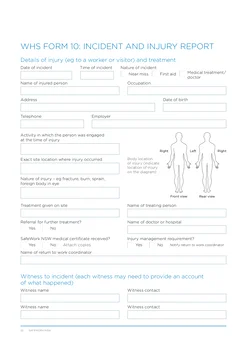
Form 06 in the SafeWork NSW Housing Industry Site Safety Pack is the record of that conversation. This guide covers running one worth recording, and recording it so the page reflects what actually took place.
Record it in the NSW WHS Form 06 toolbox talk record. For the hazards it should be drawing on, see the Form 04 site-specific risk assessment guide, and for how the pack fits together, the HISSP site pack guide. Browse NSW building forms for the rest.
What is a toolbox talk for?
It is worker consultation about safety, done in the place the work happens, close to when it happens.
Safe Work Australia's risk management guidance treats consultation with workers as part of managing risk rather than an add-on to it. The people doing the work know things the person who wrote the risk assessment does not, and the talk is the mechanism for that information moving in both directions.
That framing matters because it changes what a good talk looks like. If the purpose is to transmit information downward, reading a document aloud satisfies it. If the purpose is consultation, the talk has to leave room for the crew to say something, and the record has to capture what they said.
Cover what changed
The most common failure is a talk that covers everything and therefore lands on nothing.
A crew that hears the same general safety content every week stops listening in about a fortnight. The talk that holds attention is the one about this week: the excavation that opened yesterday, the scaffold coming down Thursday, the second crew starting on the same level, the forecast for Friday.
Draw it from the site risk assessment and any SWMS in force. If the risk assessment names a hazard and the talk never mentions it, one of the two documents is not being used. If a high risk activity starts this week, the talk is where the crew hears how the SWMS says it will be done.
Anything that changed since the last talk is the natural agenda. That is usually enough.
Running it so people participate
Ten to fifteen minutes, on site, with the thing you are talking about visible if possible.
Standing at the work face beats standing in the site shed, because people can see what is being discussed. Pointing at the actual edge, the actual trench, the actual access route removes the ambiguity that a verbal description leaves.
Ask rather than tell, at least once. "Is there anything about this that is going to be awkward" gets more useful answers than "any questions", which reliably gets silence. The crew usually knows exactly which control is going to be inconvenient, and hearing it now is better than discovering it when they work around it.
Keep it short enough that it stays a habit. A talk people dread becomes a talk people avoid.
What the record needs
The form captures who ran the talk, when, who attended, what was discussed, and what came out of it.
The topics, specifically.
Attendance, honestly. Everyone who was there signs, and nobody who was not. This is the field that most often gets stretched, and it is the one that most damages the record if it is wrong.
Issues raised. This is the most valuable content on the form and the most commonly left blank. A crew that raised a concern which was recorded and acted on is a safety system working. A blank field every week suggests either nobody speaks or nobody writes it down.
What was agreed. Where the talk produced an action, record it and who owns it. A talk that identifies a problem and produces nothing trains people not to raise the next one.
Signatures and late arrivals
Collect signatures at the talk, not later in the day.
Chasing signatures afterwards produces the thing you least want: a record that says a group of people were consulted when some of them were somewhere else. If someone missed the talk, the honest handling is to brief them separately and record that separately rather than adding them to a list they were not part of.
Workers who join the site mid-week get the talk when they arrive. A crew member who started Wednesday and signed Monday's talk is a detail that undermines the whole page if anyone checks.
How it fits with the rest of the pack
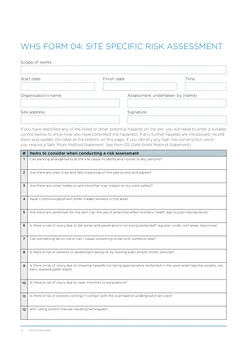
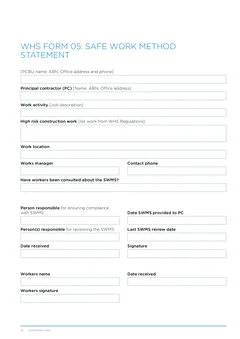
Form 04 finds the site hazards. Form 05 sets out the method for high risk construction work. Form 06 records that the people doing the work were told about both.
The three read together should be consistent. A SWMS for an activity the toolbox talks never mention suggests the crew was never briefed on it. A risk assessment listing a serious hazard that no talk covers has the same problem. Where an auditor or principal contractor reviews a pack, that consistency is what they are reading for.
Keeping the organisation and site details identical across the three is what makes them read as one pack rather than three separate documents that happen to share an address.
How often should you run one?
Frequently enough that the site has not changed much since the last one.
On a fast-moving residential job that is usually weekly, with an extra talk when something significant changes: a new trade starting, plant arriving, an excavation opening, a stage handover. On slower work a fortnightly rhythm can be enough, provided the change-triggered talks still happen.
The failure mode at both ends is predictable. Too infrequent and the talk becomes a catch-up covering too much to land. Too frequent with nothing new to say and it becomes a signature ritual, which is worse, because it trains the crew that the talk carries no information.
Let the site set the cadence rather than the calendar.
What if a worker raises something you cannot fix?
This is the moment that decides whether anyone raises anything again.
Some issues are outside a subcontractor's control: edge protection the builder has to install, an access route the principal contractor owns, a program that has two trades in the same space. Saying so plainly is fine. What is not fine is recording nothing and letting it disappear.
Record the issue, record who it was referred to, and record what came back. A crew that sees a problem escalated and answered will keep bringing them. A crew that watches an issue vanish into a form stops mentioning things, and the next problem gets worked around silently instead.
Where the answer is genuinely no, say that too, with the reason. People accept a reasoned no far better than silence.
Where the form helps
The NSW WHS Form 06 follows the pack layout, capturing the topics, attendance, and issues raised as separate entries rather than free text, which is what keeps the issues field from being skipped.
Check the organisation and site details on each form before you preview the official layout and download the finished PDF for the site file.
Tradie Forms maps your entries onto that layout. The PCBU remains responsible for holding the consultation, acting on what is raised, and checking the downloaded PDF before it goes in the pack.
Official references
Check the SafeWork NSW Housing Industry Site Safety Pack for the current forms, SafeWork NSW construction work for construction duties, the model Code of Practice on managing WHS risks for consultation as part of risk management, and Safe Work Australia on identifying, assessing and controlling hazards. Requirements vary by state and change over time, so confirm what applies to your site.