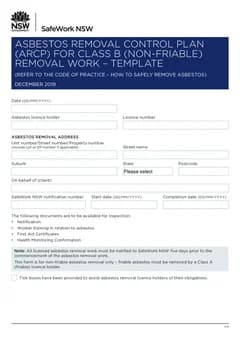
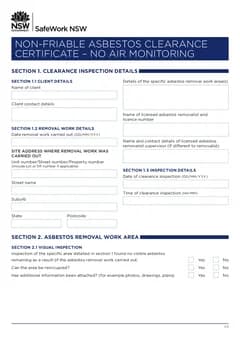
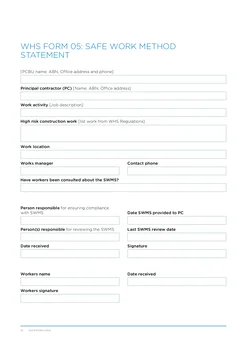
Tradie Forms: complete the SafeWork NSW Class B Asbestos Removal Control Plan on the official PDF layout before non-friable removal work starts. Work through licence holder, site, identification, consultation, workforce, emergency, site plan, PPE, RPE, method, waste, distribution and sign-off while the job setup is still in front of you.
The NSW Class B Asbestos Removal Control Plan, often shortened to ARCP, is not a piece of paperwork to patch together after the job. SafeWork NSW guidance says a licensed asbestos removalist must prepare a site-specific asbestos removal control plan before licensed asbestos removal work begins.
For Class B work, that usually means the details need to be ready before the crew starts removing non-friable asbestos or asbestos-containing material. The plan should match the site, the asbestos identified, the workers, the controls, the waste path, and the people who need to know about the work.
Use the NSW Class B ARCP template when you want a section-by-section fill, saved licence holder details, site plan support, missing-field checks, official PDF preview, and a clean PDF download. You can also browse NSW building forms, or open the related NSW asbestos clearance certificate when the removal area is ready for clearance. For the full start-to-finish file, see the ARCP and clearance handover workflow.
What is the Class B ARCP for?
SafeWork NSW says the asbestos licence holder must prepare a site-specific asbestos removal control plan before starting work. The plan is meant to set out how the asbestos will be removed, including the method, tools, equipment, and PPE, and the type, location, and condition of the asbestos to be removed.
The SafeWork NSW Class B ARCP PDF is labelled for Class B non-friable removal work and refers to the Code of Practice for how to safely remove asbestos. SafeWork's current guidance says licensed removalists must notify it at least five calendar days before removing any amount of friable asbestos or more than 10 square metres of non-friable asbestos. It also says immediate removal requires a phone call to SafeWork and notification within 24 hours. The Class B form is for non-friable asbestos removal only, and friable asbestos must be removed by a Class A licence holder.
Tradie Forms maps entries onto the SafeWork NSW PDF layout. It does not decide whether the job is licensed asbestos removal, whether a Class B licence is enough, whether notification has been lodged, or whether the controls are adequate. The licensed asbestos removalist remains responsible for the plan and the work.
When is a Class B licence needed?
SafeWork NSW's licensed removalist guidance says a Class B licence is needed before removing more than 10 square metres of non-friable asbestos.
The same guidance says Class B asbestos removal licence holders can remove non-friable asbestos, not friable asbestos.
That distinction is important. If the work is friable asbestos, this Class B ARCP template is not the right basis by itself. Check SafeWork NSW requirements and licence scope before work starts.
What should you collect before you fill the plan?
Before filling the ARCP, gather the facts that belong to this site:
- Asbestos licence holder and licence number
- Removal site address, including lot or DP if applicable
- Client name
- SafeWork NSW notification number
- Start date and completion date
- Asbestos or ACM identified, location, quantity, and condition
- People and parties to be informed
- Nominated supervisors and workers
- First aiders, kit location, and emergency facilities
- Site plan showing removal area, waste storage, barriers, signage, decontamination, access, and services
- PPE and RPE requirements
- Tools, equipment, vacuum details, and inspection notes
- Removal method across preparation, commencement, and completion
- Waste storage, disposal site, and WasteLocate details where relevant
- Distribution and sign-off
If you cannot answer those details, the plan is not ready.
Identification and consultation
The ARCP PDF has an identification table for asbestos or ACM to be removed, including location, description, quantity, and condition. This is where the plan starts to become site-specific.
Name the room, facade, roof, eaves, fence line, wall, or service area. Record quantity and condition as clearly as the job allows.
The informing parties section records who will be told about the upcoming asbestos removal and the intended start date. The ARCP PDF lists parties such as the person who commissioned the removal, workers or representatives, other PCBUs, the homeowner, occupants, neighbouring properties, and the licensed asbestos assessor or competent person where applicable.
Do not leave consultation as a memory exercise. Record how people were told and keep consultation records with the job.
Supervisors, workers, and emergency planning
The ARCP asks for nominated supervisors approved by SafeWork NSW and workers involved in the removal. It also asks for trained first aiders, first aid kit location, nearest hospital, and emergency contact numbers.
This is not just paperwork for the sake of paperwork. If something goes wrong, the crew and client need the emergency plan to be clear. Fill it with real site details, not generic text.
If workers change, update the plan or keep a clear record of the change before work proceeds.
Site plan, PPE, RPE, and equipment
The ARCP PDF asks for a plan view showing the asbestos removal area, location of asbestos, entrances and exits, waste storage, site security, barriers, warning tape, emergency equipment, signage, decontamination area, and services such as electrical, gas, and water.
Tradie Forms supports the site plan section so you can put the plan into the official PDF layout instead of trying to draw inside a small PDF field.
The PPE and RPE sections need the actual controls for the job. The official template includes checkboxes for items such as disposable coveralls, footwear, gloves, eye protection, and respiratory protective equipment. It also includes fit testing and fit check details.
The equipment section records tool and vacuum details. If tools can generate dust, check the official SafeWork guidance and the plan controls before use.
Removal method and waste
The removal method section breaks the work into preparation, commencement, and completion. Use it to describe what will happen on this site, not a generic method pasted from the last job.
For example, include how the area will be set up, how ACM will be wetted or removed, how breakage will be avoided, how waste will be contained, how tools will be decontaminated, and how the area will be cleaned for clearance.
The waste section asks whether asbestos waste will be held on-site for more than one working day, the proposed authorised disposal site, and the EPA WasteLocate consignment number. The official ARCP notes that asbestos transporters and receiving facilities in NSW must track and report certain asbestos waste loads through WasteLocate when the waste is more than 100 kilograms or more than 10 square metres of asbestos sheeting in one load.
Check the EPA and SafeWork requirements for the job. Do not invent a consignment number or disposal site.
Distribution and sign-off
SafeWork's asbestos removal Code of Practice says a copy of the ARCP must be given to the person who commissioned the licensed asbestos removal work, kept at the workplace until the work is complete, and made readily accessible on site to other PCBUs, workers or their health and safety representatives, and occupants of residential premises where applicable. The plan must also be available for inspection under the WHS Act.
The sign-off section records that the information in the plan is accurate and developed in consultation with workers on site. Supervisors and workers sign.
Finish this before work starts. If the plan is still unsigned or half filled, it is not doing its job.
Common ARCP mistakes
Reusing a generic method
Each plan must address the specific requirements for each job. A generic method can be a starting point, but it needs the actual site, ACM, controls, waste route, and people for this removal.
Site plan missing the waste route
The SafeWork template asks for waste storage and decontamination details. Mark them clearly so the crew and any inspector can understand how the work area is controlled.
Sign-off after work starts
The plan should be ready before removal work begins. If workers have not seen or signed the plan, stop and fix the record before the job moves.
How Tradie Forms helps
Tradie Forms turns the ARCP into sections you work through one at a time for plan details, identification, informing parties, supervisors, workers, emergency planning, site plan, PPE, RPE, equipment, removal method, waste management, distribution and sign-off.
You can save licence holder details, add repeatable table rows, include a site plan, catch missing site and licence details before download, preview the official PDF layout, and download the plan for the job file.
The plan still belongs to the licensed asbestos removalist. Tradie Forms helps you complete the official layout, not replace the safety work or regulatory judgement.
When licensed non-friable removal is finished and the area is ready for clearance, use the NSW asbestos clearance certificate and the SW08272 guide.
Next steps
Start the NSW Class B asbestos removal control plan before the removal work begins. When the area is ready for clearance, open the NSW asbestos clearance certificate, or browse NSW building forms.
For how the whole removal day runs from plan to clearance pack, see Class B asbestos day.
Official references
Check the SafeWork NSW asbestos removal control plan PDF, SafeWork NSW working as a licensed asbestos removalist guidance, the SafeWork NSW Class B asbestos removal licence guidance, the SafeWork NSW asbestos notifications page, and the SafeWork NSW asbestos removal Code of Practice before relying on this guide.