A Class B removal job is mostly paperwork bookended around a few hours of actual work. The control plan comes before, the notification comes before that, and the clearance pack is what turns a finished removal into a closed job. Miss a piece at either end and the removal itself does not count for much.
This is the whole day laid out in order, so the documents line up with the work rather than being reconstructed the following week.
Build the plan in the asbestos removal control plan. For the field-by-field walkthrough, see the NSW Class B asbestos removal control plan guide, and for the closing side, the asbestos removal clearance and handover workflow. For the wider set, browse NSW building forms.
Before the job is booked
Two things decide whether the job can proceed as planned.
Confirm the licence class matches the material. A Class B licence covers non-friable asbestos removal. Friable material needs a Class A licence. If the assessment on the way in says non-friable and what you find on site is degraded to the point of being friable, that is a stop, not a judgement call to make with the tools out.
Confirm the notification. Licensed removal work is notified to SafeWork NSW before work starts. Check the current notice period and process on the SafeWork NSW asbestos notifications page when you book, because working to a remembered notice period is how jobs get rescheduled at the last minute.
Both of these are cheaper to get right at quoting than at 7am on removal day.
The control plan
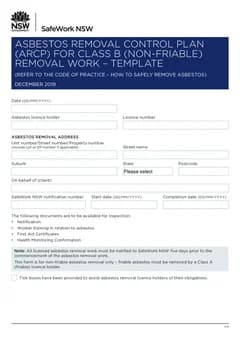
The asbestos removal control plan is prepared by the licensed removalist for licensed removal work, and SafeWork NSW publishes a template. Treat it as the document the job runs to rather than a form to be completed for the file.
The plan covers the site and the specific work area, what the asbestos is and where it is, the removal method, the controls in place, the equipment, the waste handling, and the people doing the work. The detail that matters is the part specific to this site. A plan that could describe any job on any street is not doing the thing a control plan exists to do.
Site-specific detail means the actual work area boundaries, the actual access route, who else is on site and how they are kept out of the area, where the waste goes and how it gets there, and what the plan is if something changes mid-removal. Where a shared building or a live tenancy is involved, that belongs in the plan too.
The crew should have read it. A control plan the people doing the removal have not seen is documentation rather than control.
On the day
Step 1
Set up and photograph
Before anything is disturbed
Exclusion zone, signage, and the before shot everything else is measured against.
Step 2
Remove to the plan
Not around it
If conditions force a change, the change goes into the plan first.
Step 3
Bag and label as you go
Not at the end
Disposal records are part of the clearance pack.
Step 4
Photograph after removal
Before clearance
The before and after pairing is the most useful evidence in the pack.
A removal performed differently to its control plan leaves two documents that disagree, and the plan is the one that gets read later.
The order is unremarkable and worth following anyway.
Set up the exclusion zone and signage before anything is disturbed. Confirm the area matches the plan, and where it does not, stop and update the plan rather than adapting quietly. Photograph the area before work starts, because the before shot is the reference for everything that follows.
Run the removal to the method in the plan. If conditions force a change, the change goes into the plan. A removal performed differently to its control plan leaves you with two documents that disagree, and the one that gets read later is the one that describes what was supposed to happen.
Bag and label waste as you go rather than at the end. Waste handling is where a tidy job goes sideways under time pressure, and the disposal records are part of the clearance pack.
Photograph the area after removal and before clearance. That pairing, before and after, is the most useful evidence in the whole pack.
Who issues the clearance certificate?
For non-friable removal, the area is inspected and a clearance certificate issued by a competent person independent of the removalist. SafeWork NSW publishes a non-friable asbestos clearance certificate form for removal without air monitoring.
The independence matters and it is worth being straight about. The person who did the removal is not the person who signs it off as clean. Booking the clearance inspection early, rather than after the removal is finished, is what stops a job sitting open while someone is chased.
If the clearance inspection finds the area is not clean, that is a return to work, not a negotiation. Re-clean, re-inspect, and record both rounds. A clearance certificate issued over a marginal area is the document you least want to be holding later.
The clearance pack
The pack is what you hand over and what you keep. Four things belong in it.
The control plan the job was actually run to, including any updates made during the removal.
The clearance certificate, issued by the independent competent person.
Waste disposal records, showing where the material went.
Site photographs, before, during where relevant, and after.
Together those four show that the work was planned, performed as planned, and verified. Any one of them on its own shows very little. The clearance certificate without the control plan behind it, in particular, is a conclusion with no working.
Keep the set under one job reference so it does not scatter. On a job that goes to a principal contractor or a building owner, hand over the pack rather than the certificate alone.
Other people on site
Most Class B jobs happen on live sites rather than empty ones, and the people outside the exclusion zone are part of the plan.
Where a principal contractor is running the site, they need to know when the removal is happening, what area is affected, and what the exclusion zone means for other trades. A removal that turns up unannounced on a busy site produces exactly the pressure you do not want, which is a chippie who wants to walk through the zone for two minutes.
In an occupied building, the occupants matter as much as the trades. Residents, tenants, staff, and neighbours in a shared building all need to know what is happening and what the boundary is. That communication belongs in the plan rather than being handled ad hoc on the morning.
Signage and physical barriers do the work once you are set up, but they only hold if someone with authority on site is supporting them. Agree who that is before the day.
When the material is not what the assessment said
This is the most common reason a Class B day stops.
An assessment describing non-friable material is a starting point, not a guarantee. Material that has weathered, been water damaged, or been previously disturbed can be in a condition that puts it outside a Class B licence. That determination is made on site, by the licensed removalist, before the removal proceeds.
The answer is to stop and reassess rather than to continue carefully. A Class A licence exists for friable material, and the equipment, controls, and clearance requirements are different. Continuing under a Class B plan because the job is booked and the crew is standing there is the decision that turns a scheduling problem into a serious one.
Record the stop. What was found, how it differed from the assessment, and what was done about it. That record is what explains the changed scope and cost to whoever engaged you, and it is the document that shows the call was made properly.
Common ways the pack ends up thin
A generic control plan. Reused from the last job with the address changed. It fails the moment anyone compares it to the site.
A plan that does not match what happened. The method changed on site and the document did not.
Waste records missing. Everything else is in order and nobody can show where the material went.
No before photos. The after shots exist because someone thought to take them at the end, but there is nothing to compare them against.
Clearance booked late. The removal finished on Tuesday and the certificate is dated the following Monday, with the area unsecured in between.
Where the form helps
The asbestos removal control plan walks the plan section by section, which is what keeps the site-specific detail from being skipped in favour of the parts that are the same every job. Licence, business, and crew details are saved and reused, so the repeated blocks are right without retyping.
The form flags missing fields before download, you preview the entries on the control plan layout, then download the finished PDF to carry on site and to keep in the clearance pack.
Tradie Forms maps your entries onto that layout. The licensed removalist remains responsible for the plan, the notification, the removal method, the controls on site, and checking the downloaded PDF before the job starts.
Official references
Check the SafeWork NSW Class B asbestos removal licence page for what the licence class covers, the asbestos removal control plan template for the plan structure, SafeWork NSW asbestos notifications for the notification process, the How to safely remove asbestos Code of Practice for the removal requirements, and the non-friable clearance certificate SW08272 for the clearance form. Requirements and notice periods change, so confirm the current process with SafeWork NSW before booking removal work.