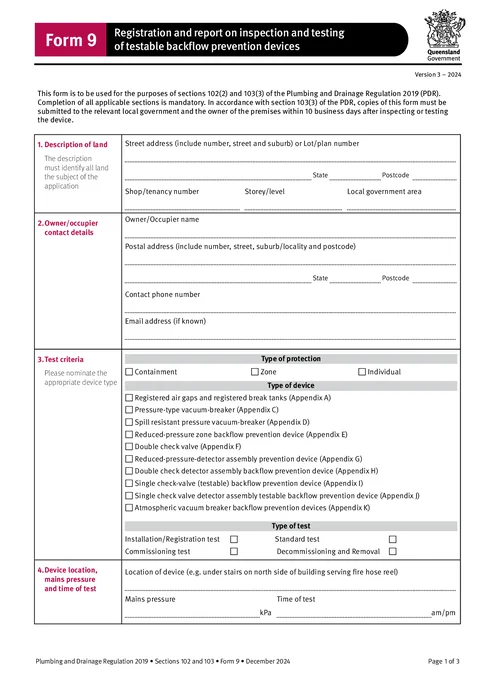
Form 9 is the approved report for registration and inspection or testing of testable backflow prevention devices, registered air gaps and registered break tanks. It is used for sections 102(2) and 103(3) of the Plumbing and Drainage Regulation 2019. The authorised tester finishes the report, then gives copies to the relevant local government and the owner of the premises within 10 business days after inspecting or testing the device.
This is the current Queensland Form 9. Tradie Forms follows the official section order and maps your answers onto the official PDF layout.
Reporting general plumbing testing or commissioning rather than a testable backflow device? Use QLD Form 5
Have these in front of you while the test kit is still connected. Reconstructing readings after you leave is how most Form 9 rework starts.
The device plate and site register
Make, model, size, serial number and any owner asset tag for the main device and bypass where one is fitted.
The test kit certificate or sticker
Serial number and last verification date for the kit used on this test.
The readings as the test is run
Mains pressure, time of test, valve and relief readings, and isolation results before the gauges come off.
Protection, device type and test type
Containment, zone or individual; the AS/NZS 2845.3 appendix that matches the device; and whether this is installation, standard, commissioning or decommissioning.
Owner or occupier contact for the premises
Who receives the owner copy, and how they want it delivered, before you leave site.
Your licence and contractor details
Occupational licence for the authorised tester, contractor licence where it applies, and contractor company details when you are not the contractor for the work.
Two fields gate download: the declaration acknowledgement and the declaration date. Everything else is optional in the app, but the official form says completion of all applicable sections is mandatory.
Identifies the premises where the device is installed. The official form says the description must identify all land the application covers. Match the property the device protects, not a job nickname.
Street addressAddressOptional
Physical address of the premises. Address search is limited to Queensland and fills street, suburb, state and postcode. State starts as QLD. Check against the rates notice or previous Form 9, because search returns the current postal address and a device can predate a renaming or subdivision.
Shop / Tenancy NumberTextOptional
Fill on multi-tenancy sites so the report ties to the correct unit or shop.
Storey / LevelTextOptional
Fill when the building has more than one level and the device could sit on more than one of them.
Local Government AreaTextOptional
The council that receives the local government copy. Address search may fill this. Confirm it near a boundary, on new estates, and whenever the invoice suburb sits in a different council from the premises.
Records who receives correspondence and the owner copy. Owner, occupier, site manager and accounts contact can all be different people.
Owner/Occupier NameTextOptional
Prefer the legal owner of the premises when you know them, such as a body corporate name, rather than only the site manager who met you at the gate.
Postal addressAddressOptional
Where written correspondence for this report should go. Address search is limited to Queensland. State starts as QLD. A PO Box is fine when that is the address the owner uses for compliance mail.
Contact Phone NumberTelOptional
The best number for follow-up on this report, not a disconnected site phone.
Email Address (if Known)EmailOptional
Add it when known. Prefer an inbox the owner or body corporate actually monitors for the owner copy.
Records what was tested and why. Tick the options that match the installation and this visit, using the device plate, asset record and the AS/NZS 2845.3 appendix you tested under.
Type of protectionCheckboxGroupOptional
Containment, Zone or Individual. Match the protection level of the installation, not a default from last year's PDF for a different device on the same site.
Type of deviceCheckboxGroupOptional
One of the listed types with its appendix, for example reduced-pressure zone (Appendix E), double check valve (Appendix F), pressure-type vacuum-breaker (Appendix C), or registered air gaps and registered break tanks (Appendix A). The selection decides which later sections carry real readings rather than blanks.
Type of testCheckboxGroupOptional
Installation/Registration Test, Standard Test, Commissioning Test, or Decommissioning and Removal. Annual testing is usually a standard test. A new install, replacement, removal or first registration needs the option that matches this visit.
Selecting a pressure-type vacuum-breaker, registered air gap or registered break tank does not hide other sections. Complete the sections that apply and leave non-relevant fields blank, as the form says on the device pages.
Records where the device is and the site conditions when you tested it.
Location of DeviceTextOptional
Write a location another licensed tester can find without calling you. On multi-building sites include building or block, level or plant room, which riser or meter assembly, side of building, and any asset tag.
Useful
Building C, level 1 plant room, fire service riser 2, asset tag BF-114
Too vague
Plant room
Mains PressureTextOptional
Mains pressure in kPa at the time of test, from the kit while it is connected. Example: 450.
Time of TestTimeOptional
Time the test was carried out. Enter it on site so it matches the diary and the readings.
Records the main device identity and the readings that support pass or fail. Leave non-relevant fields blank. Take make, model, size and serial from the plate in front of you, not last year's PDF alone. Values land on page 2 of the finished PDF.
MakeTextOptional
Manufacturer from the plate, such as Watts or Zurn.
SizeTextOptional
Nominal size in mm from the plate, such as 20.
Model NumberTextOptional
Model from the plate, such as 009M2-QT. Do not invent it after the cover is back on.
Serial NumberTextOptional
Exact serial from the plate. A replaced device with last year's serial is how the council register drifts from the site.
Check Valve #1TextOptional
Measured check valve 1 reading in kPa, such as 98.
Check Valve #2TextOptional
Measured check valve 2 reading in kPa, such as 102. Leave blank only when this device type has no second check valve reading.
Relief Valve OpenedTextOptional
Relief valve opening pressure in kPa where the procedure records it, such as 145. Leave blank when the device has no relief valve test point.
Isolating valvesCheckboxGroupOptional
Mark whether the upstream and downstream isolating valves were tight or leaked. Tick the results that match the test, not both tight and leaked for the same side.
If the device fails, keep the readings, overall result and any repair notes consistent rather than tidying a fail into a silent pass.
Complete only when a bypass device is fitted. When there is no bypass, leave the whole section empty. Do not copy main-device readings into these fields.
MakeTextOptional
Manufacturer from the bypass plate.
SizeTextOptional
Bypass size in mm from the plate. It is often smaller than the main device.
Model NumberTextOptional
Model from the bypass plate.
Serial NumberTextOptional
Bypass serial from the plate. Swapping main and bypass serials is a common copy error on meter assemblies.
Check Valve #1TextOptional
Bypass check valve 1 reading in kPa from this test of the bypass, not a reuse of the main-device reading.
Check Valve #2TextOptional
Bypass check valve 2 reading in kPa when the procedure records it.
Relief Valve OpenedTextOptional
Bypass relief valve opening pressure in kPa when that test applies.
Isolating valvesCheckboxGroupOptional
Upstream and downstream isolating valve results for the bypass only.
Complete when the tested device is a pressure-type vacuum breaker (or spill-resistant type using these fields). Leave blank for RPZ, double check and other assemblies.
MakeTextOptional
Manufacturer from the PVB plate.
SizeTextOptional
Size in mm from the plate.
Model NumberTextOptional
Model from the plate.
Serial NumberTextOptional
Serial from the plate on the device you tested today.
Non Return ValveTextOptional
Non-return valve reading in kPa, such as 12.
Air Inlet Opening PressureTextOptional
Air inlet opening pressure in kPa, such as 7. Enter the measured value, not an estimate.
Isolating valvesCheckboxGroupOptional
Includes Failed to Open plus upstream and downstream isolating valve tight or leaked results for this PVB.
Complete for a registered air gap or registered break tank. Refer to AS 2845.2 for type (Type 1, Type 2 or Type 3). Use measured values, not estimates.
Type of air gapCheckboxGroupOptional
Overflow Type 1, Overflow Type 2, Overflow Type 3, Registered Air Gap, or Registered Break Tank.
ID NumberTextOptional
Identifier from the site register or previous reports, such as AG-1042.
Size of Inlet OrificeTextOptional
Inlet orifice size in mm, such as 25.
Air Gap SizingTextOptional
Air gap size in mm, such as 50.
Total Height Spill Level Plus Air GapTextOptional
Combined spill level plus air gap height in mm, such as 125.
Overflow SizingTextOptional
For Overflow Type 1 or 2 the value is in mm; for Type 3 it is in mm². Match the unit to the type you selected.
Records the kit that produced the readings on this report. Clean valve numbers with a stale verification date still look unfinished to council.
Test Kit Serial NumberTextOptional
Exact serial from the kit body or its certificate, such as TK-55291.
Date Test Kit Last VerifiedDateOptional
Last verification or calibration date on the kit record. Does not accept a future date. Today and Yesterday shortcuts are available. Check the sticker before the first PDF of the day.
Save this section as Test Kit to prefill it on your next Form 9 you run with the same kit.
Records the licensed person who carried out the test. Put the person who tested this device, not a colleague whose licence is saved in the app.
Authorised Tester's NameTextOptional
Full name of the tester responsible for this report.
Authorised Tester's Phone NumberTelOptional
A number council or the owner can use if the report needs clarifying.
Occupational Licence NumberTextOptional
Occupational licence used for this testing work. Licence check against the QBCC register can fill the tester name from the number. Confirm the name still matches the person on site.
Contractor Licence Number (if Applicable)TextOptional
Contractor licence when it applies to the authorised tester. Leave blank when it does not. Licence check can fill the name from the number.
Date of TestDateOptional
Date the readings were taken. Today and Yesterday shortcuts are available. Does not accept a future date. Different from the declaration date when you sign later, even if both are often the same day.
Authorised Tester's EmailEmailOptional
Working email for the tester or their office.
Save this section as Authorised Tester to prefill it on your next Form 9 you prepare as the tester.
Complete when the responsible person is not the contractor for the work. Leave both fields blank when the section does not apply.
Full Name of Company (or Individual if Not a Company)TextOptional
Company name on the contractor licence, or the individual when there is no company. If you fill either contractor field, fill both so the section is complete.
Contractor's Licence NumberTextOptional
Contractor licence number. Licence check against the QBCC register can fill the company name. Confirm it matches the contractor on this job.
Save this section as Contractor Licence to prefill it on your next Form 9 where the same contractor applies.
Records the overall result under AS/NZS 2845.3:2020. Pass or fail must agree with the readings and any repair notes. Result and comments land on page 3 of the finished PDF.
I have tested the device/s marked in this form in accordance with the relevant appendix of AS/NZS 2845.3:2020.RadioGroupOptional
Select Pass or Fail from the readings. If the device fails, select Fail, record the comments, and keep any repair or retest trail with the job rather than rewriting the first result as a pass.
CommentsTextareaOptional
Explain failures, repairs, limitations or site notes council and the owner need. On a fail, write what failed and what happens next clearly enough without your test sheet.
Useful
Check valve 2 below required differential. Device failed. Isolation left in place. Replacement booked; retest Form 9 to follow.
States that the information on the form is a true and accurate record. Sign only after land, device, readings, kit, licence and result are checked. These two fields block download on an untouched form.
DeclarationLegalDeclarationRequired
Acknowledge the statement that the information provided is a true and accurate record. Download will not proceed until this is accepted.
SignatureSignatureOptional
Signature of the authorised tester. Use a saved signature when it is yours. On the finished PDF it lands on page 3 with the declaration text and date.
DateDateRequired
Date you sign the declaration. Today and Yesterday shortcuts are available. Does not accept a future date. Download will not proceed without it. Often the same day as the test, but it is still the declaration date, not a second copy of the test time.
Copies must go to the relevant local government and the owner within 10 business days after inspecting or testing the device. Treat both as part of test closeout, not a later office chore.
Send the local government copy using that council's current method. Keep the portal reference or email acknowledgement with the job.
Deliver the owner copy on purpose. Body corporate, owner or managing agent, by the method they accept.
Name the file so the site, device and test date are obvious.Form 9 - 42 Stanley St - BF-114 - 1 Jun 2026.pdf is easier to find next year than Form9-final.pdf.
Keep the PDF with the underlying test record. A query weeks later needs the readings behind the report.
If the device failed, keep the fail report, repair notes and any retest Form 9 in the same device history.
Check the current Business Queensland requirements and your local government's lodgement process. Tradie Forms does not lodge the report for you.