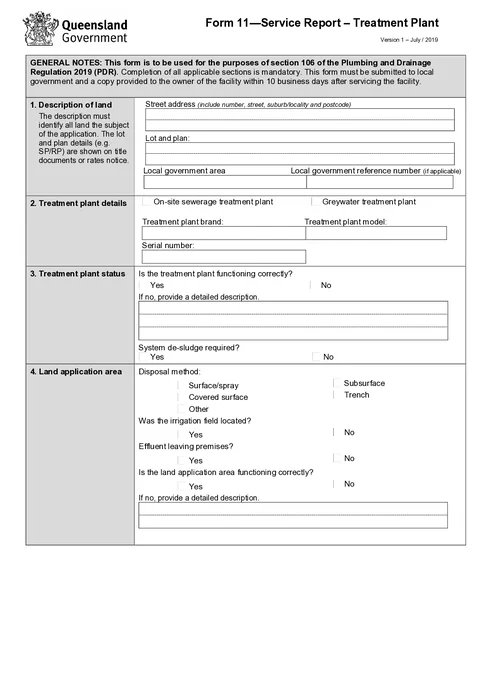
Form 11 is the service report for an on-site sewerage or greywater treatment plant. It records the plant status, land application area, service and annual tests where they apply, and the licensed technician who did the work. The official form is used for section 106 of the Plumbing and Drainage Regulation 2019, and it must go to the local government and the facility owner within 10 business days after the service.
This is the current Queensland Form 11. Tradie Forms follows the official section order and maps your answers onto the official PDF layout.
Reporting testing or commissioning of permit plumbing work rather than a treatment plant service visit? Use QLD Form 5
Almost every Form 11 problem comes from reconstructing the visit in the ute after the panels are closed. Have these in front of you.
The plant nameplate
Brand, model, and serial number from the unit itself, not from the job booking.
Service and annual test gear
Whatever the manufacturer procedure and this plant type need on this visit, including sludge and back-pressure equipment when it is an annual service.
Access to the land application area
Irrigation field, trenches, or sprays so you can answer disposal method and area status from observation.
Owner contact details
Name, postal address, phone, and email for the facility owner who must receive a copy, not only the property manager who booked the job.
Your licence and company details
The technician who performed the service, company name, and licence number that will appear on the report.
Arrival and departure times
Capture them on site so minutes on site are accurate without reconstructing the day later.
Sixteen fields gate the download: site address (including LGA), plant type, owner name and postal address, service date, company, technician name and licence, and declaration date.
Identifies the land the service report covers. The official form says the description must identify all land the subject of the report, and that lot and plan details are on title documents or a rates notice.
Street addressAddressRequired
The street line for the plant site. Address search is limited to Queensland and fills street, suburb, state and postcode. Check against the rates notice or previous service report: search returns the current postal address, and a property can predate a street renaming. On the PDF these lines compose into one address.
SuburbAddressRequired
The suburb or locality for the site. Address search usually fills this with the street line. Confirm it when the plant sits near a suburb boundary so the council copy lands in the right place.
StateAddressRequired
Must be Queensland for this form. Address search fills it when you pick a QLD result; do not leave it blank after a partial manual entry.
PostcodeAddressRequired
The postcode that matches the site address. Take it from address search or the rates notice, not from a nearby job on the same road.
Lot and PlanTextOptional
The legal land description. It is on title documents or the rates notice, which is usually the quickest source if the owner is on site. Fill it whenever you have it, especially on rural blocks where the street address alone is weak.
Useful
Lot 8 on RP123456
Too vague
Rural block near creek
Local Government AreaTextRequired
The council area that receives the report. Address search can fill this. Confirm it near a boundary, because the LGA determines which local government the 10-business-day submission goes to.
Local Government Reference NumberTextOptional
Only when council has already allocated one for this facility or approval. Leave it blank rather than inventing a job number, because a number here reads as the authority's own.
Save this section as Property to prefill it on your next service at the same plant.
Records which plant you serviced. Match the unit on site, not what the booking system said.
Plant TypeChoiceRequired
On-site sewerage treatment plant or Greywater treatment plant. Pick from what is installed, not from the job title. A wrong type misfiles the report against the wrong class of facility at council.
Treatment Plant BrandTextOptional
From the nameplate on the unit. Check the plate rather than the invoice brand if they disagree.
Treatment Plant ModelTextOptional
From the same nameplate. Brand and model help; they are not enough without the serial number when the owner has more than one unit.
Serial NumberTextOptional
The identifier that ties this report to the specific unit. Photograph the nameplate if it is hard to read. Missing serials are the most common reason a later technician cannot match the service history to the plant.
Records whether the plant is operating correctly on this visit and whether de-sludge is needed. When the answer is no, the official form asks for a detailed description.
Is the treatment plant functioning correctly?ChoiceOptional
Answer from what you observed on this service, not from the last visit's report. Yes means the plant is operating as expected at the time of service. No opens the detailed description field.
Detailed DescriptionTextRequired when the plant is not functioning correctly
What you saw, what you did, and the state you left the plant in. Write observations rather than an unconfirmed diagnosis. The PDF maps this into three short lines, so keep it tight and put longer notes with the job photos if needed.
Useful
Aerator motor seized, no rotation on start. Isolated and tagged, replacement quoted. Land application area dry at time of visit.
Too vague
Not working
System de-sludge required?ChoiceOptional
Yes when sludge levels or the manufacturer procedure mean the system needs de-sludging. This is the flag the owner and council use to track follow-up work, so do not leave it blank when you have already decided.
Records how treated effluent is disposed of and whether the land application area is working. These fields are easy to skip when access is awkward, and they are the ones that explain whether the treated side of the system behaves as expected.
Disposal MethodCheckboxOptional
Tick every method in use: Surface/spray, Subsurface, Covered surface, Trench, or Other. Match what is installed on site, not what the original approval assumed if the system has been altered.
Was the irrigation field located?ChoiceOptional
Yes when you found and checked the field. No when you could not locate it, including when access was blocked. Say so rather than leaving the question unanswered for the office to guess.
Effluent leaving premises?ChoiceOptional
Yes when treated or untreated effluent is leaving the property boundary. This is a compliance signal for council, so answer from observation on the day.
Is the land application area functioning correctly?ChoiceOptional
Separate from plant status. The plant can run while the irrigation field is blocked, ponding, or dry for the wrong reason. No opens the detailed description field.
Detailed DescriptionTextRequired when the land application area is not functioning correctly
Site language for what you found in the land application area: blocked sprays, ponding, broken laterals, or effluent at the boundary. The PDF has two short lines for this note, so lead with the observation that matters most.
Tests to be completed every service where they apply to this system. "If applicable" is real: follow the manufacturer procedure and the plant type, and leave a row alone when that check was not part of this visit. Do not invent a reading to make the section look complete.
Tick the row when you completed that check, then enter the result. On the PDF each completed row shows a performed marker and the value with its unit.
pH (Irrigation Chamber)CheckboxOptional
Tick when you measured irrigation chamber pH on this visit. Enter the reading in pH (Irrigation Chamber) result as the pH value, such as 7.2.
pH (Irrigation Chamber) resultTextOptional
pH reading from the irrigation chamber. Units are pH on the PDF.
Residual ChlorineCheckboxOptional
Tick when you measured residual chlorine. Enter the result in ppm, such as 0.8.
Residual Chlorine resultTextOptional
Residual chlorine in ppm.
Clarity (Irrigation Chamber)CheckboxOptional
Tick when you measured irrigation chamber clarity. Enter the result in NTU, such as 12.
Clarity (Irrigation Chamber) resultTextOptional
Clarity in NTU.
TemperatureCheckboxOptional
Tick when you measured temperature. Enter the result in °C, such as 24.
Temperature resultTextOptional
Temperature in °C.
Air Blower Filter Cleaned or ReplacedChoiceOptional
Cleaned or Replaced when you serviced the air blower filter on this visit. Leave it unset when the filter was not touched.
Pump workingChoiceOptional
Yes or No from the check you ran on this visit.
Audible alarm workingChoiceOptional
Yes or No after testing the audible alarm.
Visual alarm workingChoiceOptional
Yes or No after testing the visual alarm.
Chlorine tablets addedChoiceOptional
Yes when tablets were added on this visit, No when you checked and did not add any. Leave unset when the plant has no chlorinator or the check did not apply.
Annual testing where it applies: primary and secondary tank sludge and air blower back pressure. Complete these on the annual service for systems that need them. Leave every row alone on a routine visit that is not the annual test, rather than typing a number to fill the page.
Primary Tank Sludge TestCheckboxOptional
Tick when you completed the primary tank sludge test on this visit. Enter the depth in Primary Tank Sludge Test result in mm, such as 45.
Primary Tank Sludge Test resultTextOptional
Primary tank sludge depth in mm.
Secondary Tank Sludge TestCheckboxOptional
Tick when you completed the secondary tank sludge test. Enter the depth in mm, such as 38.
Secondary Tank Sludge Test resultTextOptional
Secondary tank sludge depth in mm.
Air Blower Back Pressure TestCheckboxOptional
Tick when you completed the air blower back pressure test. Enter the result in kPa, such as 12.
Confirms whether this service followed the manufacturer's operation and maintenance procedures. The form notes that technicians can get those procedures from the manufacturer or supplier.
Has the service been completed in accordance with the manufacturer's operation and maintenance recommended procedures?ChoiceOptional
Yes when the visit followed the manufacturer procedure for this plant. No when a step could not be completed (access blocked, part on order, owner declined work). Where the answer is no, make the reason visible in the plant status or land application notes rather than only in a private job memo.
Owner details for the facility that must receive a copy of the report. Use the facility owner, not only the property manager who booked the job, when those are different people.
Owner's NameTextRequired
The facility owner's name as they should appear on the council and owner copies. If a manager booked the service, confirm who the owner of the facility is before you leave.
Phone NumberTelOptional
A number the owner actually answers. Useful when council or the next technician needs to follow up.
Postal addressAddressRequired
Where the owner copy should be addressed. Address search is limited to Queensland and fills the postal line, suburb, state and postcode. On rural plants this is often a PO Box rather than the site street address. On the PDF the parts compose into a single postal address line.
SuburbAddressRequired
Suburb or locality for the postal address. Confirm it when the owner lives off-site and the site suburb would be wrong for the mail copy.
StateAddressRequired
State for the postal address. Address search fills it for a QLD result; keep it accurate when the owner is posted interstate.
PostcodeAddressRequired
Postcode for the postal address. Match the postal line, not the plant site, when those differ.
Email AddressEmailOptional
Useful when you send the owner copy digitally. Confirm spelling with the owner on site rather than from an old booking.
Save this section as Owner to prefill it on your next service for the same facility owner.
When the service happened and who performed it. Arrival, departure, and minutes on site are optional in the app but expected on the official form when you have them.
DateDateRequired
The date the service was carried out. Today and Yesterday shortcuts are there because this is usually filled on site or the next morning. The field does not accept a future date.
Arrival TimeTimeOptional
Time you arrived on site. Capture it while you are there so you are not reconstructing the day later.
Departure TimeTimeOptional
Time you left site. Used with arrival time to fill minutes on site.
Minutes on SiteNumericOptional
Filled automatically from arrival and departure times. Override only when the auto value is wrong, for example when you left and returned on the same job.
Full Name of CompanyTextRequired
The company name, or your own name if you are not trading as a company. This is what council and the owner see as the service provider.
Service Technician NameTextRequired
The licensed person who performed the service. Must match the person who signs the declaration.
Licence NumberTextRequired
The technician's licence number. Use Licence check against the QBCC register to fill the technician name when the number is known, then confirm the name matches the person on site.
Save this section as Technician to prefill it on your next treatment plant service.
The official form states: I hereby state that the information provided in this form is a true and accurate record. Sign after the status, tests, and technician details are correct for this visit.
SignatureSignatureOptional
The service technician named above. Sign when the report is true for this visit, not as a blank stamp for later jobs. You can use a saved signature; check the preview so it sits cleanly in the page 2 signature box.
DateDateRequired
The date you sign the declaration. Often the same calendar day as the service date, but it is a separate field. Today and Yesterday shortcuts are available, and the field does not accept a future date.
Brand and model help; the serial number is what ties this visit to the specific unit. Photograph the nameplate before you close the panels.
Writing a one-word fault note.
Not working tells the owner, council, and the next technician nothing. Record what you observed, what you did, and the state you left the plant in.
Skipping the land application area.
The plant can run while the irrigation field is blocked or effluent is leaving the premises. Walk the disposal area on every service you can access it.
Inventing annual test numbers on a routine visit.
Leave annual rows alone when this is not the annual service. A made-up sludge depth is worse than a blank row.
Putting the property manager in Owner's name.
The facility owner must receive a copy within 10 business days. Confirm who the owner is when a manager booked the job.
Signing with a different name to the technician field.
The declaration is a true and accurate record of the service visit. The person named as service technician is the person who signs.
Leaving the report only in the company inbox.
The finished PDF has to reach local government and the owner. Filing it under the job number without sending either copy is the step most often missed.
The official Form 11 says the form must be submitted to local government and a copy provided to the owner of the facility within 10 business days after servicing the facility. Both parts matter; the owner copy is the step most often missed.
Send both copies on purpose. Lodge with the local government for the property's LGA, and give the owner their copy by the method they use (email or post). Do not assume the manager who booked the job will pass it on.
Name the file so the plant is obvious.Form 11 - Mount Tamborine - 2026-06-10.pdf is easier to find next year than a generic job number.
File it under the property, in date order. Treatment plant work is mostly repeat business. A run of reports shows whether a fault is new or recurring and whether the owner acted on de-sludge or repair recommendations.
Keep readings and photos with it. The PDF is the formal record; the job folder still needs the nameplate photo, test notes, and any quote for follow-up work.
Check the current Business Queensland and local government requirements for your job. Retention and lodgement detail sit with the local government for that facility.