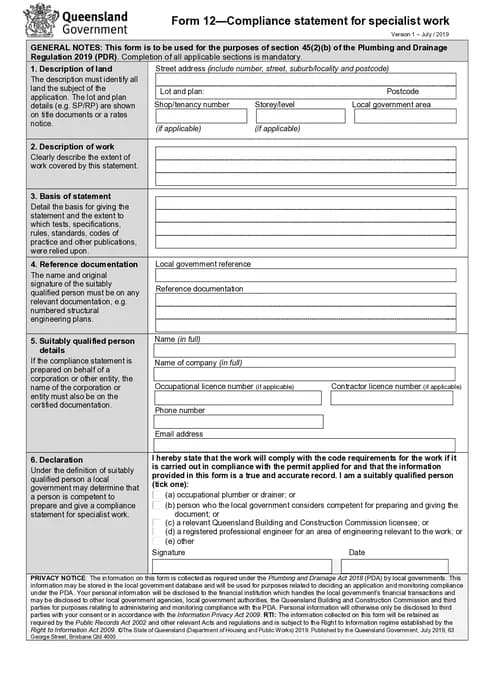
Form 12 is the compliance statement for specialist plumbing or drainage work under section 45(2)(b) of the Plumbing and Drainage Regulation 2019. A suitably qualified person gives it to support a permit application, so the local government can read the specialist scope, basis and references without chasing loose notes. It is not a declaration that completed work has passed an inspection, and it is not the building Form 12 aspect certificate.
This is the current Queensland Form 12. Tradie Forms follows the official section order and maps your answers onto the official PDF layout.
Need the building aspect inspection certificate rather than this plumbing specialist statement? Use QLD Form 12
Declaring that completed work under an action notice is compliant, rather than supporting specialist work on a permit application? Use QLD Form 14
Certifying final inspection of completed permit work rather than a specialist statement for the application? Use QLD Form 19
Almost every Form 12 problem comes from filling it after the permit pack has already closed. Have these open before you type.
The current permit application pack
Land details, specialist drawings, specifications and any amendments the statement will support.
Current drawing and report revisions
Title, revision and issue date checked on each document you will name.
Local government correspondence
Source for the local government reference when one has already been allocated.
Standards, codes and publications relied on
The real technical basis for this specialist work, not a generic paste list.
Suitably qualified person details
Full name, company if preparing for an entity, licence numbers and contact details for the person who will sign.
A decision on which declaration option applies
Occupational plumber or drainer, local-government competent person, QBCC licensee, registered engineer, or other.
Nine fields gate the download: street address, suburb, postcode, local government area, description of work, basis of statement, name in full, suitably qualified person option, and date. Sign after the finished statement matches the pack.
Identifies all land the statement covers. This has to match the permit application, not the delivery gate or a previous stage. The form is used for the purposes of section 45(2)(b) of the Plumbing and Drainage Regulation 2019, and completion of all applicable sections is mandatory.
Street addressAddressRequired
The site street line from the current permit material. Address search is limited to Queensland and fills the street line, suburb, state and postcode. Check the result against the permit pack, because search returns the current postal address and a permit can predate a street renaming or a subdivision. State defaults to QLD if you skip it.
SuburbAddressRequired
The suburb or locality on that same permit material. Do not take it from a supplier docket or a builder's estimate, which often carry a nearby but different site.
PostcodeAddressRequired
The postcode that belongs with the street and suburb above. Confirm it when the job sits near a postcode boundary.
Shop / Tenancy NumberTextOptional
Fill this on multi-tenancy or fit-out work so the statement is tied to the unit it covers. Without it, a specialist statement for one tenancy can be read as covering the whole building.
Storey / LevelTextOptional
Fill this on anything above one storey, for the same reason.
Local Government AreaTextRequired
The council area for the land, not the builder's office. Address search may fill this. Confirm it near a boundary, because the LGA is who receives the permit pack and assesses the statement.
On a staged or multi-building site, check the street line, tenancy or level, and LGA against the application land before you move on. The official form also notes that lot and plan details appear on title documents or a rates notice; use those sources when you need to confirm which parcel the application covers.
Describes the specialist plumbing or drainage work this statement covers. Council will compare this line to the drawings and the rest of the permit pack.
Description of WorkTextRequired
Name the system or specialist work and the part of the job covered, in the same language as the current drawings. Project labels such as shop fit-out or plumbing works push the whole job onto the drawings and leave the statement empty. The PDF has about three lines (roughly 86 characters each); overflow is cut, so keep the scope bounded and put long publication lists in Basis instead.
Useful
Trade waste pre-treatment system to tenancy 4, as shown on hydraulic drawings H12 to H15, Rev B
Too vague
Shop fit-out
If the installed scope changed on site, describe the work as carried out rather than as first designed. A statement that matches an old plan but not the installation is harder to defend later than one that records the variation.
Records why the suitably qualified person can give the statement, and which tests, specifications, rules, standards, codes of practice and other publications were relied on.
Basis of StatementTextRequired
List the real technical basis for this job: current drawing set, specification, approval documents, and the laws, codes or standards actually used. Include enough title, revision and date detail that an older issue cannot be mistaken for the current one. A short accurate list beats a long generic block of standards nobody used. The PDF has about four lines (roughly 86 characters each); overflow is cut, so prioritise the publications that matter.
Do not reuse a basis block from a previous job without checking every named document against this pack. If you are unsure whether a publication applies, resolve that with the right person before anyone signs.
Links the statement to the local government file and the supporting documents that carry the suitably qualified person's name and original signature.
Local Government ReferenceTextOptional
Copy it from current local government correspondence or permit paperwork, not from memory. This matters most when several jobs share a street name, when an application has been amended, or when the office is preparing more than one stage. If no reference has been allocated yet, leave the field blank and keep the statement as a draft rather than inventing a number that later reads as a lodged file reference.
Reference DocumentationTextOptional
Plan numbers, engineer sign-off, specifications and other supporting documents the statement relies on. The official form says the name and original signature of the suitably qualified person must be on any relevant documentation, such as numbered structural engineering plans. The PDF has about three lines (roughly 86 characters each); name the documents and revisions clearly enough that the pack can be matched without a phone call.
Details of the suitably qualified person giving this compliance statement. These belong to the person who will tick the declaration option and sign, not to whoever typed the draft.
Name (in Full)TextRequired
Legal name of the person giving the statement. Licence check against the QBCC register can fill this from an occupational or contractor licence number; confirm the result matches the person who will sign.
Name of Company (in Full)TextOptional
Fill when the statement is prepared on behalf of a corporation or other entity. The official form says the entity name must also be on the certified documentation.
Occupational Licence NumberTextOptional
Occupational plumber or drainer licence where that applies. Licence check can fill the name field from this number; still confirm the person and licence type against the specialist work.
Contractor Licence NumberTextOptional
QBCC contractor licence where that applies. Same check as the occupational number: the licence must belong to the person or entity giving the statement for this work.
Phone NumberTextOptional
A current contact number for the person or office that can answer questions about the statement. Saved details often carry an old number after a staff change, so check it.
Email AddressTextOptional
A current email for the same reason. Council and the permit applicant both need a working path back to the person who signed.
Save this section as Qualified Person to prefill it on your next Form 12 for the same suitably qualified person.
Saved details are a starting point only. A changed phone number, company name or licence detail is far easier to correct before the statement is attached to an application.
The person giving the statement confirms that the work will comply with the code requirements if it is carried out in compliance with the permit applied for, and that the information on the form is true and accurate. A local government may determine whether a person is competent to prepare and give this statement.
Suitably Qualified PersonChoiceRequired
Tick the option that describes the person who is signing. The official options are occupational plumber or drainer; a person the local government considers competent for preparing and giving the document; a relevant QBCC licensee; a registered professional engineer for an area of engineering relevant to the work; or other. Do not pick the most convenient label. Confirm the right option for the specialist work and the local government process before anyone signs.
SignatureSignatureOptional
The suitably qualified person signs after checking the finished statement against the current drawings, basis and references. Use a saved signature if you have one; check the preview so the stamp sits cleanly in the signature box on page one. Sign the final version, not a draft that may still change.
DateDateRequired
The date the person signs the finished statement. Today and Yesterday shortcuts are there because this is often completed on site or the next morning. The field does not accept a future date. Keep the date aligned with the actual sign-off, not with when the draft was first prepared.
The declaration is about the person actually giving the statement. It should not be signed on behalf of someone who has not checked the final record.
A one-line work description with a thin basis is not a statement council can assess. Complete basis and references while the design package is open.
Taking the land details from a delivery address.
Supplier dockets and builder estimates often point at the gate, not the parcel, tenancy or level the application covers. Take address and LGA from the current permit material.
Describing the job with a project label.
Shop fit-out or plumbing works tells the assessor nothing. Name the specialist system and the part of the job, in the same terms as the drawings.
Pasting a generic standards block into Basis.
Naming publications that were not used is harder to defend than a short accurate list. Check title, revision and date on every document you name.
Inventing a local government reference.
A finished-looking PDF with a guessed reference is worse than an obvious draft. Leave the field blank until correspondence confirms it.
Signing for someone who has not checked the statement.
The declaration options and signature belong to the person giving the statement. The preparer gathers the pack; the suitably qualified person reviews, ticks their option, signs and dates.
Dating the draft instead of the sign-off.
Keep the date with the finished, checked statement. A draft date that predates a drawing revision makes the trail harder to read.
Business Queensland lists Form 12 among plumbing and drainage forms lodged with local government. Attach the finished PDF and the referenced documentation to the permit application through the process your local government requires.
Name the file so the site and specialist scope are obvious.Form 12 - 12 Cable St - trade waste TMV.pdf is easier to find later than a generic site-only name.
File it with the drawings and specifications it names. The statement alone does not show the revision trail. Keep the pack that supports it in the same job folder.
Keep correspondence about the application with it. If the scope changes after the statement is given, the trail shows what was declared and what changed.
Check the current Business Queensland and local government requirements for your job. Lodgement paths and retention expectations sit with the local government assessing the permit.