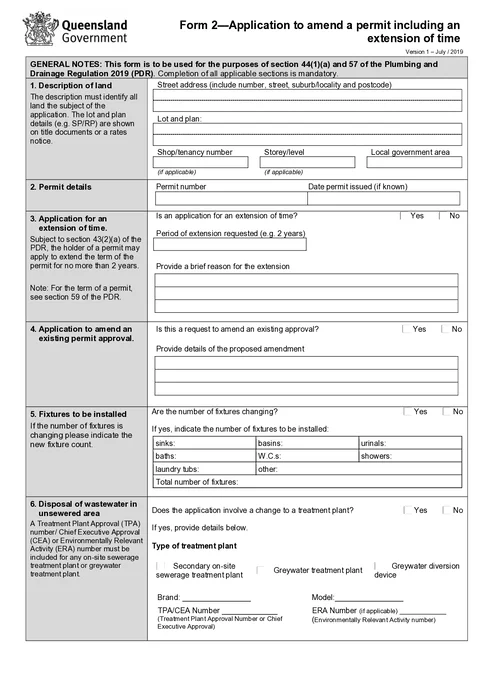
Form 2 is the application to amend an existing Queensland plumbing or drainage permit, including an extension of time. You prepare it for lodgement with the local government; the council decides whether the amendment or extension is approved. Business Queensland says an amended permit must be approved and issued before the extra work starts, and that extension requests must be lodged at least 10 business days before the permit ends.
This is the current Queensland Form 2. Tradie Forms follows the official section order and maps your answers onto the official PDF layout.
Applying for a new permit rather than changing an existing one? Use QLD Form 1
Form 2 fails when the office invents the change from memory. Have these in hand before you open it.
The current permit and any earlier amendments
Source for the land description, permit number, issue date, and what is already approved.
A decision on what you are asking for
Extension only, amendment only, or both, and which fixture or treatment plant details change.
The permit end date
Needed before you request more time. Business Queensland expects the extension application at least 10 business days before the term ends.
Supporting documents for the change
Updated plans, fixture schedules, SEQ service-provider consent where it applies, and the local government fee details.
Treatment plant papers when disposal is changing
Brand, model, TPA or CEA number, ERA number if used, bedroom and flow figures, and the site and soil evaluation report.
Owner and applicant contacts
Correct owner details and the person authorised to lodge on their behalf.
Only the declaration date is required to download. The official form still expects every applicable section completed before lodgement, and an empty property or permit block will not survive council review.
Identifies all land the application covers. The description has to match the current permit, not a job nickname or a builder's shorthand.
The form notice says completion of all applicable sections is mandatory and incomplete forms may be returned.
Street AddressAddressOptional
The street address on the permit. Address search is limited to Queensland and fills the street line, suburb, state and postcode. Check the result against the permit, because search returns the current postal address and a permit can predate a street renaming or a subdivision.
Lot and PlanTextareaOptional
The legal land description from the permit, title documents, or the rates notice. On new estates the street address may not exist in any council system yet, so lot and plan is the reliable identifier. Fill it whenever the permit carries it.
Useful
Lot 12 on SP 123456
Too vague
new estate lot
Shop / Tenancy NumberTextOptional
Fill this on multi-tenancy sites so the amendment is tied to the unit the work covers.
Storey / LevelTextOptional
Fill this on anything above one storey when the change is level-specific.
Local Government AreaTextOptional
The council area that holds the permit. Address search may fill this. Confirm it near a boundary, because that LGA is who receives the application.
Links the application to the existing permit being extended or amended.
Permit NumberTextOptional
From the current permit document. Do not take it from an invoice, a quote or an old job record, because those often carry a superseded number after an earlier amendment. If you are on site without the permit, the permit holder or the council's plumbing team can confirm it.
Date Permit IssuedDateOptional
The issue date on that same permit. Fill it when you know it: it helps the authority match the request to the correct permit record rather than a replaced one. The field does not accept a future date.
If the permit has already been amended, use the current permit number and issue date, not the original Form 1 values.
Records whether you are asking for more time to finish work already permitted. Business Queensland says a permit is valid for 2 years unless a longer period is stated, that you can apply to extend by up to 2 years, and that you need to apply at least 10 business days before the term ends.
Is an application for an extension of time?ChoiceOptional
Select Yes when you need more term. Select No when this Form 2 is only an amendment. Leaving it blank is fine for download, but a lodgement without a clear Yes or No on the sections that apply will be sent back.
Period of Extension RequestedTextRequired when you select Yes for an extension of time
How long you are asking for, such as 12 months or 2 years. Under PDR section 43(2)(a), an extension is limited to no more than 2 years. Confirm the remaining term and the council's practice before you pick a period that overshoots.
Brief Reason for the ExtensionTextareaRequired when you select Yes for an extension of time
Why the work cannot finish inside the current term. Name the real delay so a council officer who has never been to site can assess it. Vague one-word reasons read as incomplete.
A slipping job still has to hit the 10 business day mark. Check permit end dates as an office routine rather than waiting for site to raise it.
Records whether you are changing the approved scope, and what that change is. Business Queensland says the amended permit must be approved and issued before the additional work starts.
Is this a request to amend an existing approval?ChoiceOptional
Select Yes when the approved work plan, fixtures, systems or conditions need to change. Select No when this Form 2 is only an extension of time.
Details of the Proposed AmendmentTextareaRequired when you select Yes for a permit amendment
What was approved, what is now proposed, and where on the property it applies. Say whether drawings or fixture schedules change, and whether wastewater disposal is affected. Do not paste a vague site email into the box and hope the assessor reconstructs the job.
Long amendment text sits in a fixed box on page one of the PDF. Check the preview so the description still reads in full.
Records an updated fixture count when the installation changes after approval. The official form asks for the new counts when the number of fixtures is changing.
Are the number of fixtures changing?ChoiceOptional
Select Yes when sinks, basins, urinals, baths, W.C.s, showers, laundry tubs or other fixtures differ from the approved permit. Select No when the fixture schedule is unchanged. The count fields only appear when the answer is Yes.
SinksNumericRequired when you select Yes that fixtures are changing
Updated count for sinks. Take it from the current drawings or site instructions compared to the approved permit, not from memory of the original application.
BasinsNumericRequired when you select Yes that fixtures are changing
Updated basin count for the amended layout.
UrinalsNumericRequired when you select Yes that fixtures are changing
Updated urinal count. Enter 0 when that fixture type is not part of the amended work.
BathsNumericRequired when you select Yes that fixtures are changing
Updated bath count for the amended layout.
W.C.sNumericRequired when you select Yes that fixtures are changing
Updated water closet count.
ShowersNumericRequired when you select Yes that fixtures are changing
Updated shower count.
Laundry TubsNumericRequired when you select Yes that fixtures are changing
Updated laundry tub count.
OtherNumericRequired when you select Yes that fixtures are changing
Any fixtures that do not fit the named categories. Keep the schedule or drawing note that explains what is counted here.
Total Number of FixturesNumericRequired when you select Yes that fixtures are changing
Sum of the fixture counts above. The form totals the named counts automatically when you fill them; confirm the total still matches the drawings before download.
If a fixture type is not changing, leave that path alone rather than inventing numbers for an unchanged installation. Only open this section when the approved count is wrong for the work now proposed.
Covers a change to a treatment plant or related on-site disposal in an unsewered area. The official form requires a TPA, CEA or ERA number for on-site sewerage or greywater treatment plant work.
Does the application involve a change to a treatment plant?ChoiceOptional
Select Yes when brand, model, approval reference, capacity or land application details change. Select No when wastewater disposal is untouched. The detail fields only appear when the answer is Yes.
Type of Treatment PlantChoiceRequired when you select Yes for a treatment plant change
Tick the plant type that applies: secondary on-site sewerage treatment plant, greywater treatment plant, or greywater diversion device. Match the approval documents, not a site nickname.
BrandTextRequired when you select Yes for a treatment plant change
From the manufacturer's plate or the current approval documents, such as AquaMax.
ModelTextRequired when you select Yes for a treatment plant change
The model string from the same documents, such as ATU-500.
TPA / CEA NumberTextRequired when you select Yes for a treatment plant change
Treatment plant approval or chief executive approval number from the current approval papers, not a photo of an old label on another job.
ERA NumberTextRequired when you select Yes for a treatment plant change
Environmentally relevant activity number when one applies. Leave it empty only when the plant paperwork has no ERA reference and the council does not expect one.
Total Bedrooms Serviced by the FacilityNumericRequired when you select Yes for a treatment plant change
Bedroom count for every dwelling the facility serves, taken from the design or site and soil evaluation, not a round guess.
Total Wastewater Flow per DayTextRequired when you select Yes for a treatment plant change
Daily flow in litres, entered as a number such as 1200. The field shows an L/day suffix.
A Copy of the Site and Soil Evaluation Report Is AttachedCheckboxRequired when you select Yes for a treatment plant change
Tick when the report is included with the lodgement pack. The PDF only records the tick; the actual report is a separate attachment the council expects with the application.
CommentsTextareaRequired when you select Yes for a treatment plant change
Use for substitution notes and anything the assessor needs beyond brand and model, such as keeping the approved land application area footprint.
Brand, model and approval numbers continue onto page two of the PDF with bedrooms, flow, the soil-report tick and comments. Check the preview so none of those values are cut off.
The person lodging the application. They need not be the owner, but they are responsible for the information and for being authorised to manage the application on the owner's behalf.
Applicant NameTextOptional
The person lodging, often the plumber, builder or agent. Match the name that will sign the declaration.
Phone NumberTelOptional
A number the council can reach the applicant on while the application is open.
Company Name in FullTextOptional
Full company name when the applicant is lodging for a business, such as River City Plumbing Pty Ltd.
Email AddressEmailOptional
The applicant email for lodgement follow-up.
Save this section as Applicant to prefill it on your next Form 2 you lodge for this business.
Check saved owner and applicant details against this job before download. Stale contacts are easy to carry from one permit file to the next.
Closes the application. The local government relies on the owner and applicant information when assessing it. The form states that the information provided is a true and accurate record.
SignatureSignatureOptional
Sign when the property, permit, extension or amendment details, and parties are correct for this application. You can use a saved signature; check the preview so the stamp sits cleanly in the signature box on page two of the PDF.
DateDateRequired
The date of the declaration. Today and Yesterday shortcuts are there because this is often finished on the day of lodgement. The field does not accept a future date.
Form 2 only changes or extends an existing permit. Fresh permit work is Form 1. Starting the wrong form wastes the lodgement cycle.
Taking the permit number from an invoice.
Invoices are raised early and often carry a number that was later amended. Take it from the current permit document.
Applying for an extension inside the last few days of the term.
Business Queensland expects at least 10 business days before the permit ends. A late request can leave the job without cover while the council processes it.
Asking for more than two years of extension.
The approved form and PDR section 43(2)(a) limit an extension to no more than 2 years. Pick a period the regulation allows.
Writing a one-word extension reason.
Delayed means nothing to an assessor six months later. Name the construction stage, access issue or owner change that held the work up.
Starting the amended work before the council issues the amended permit.
Business Queensland says the amended permit must be approved and issued first. Small scope changes still sit ahead of their approval if site keeps moving.
Describing the amendment with a vague email paste.
The assessor has not been to site. State what was approved, what is proposed, and where it applies, and attach the drawings the change depends on.
Rebuilding treatment plant details from a phone photo.
Brand, model, TPA or CEA, and ERA numbers have to match current approval documents. A wrong reference delays the application and can block the substituted plant.
Business Queensland guidance says you need any required documents, written consent from the South East Queensland service provider when the application relates to SEQ water or sewerage work and local government is not the water service provider, and the local government application fee.
Lodge through the current local government process. Form 2 is an application, not an approval. Keep the lodgement receipt with the job file.
Include the supporting pack. Updated plans, fixture schedules, treatment plant approvals, the site and soil evaluation report when wastewater changes, SEQ consent where it applies, and the fee.
Name the file so the request is obvious. Use something like Form 2 - 12 Cable St - extension 12 months.pdf rather than the address alone, so an amendment and an extension on the same site do not get mixed later.
File it with the original permit and any earlier amendments. The application alone does not show what was already approved.
Do not start the extra work until the amended permit is issued. Track the council decision against the job so site does not run ahead of the approval.
Check the current local government and Business Queensland requirements for your job. Lodgement method, fees and supporting documents sit with the authority that holds the permit.