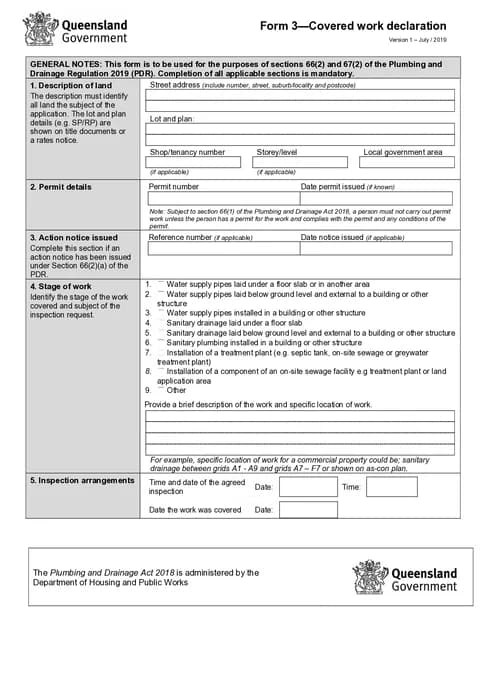
Form 3 is the covered work declaration for plumbing and drainage when work was covered before inspection, or when an agreed inspection did not start in time and the local government allows this pathway instead. Business Queensland describes Form 3 as the declaration to use when local government has allowed the form to certify that covered work is compliant. You end up with the official PDF for lodgement with the local government for that permit.
This is the current Queensland Form 3. Tradie Forms follows the official section order and maps your answers onto the official PDF layout.
Closing out completed permit work with a final inspection certificate rather than declaring covered work? Use QLD Form 19
An action notice that asks for a compliance declaration on specified work, not a covered work declaration? Use QLD Form 14
Recording testing or commissioning results rather than covered work? Use QLD Form 5
Almost every Form 3 problem comes from reconstructing the declaration after the trench is backfilled. Have these in front of you while the covered work is still clear.
Confirmation the pathway applies
Local government must allow Form 3 for this job, either via an action notice or the delayed-inspection route.
The current permit
Source for the land description, permit number, and permit issue date.
The action notice, if one was issued
Reference number and issue date under section 66(2)(a). Leave it out if none applies.
What stage was covered and where
Stage tick boxes plus a location description you can match to the site later.
Inspection request and agreed time
The agreed inspection date and time, and the date the work was actually covered.
Responsible person and contractor details
Licence numbers and contacts for the person who performs or supervises the work, and the contractor if different.
Photos and as-constructed notes before cover-up
Supporting record for the declaration, filed with the finished PDF rather than typed into the form.
Only the declaration date blocks download on an untouched form. Everything else still has to be complete and accurate before you give the PDF to the local government.
Identifies the land the covered work sits on. The official form says the description must identify all land the subject of the application, and that lot and plan details are shown on title documents or a rates notice.
Street AddressAddressOptional
The address on the permit. Address search is limited to Queensland and fills the street line, suburb, state and postcode. Check the result against the permit, because search returns the current postal address and a permit can predate a street renaming or a subdivision.
Lot and PlanTextOptional
The legal land description from the permit, title, or rates notice. On new estates the street address may not exist in any council system yet, so lot and plan is often the only reliable identifier. The PDF has two lines for this field.
Useful
Lot 12 on SP 123456
Too vague
Lot 12, new estate
Shop / Tenancy NumberTextOptional
Fill this on multi-tenancy sites so the declaration is tied to the tenancy that was covered, not the whole complex.
Storey / LevelTextOptional
Fill this on anything above one storey for the same reason.
Local Government AreaTextOptional
The council area. Address search may fill this. Confirm it near a boundary, because the LGA is the authority the declaration goes to.
Check the property details match the permit and the work location.
Links the declaration to the compliance permit for the work. The form notes that a person must not carry out permit work without a permit and without complying with its conditions.
Permit NumberTextOptional
From the current permit document. Do not take it from an invoice, a quote, or an old job record, because those often carry a superseded number after an amendment. If you are on site without the permit, the permit holder or the council's plumbing team can confirm it.
Date Permit Issued (if Known)DateOptional
The issue date on that same permit. Fill it when you have it: it helps the authority confirm you declared against the current permit rather than a replaced one. No future dates.
If the permit was amended during the job, use the number the local government still holds for the work being declared.
Complete this section only when an action notice has been issued under section 66(2)(a) of the Plumbing and Drainage Regulation 2019. That is one of the two pathways the official form is written for. The other pathway is section 67(2): an inspection was requested, it did not start within the required period, and the local government has allowed the declaration instead.
Reference NumberTextOptional
The action notice reference from the notice itself, not from a job note or email subject line that paraphrases it. Leave blank when no action notice applies.
Date Notice Issued (if Known)DateOptional
The issue date on that notice. Leave blank with the reference when no notice applies. No future dates.
Identifies the stage of work covered and the subject of the inspection request. Covered work is hard to check later because the physical work is no longer visible, so stage and location have to stand alone on the record.
Stage of WorkChoiceOptional
Tick every stage that matches the work that was covered. The options are water supply under slab or in another area, water supply below ground external, water supply in a building, sanitary drainage under slab, sanitary drainage below ground external, sanitary plumbing in a building, treatment plant installation, on-site sewage facility component, and other. Do not tick a broad option because it is close; choose the stage that actually matches the covered work.
Work Description and LocationTextOptional
A brief description of the work and its specific location. The official form gives a commercial example using grid references. On a house job, name the run, the side of the dwelling, the trench, the fixture group, the unit, or the plan reference. The PDF has four lines for this field; keep the wording short enough to fit without cutting off the part that identifies the location.
Useful
Sanitary drainage from ensuite group to inspection opening on north side of dwelling
Too vague
Drainage under slab
Check the selected stages and description match what was covered on site, not what is still open elsewhere on the permit.
Records the agreed inspection arrangements and when the work was covered. These dates explain why the declaration exists and how the inspection pathway played out.
Agreed Inspection DateDateOptional
The date agreed with the local government for the inspection, from the inspection request or council confirmation, not a guess from the site diary. Today is available as a shortcut when you are filling the form on the agreed day.
Agreed Inspection TimeTimeOptional
The agreed time on that same request or confirmation, such as 09:30. Record what was agreed, even if the inspector did not attend.
Date the Work Was CoveredDateOptional
The date the work was actually covered on site. Often a different day from the agreed inspection. Today and Yesterday shortcuts are there because this is usually filled on the day of cover-up or the next morning. No future dates.
Check the inspection date and time match what was agreed with the local government, and that the covered date is the real cover-up date rather than the declaration date.
Details for the licensed person who performs the work or supervises its performance. The official form puts that person at the centre of the declaration.
Name (in Full)TextOptional
Legal name of the responsible person as on their occupational licence, not a trading name or company name. Licence check can fill the name when you look up a QBCC licence number.
Occupational Licence NumberTextOptional
The occupational licence for the work being declared, such as a plumber or drainer licence. Use Licence check against the QBCC register to confirm the number and fill the name. Check it is current before download.
Contractor Licence Number (if Applicable)TextOptional
Fill when the responsible person also holds a contractor licence for the work. Leave blank when they only hold an occupational licence and the contractor sits in the next section.
Phone NumberTelOptional
A number the local government can use about this declaration, usually a mobile that is answered on site days.
Email AddressEmailOptional
The email used for permit and inspection correspondence on this job.
Postal AddressAddressOptional
Postal address for the responsible person. Address search is limited to Queensland. Confirm the result if the licence record carries a different postal address.
Save this section as Responsible Person to prefill it on your next covered work declaration.
Check licence numbers and contact details are current before you sign.
Complete this section when the responsible person is not the contractor for the work. Leave it blank when the responsible person is also the contractor.
Full Name of Company (or Individual if Not a Company)TextOptional
Company name as on the contractor licence, or the individual's full name when the contractor is not a company. Licence check can fill the name from a QBCC contractor licence number.
Contractor Licence NumberTextOptional
The contractor licence for the work. Use Licence check against the QBCC register to confirm the number and fill the company or individual name.
Phone NumberTelOptional
A contact number for the contractor on this job.
Email AddressEmailOptional
The contractor email used for this permit file.
Save this section as Contractor to prefill it on your next covered work declaration.
Do not squeeze contractor details into the responsible person fields when they are different people or entities.
The responsible person signs that the work has been completed in conformity with the Plumbing and Drainage Regulation 2019, that the information on the form is true and accurate, and that they are the responsible person.
SignatureSignatureOptional
Sign as the responsible person named above, after the property, permit, stage, inspection, and licence details are correct. You can use a saved signature; check the preview so the stamp sits cleanly in the signature box on page 2 of the PDF. Do not sign for someone else, and do not sign before the stage and covered date are right.
DateDateRequired
The date the declaration is made. Today and Yesterday shortcuts are there for on-site completion. No future dates. This is the field that blocks download when left empty.
Before signing, confirm the form covers only work you performed or supervised, the stage and location match what was covered, the inspection arrangements are accurate, any action notice reference is correct, and the licence details are current.
Using Form 3 without local government allowing the pathway.
Covered work alone is not enough. Confirm the action notice or the delayed-inspection route before treating the job as a declaration job.
Inventing an action notice reference.
Section 3 is only for notices under section 66(2)(a). If the delayed-inspection pathway applies and no notice was issued, leave both notice fields blank and keep the inspection request with the file.
Ticking a stage that is only close to the covered work.
Under slab is not the same as below ground external. Tick the stage that matches what was covered, and use the description for location, not as a substitute for the wrong stage.
Describing the work as drainage or water pipe only.
Once it is backfilled, a vague line is all the record says. Name the run and both ends of it, or the tenancy, floor, or plan reference.
Guessing the date the work was covered.
The covered date is part of why the declaration exists. Take it from the site note or photo timestamp from the day of cover-up, not from the declaration date.
Putting the contractor into the responsible person fields.
If the responsible person is not the contractor, use the contractor section. Mixing the two parties makes the declaration hard to read against the licences on file.
Taking the permit number from an invoice.
Invoices are raised early and often carry a number that was later amended. Take it from the current permit document.
Give the finished PDF to the local government through the process they require for that permit. Business Queensland guidance treats a covered work declaration as an alternative pathway where the local government has allowed it, not as a general completion certificate.
File it with the permit and the inspection trail. Keep the inspection request, any action notice, photos before cover-up, as-constructed sketch or plan reference, and council correspondence in the same job folder.
Name the file so the stage is obvious.Form 3 - 12 Cable St - sanitary drainage north.pdf is clearer later than the address alone.
Note why the declaration was used. A short job note that names the action notice or the delayed inspection saves a reconstruction when the file is reviewed years later.
Check the current Business Queensland and local government requirements for your job. Lodgement and retention sit with the local government for the permit.