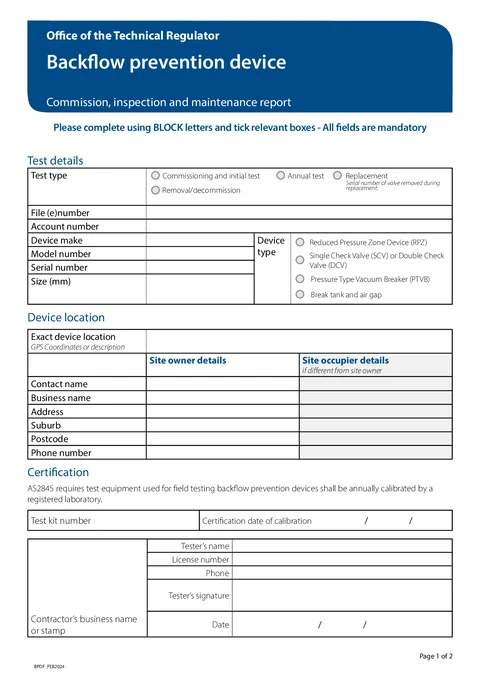
This report records commissioning, annual testing, replacement, or decommissioning of a testable backflow prevention device in South Australia. The licensed plumber with backflow prevention accreditation completes it at the device, then forwards the finished PDF to the Office of the Technical Regulator. OTR plumbing trades guidance says the completed report must be forwarded within 7 days of completing the work.
This is the current Office of the Technical Regulator Backflow Prevention Device Report. Tradie Forms follows the official section order and maps your answers onto the official PDF layout.
Testing a device in Queensland rather than South Australia? Use QLD Form 9
Have these in front of you while the test kit is still connected. Reconstructing readings after you leave is how most SA backflow rework starts.
The device plate and site register
Make, model, size, serial number, and any site asset tag for the unit in front of you.
The reason for this visit
Commissioning and initial test, annual test, replacement, or removal and decommission, decided before you open the form.
OTR file and account references
File (e)number and account number from the OTR or water authority correspondence for this property.
The test kit certificate or sticker
Kit number and last calibration date for the kit used on this test.
The readings as the test is run
Isolation or gate valve results, differentials, relief or air-inlet pressures, and pass checks before the gauges come off.
Site owner and occupier contacts
Owner name, business, address and phone, plus occupier details when they differ from the owner.
Your licence and contractor stamp
Tester name, plumbing licence with backflow accreditation, phone, and contractor business name or stamp.
Almost every field on this form gates download once the matching device type is selected. The official PDF states that all fields are mandatory on the printed form.
Records why you are on site and the identity of the device under test. Take make, model, size and serial from the plate in front of you, not last year's PDF alone.
Test TypeRadioGroupRequired
Commissioning and Initial Test, Annual Test, Replacement, or Removal/Decommission. Match this visit, not a default from the last job. Selecting Replacement opens the serial number field for the valve you removed.
Serial Number of Valve RemovedTextRequired when you select Replacement
Serial of the device taken out, from its plate or the removal tag, such as RPZ-12004. Do not put the new device's serial here.
File (e)numberTextRequired
OTR or water authority file reference for this property, such as E123456. Take it from the correspondence that scheduled or registered the device, not from a job nickname.
Account NumberTextRequired
Account number linked to the property or owner for this report, such as ACC-88421. Match the number on the OTR or authority paperwork for the site.
Device MakeComboboxRequired
Manufacturer from the plate, such as Watts, Zurn, or Apollo. Common makes are listed; type a custom value when the plate shows something else.
Model NumberTextRequired
Model from the plate, such as 009M2-QT. Do not invent it after the cover is back on.
Serial NumberTextRequired
Exact serial from the plate on the device you tested today. A replaced device with last year's serial is how the OTR register drifts from the site.
Size (mm)ComboboxRequired
Nominal size in millimetres from the plate, such as 20 or 32. Common sizes are listed; enter the plate value when it is outside the list.
Device TypeRadioGroupRequired
Reduced Pressure Zone Device (RPZ), Single Check Valve (SCV) or Double Check Valve (DCV), Pressure Type Vacuum Breaker (PTVB), or Break Tank and Air Gap. This choice decides which Test Results or Break Tank fields appear and which ones must be filled before download.
Pick the device type that matches the installed hardware. Only the matching results block carries real readings; the other result rows stay hidden.
The owner block is always required. Use the legal owner or body corporate the report should reach, not only the person who met you at the gate.
Exact Device LocationTextareaRequired
Write a location another licensed tester can find without calling you. On multi-building sites include building or block, level or plant room, which riser or meter assembly, side of building, and any asset tag. GPS coordinates are fine when you have them.
Useful
Building C, level 1 plant room, fire service riser 2, asset tag BF-114
Too vague
Plant room
Contact NameTextRequired
Site owner contact name, such as the body corporate name or property owner, for example Riverside Apartments Body Corporate.
Business NameTextRequired
Owner business or trading name as used for compliance mail, such as Riverside BC.
AddressAddressRequired
Site owner street address. Address search is limited to South Australia and fills the street line, suburb and postcode. Check the result against the rates notice or previous report when the owner uses a postal address that differs from the device site.
PostcodeAddressRequired
Four digits. Filled by address search; confirm it when typing manually.
Phone NumberTelRequired
Best number for follow-up on this report, such as 08 8123 4567. Prefer a number that reaches the owner or managing agent, not a disconnected site phone.
Complete only when the occupier differs from the owner. Leave the whole block empty when they are the same. If you fill any occupier field, fill name, business, address, suburb, postcode and phone so the block is complete.
Contact NameTextRequired
Occupier or site manager name when different from the owner, such as Priya Nair.
Business NameTextRequired
Occupier business name when different from the owner, such as Riverside Apartments Management.
AddressAddressRequired
Occupier address when different. Address search is limited to South Australia.
PostcodeAddressRequired
Four digits for the occupier address when that block is used.
Phone NumberTelRequired
Occupier phone when different from the owner, such as 0412 345 678.
Records the test kit behind the readings and the licensed tester who stands behind the report. Sign only after device identity, location, readings and kit details are checked.
Test Kit NumberTextRequired
Exact serial or kit number from the kit body or its certificate, such as TK-55291.
Certification Date of CalibrationDateRequired
Calibration or verification date on the kit record or sticker. Does not accept a future date. Today and Yesterday shortcuts are available. Check the sticker before the first PDF of the day; a clean reading with a stale calibration date still looks unfinished to OTR.
Contractor's Business Name or StampTextareaRequired
Contractor business name as it should appear on the report, such as Riverside Backflow Testing Pty Ltd. Use the same wording as your licence or stamp.
Tester's NameTextRequired
Full name of the licensed plumber who tested this device, not a colleague whose details are saved in the app.
License NumberTextRequired
Plumbing licence number used for this testing work, with backflow prevention accreditation where SA requires it, such as PL123456. Match the licence card, not a quote number.
PhoneTelRequired
A number OTR or the owner can use if the report needs clarifying, such as 0412 345 678.
Tester's SignatureSignatureRequired
Signature of the tester named above. Use a saved signature when it is yours. Sign after the readings and kit details are final, not before.
DateDateRequired
Date you sign the report. Today and Yesterday shortcuts are available. Does not accept a future date. Often the same day as the test, but it is still the signed date, not a second copy of the test time.
Save this section as Backflow Tester to prefill it on your next SA backflow report you prepare as the same tester.
Records valve readings and pass checks for RPZ, SCV/DCV, or PTVB devices. Only the block that matches the Device Type you selected is shown. Enter measured values from the kit while it is connected. Leave other device result fields blank; they stay hidden when that type is not selected.
Complete when Device Type is Pressure Type Vacuum Breaker (PTVB).
Downstream Gate Valve PassedCheckboxRequired when device type is PTVB
Tick only when the downstream gate valve passed the isolation check for this PTVB.
Air Inlet ValveRadioGroupRequired when device type is PTVB
Not Opened or Opened At. Match the air inlet result on this test. Selecting Opened At opens the pressure field.
Opened AtTextRequired when air inlet is Opened At
Air inlet opening pressure in kPa, such as 7. Enter the measured value, not an estimate.
Check Valve PassedCheckboxRequired when device type is PTVB
Tick only when the check valve passed on this test.
If the device fails, keep the readings and pass ticks consistent rather than tidying a fail into a silent pass. Record what failed on the job file and book the repair or retest.
Records registered break tank and air gap measurements. This section only appears when Device Type is Break Tank and Air Gap. Use measured values in the units shown on each field.
Inlet SizeRadioGroupRequired when device type is break tank
Inlet Orifice Size or Water Service Pipe Size (DN). Pick the measurement that applies to this installation before entering the size.
Inlet Orifice SizeTextRequired when you select Inlet Orifice Size
Inlet orifice size in millimetres, such as 25.
Water Service Pipe SizeTextRequired when you select Water Service Pipe Size
Water service pipe size in millimetres (DN), such as 20.
Minimum Air GapTextRequired when device type is break tank
Minimum air gap in millimetres, such as 20.
Total HeadTextRequired when device type is break tank
Total head in millimetres, such as 150.
Break Tank CapacityTextRequired when device type is break tank
Tank capacity in litres, such as 500.
Overflow Pipe SizeTextRequired when device type is break tank
Overflow pipe size in millimetres, such as 40.
Check units match the PDF: millimetres for sizes and head, litres for tank capacity.
Copying last year's serial without reading the plate.
Devices get replaced between annual tests. Make, model, size and serial must match the unit in front of you, including after a replacement visit.
Writing a plant-room location that could be any of three risers.
Next year's tester cannot call you for directions. Name the building, level, riser or meter assembly, and asset tag when the owner uses one.
Selecting the wrong device type and filling the wrong results block.
RPZ, SCV/DCV, PTVB and break tank each open different fields. The type on the plate decides the block, not last year's PDF for a different device on the same site.
Leaving kit calibration on last season's date.
Saved tester details go stale after re-verification. Check the sticker before the first PDF of the day.
Merging owner and occupier on a tenanted commercial site.
The report then reaches the wrong person, or nobody. Fill the owner fully, and complete the occupier block only when they differ.
Tidying a fail into a silent pass.
Record the fail, the repair or replacement, and the retest rather than rewriting the first visit as a pass.
Signing before the readings and kit details are final.
Finish device identity, location, results and calibration, check the preview, then sign and date.
Treating download as lodgement.
The finished PDF still has to go to OTR within 7 days. Completing the form in the app does not close that obligation.
Office of the Technical Regulator, Plumbing trades, GPO Box 320, Adelaide SA 5001.
Name the file so the site, device and test date are obvious.SA Backflow - 42 King William St - BF-114 - 1 Jun 2026.pdf is easier to find next year than backflow-final.pdf.
Keep your own copy with the underlying test record. A query weeks later needs the readings behind the report, not only the PDF.
File it against the property, not only the job number, because property is how it will be searched for next annual test.
If the device failed, keep the fail report, repair notes and any retest in the same device history.
Set the next due reminder while the report is open rather than intending to work it out later.
Check the current OTR requirements for your job. Tradie Forms does not lodge the report for you.