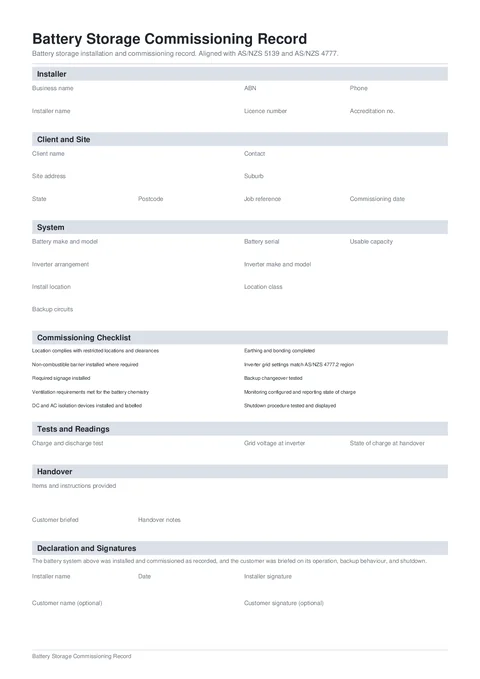
This record captures a battery storage install as one PDF: equipment identity, AS/NZS 5139 location assessment, ten commissioning checks, charge and discharge results, customer handover, and signatures. You prepare it when the system is ready for final testing, then keep it with the job file, warranty pack, and any network or scheme paperwork. It does not replace the electrical compliance certificate required where the work was done, and it does not validate compliance for you.
This is a Tradie Forms designed record, not a government form. There is no official layout to match, so the PDF is a clean single-page commissioning record of the installer's assessment, checks, tests, and handover.
Commissioning a solar array rather than battery storage? Use Solar Commissioning
Have the plate data, location decision, and test readiness sorted before you open the form. Guessing serial numbers or location class after you leave site is how these records come back wrong.
Battery and inverter identity
Make, model, serial, usable capacity, and arrangement from the nameplates or commissioning pack, not from the quote.
Install location and class decision
Where the unit sits on site and the AS/NZS 5139 location class you assessed, with clearances, barriers, ventilation, isolation, and signage checked.
Backup circuit list
Which circuits stay live in an outage, if backup is configured, so the discharge test and handover match.
Test and meter readiness
System ready for charge, discharge, backup changeover, monitoring, and shutdown checks, plus a meter for grid voltage at the inverter.
Handover pack
Manuals, warranty docs, monitoring access, shutdown procedure, and fire emergency information ready to give the customer.
Installer licence and accreditation
Electrical licence and any scheme accreditation numbers that identify who commissioned the system.
Business name, installer name, client name, commissioning date, battery make and model, inverter arrangement, install location, location class, the three test fields, customer briefed, and the declaration name and date gate the download.
Your business and the installer who commissioned the system. These details sit at the top of the single-page PDF.
Business Logo (Shown top right on the downloaded record)PhotoOptional
Optional logo placed top right on the finished PDF. Use the same brand mark as your compliance certificates so the job file looks consistent.
Business NameTextRequired
Trading name that owns the install, for example Bright Spark Energy Pty Ltd. Use ABN lookup to fill the business name and ABN, then confirm both match the entity on the job paperwork.
ABNTextOptional
Eleven-digit ABN for that business. ABN lookup can fill it from the business name, or fill the name from the ABN. Leave blank rather than inventing a number.
Installer NameTextRequired
Person who commissioned the system, as you want it on the record, for example Alex Smith. This is the installer identity at the top of the PDF, separate from the declaration name later.
Licence NumberTextOptional
Electrical licence number as printed on the card, for example EC 12345. Fill it whenever the customer or scheme pack expects it.
Accreditation No.TextOptional
Scheme or accreditation number where the job needs it, for example SAA 123456. Leave blank when none applies.
PhoneTelOptional
Number that reaches the business or installer for follow-up, for example 0412 345 678.
Save this section as Business to prefill it on your next battery commissioning job.
Who owns the install, when you commissioned it, and where it sits. Address search is Australia-wide and fills the street line, suburb, state, and postcode together.
Client NameTextRequired
Customer or site owner name as you file the job, for example Sam Taylor. Match the name on the quote, invoice, or handover pack so copies land with the right person.
ContactTextOptional
Phone or email that reaches them after you leave, for example sam.taylor@example.com or 0412 345 678.
Job ReferenceTextOptional
Your internal job number, for example BESS-24072. Useful when the same client has more than one system or site.
Commissioning DateDateRequired
Date the commissioning tests were done. Today and Yesterday shortcuts are available. Future dates are not accepted, so you cannot date the record ahead of the tests.
Street addressAddressOptional
Install site street line. Use address search, then check the result against the job sheet, because search returns the current postal address and a job can predate a street rename or subdivision.
StateAddressOptional
Filled by address search. Confirm it when typing by hand so network and compliance paperwork for that jurisdiction stay aligned.
PostcodeAddressOptional
Filled by address search. Confirm against the job sheet when typing manually.
Identifies the battery, how it connects, where it is installed, and which circuits it backs up. Take plate values from the equipment, not from the sales quote.
Battery Make and ModelTextRequired
Full make and model from the nameplate or commissioning pack, for example Tesla Powerwall 3. Do not shorten to the brand alone; warranty and support need the model.
Useful
Tesla Powerwall 3
Too vague
Tesla battery
Battery SerialTextOptional
Serial from the unit plate, for example PW3-24072001. Photograph the plate if the sticker is hard to read later.
Usable CapacityTextOptional
Usable energy as stated by the manufacturer or commissioning pack, for example 13.5 kWh. Prefer usable capacity over nominal when both are published.
Inverter ArrangementComboboxRequired
How the battery couples to the site: Integrated (all-in-one), Separate hybrid inverter, or AC-coupled to existing solar. You can type a custom value when none of the presets fit. The choice tells a later reader whether to expect a separate inverter model.
Inverter Make and ModelTextOptional
Separate inverter make and model when the battery is not an all-in-one unit. Helper text on the form says this is optional when the battery is integrated. Leave blank for a true all-in-one rather than typing N/A.
Install LocationTextRequired
Exact place on the property, for example Garage external wall or South wall of laundry, non-habitable. Vague answers like Outside do not help a later service visit or an assessor reading the file.
Location ClassComboboxRequired
AS/NZS 5139 location class you assessed for this install. Presets include Outdoors against a wall, Garage or non-habitable room, and Dedicated enclosure; you can type a custom class when needed. This field records your decision. The form does not judge whether that location complies.
Backup CircuitsTextOptional
Circuits supplied during an outage when backup is configured, for example Lights, fridge, garage door. Leave blank when no backup is fitted, and keep the list consistent with the discharge test and handover briefing.
Ten installation and commissioning checks. Answer every row with Yes, No, or N/A. Use Yes when the item was completed and verified, No when it was not met (a short note is required), and N/A only when the item does not apply, such as grid settings on an off-grid system or backup testing where no backup is fitted. Notes are limited to 62 characters on the PDF, so keep them concrete. Each row writes as the result, or result · note when a note is present.
Commissioning ChecklistChecklistOptional
The ten checks, in form order: location complies with AS/NZS 5139 restricted locations and clearances; non-combustible barrier installed where required; required signage installed (battery, shutdown, fire information); ventilation requirements met for the battery chemistry; DC and AC isolation devices installed and labelled; earthing and bonding completed; inverter grid settings match AS/NZS 4777.2 region (N/A if off-grid); backup changeover tested (N/A if no backup); monitoring configured and reporting state of charge; shutdown procedure tested and displayed at the equipment. Bulk pass is available when every item is a genuine Yes. For manufacturer-specific ventilation treatment, record the result and note the basis used.
A row left blank will stop a clean completion later even though the checklist block does not sit in the same required-field list as client name. Treat unanswered checks as unfinished work, not as optional detail.
Measured and observed results from commissioning. The charge and discharge narrative is limited to about 120 characters on the PDF, so write the outcome, not a full test log.
Charge/Discharge TestTextareaRequired
What you ran and what happened, for example charge reached and whether nominated backup circuits discharged correctly. Keep it concrete enough that a later reader can see the system was exercised.
Useful
Charged to 100%; backup circuits discharged correctly
Too vague
OK
Grid Voltage at InverterTextRequired
Voltage measured at the inverter during commissioning, with units, for example 238 V. Take it from the instrument at the time of test, not from a design value.
State of Charge at HandoverTextRequired
Battery state of charge when you handed the system to the customer, for example 82%. Use the value the monitoring or local display showed at handover, not an earlier mid-test reading.
What the customer received and whether they were briefed. Tick only what you actually provided or explained on this job.
Items ProvidedCheckbox groupOptional
Optional ticks for Manuals and warranty documents provided, Shutdown procedure explained and displayed, Monitoring app configured, Backup behaviour explained, and Fire emergency information displayed. Only ticked items appear as a compact list on the PDF. Leave a box clear when that item does not apply or was not done.
Customer BriefedChoiceRequired
Yes or No. Choose Yes only when the customer (or their nominated site contact) was walked through operation, backup behaviour, and shutdown. A No still downloads, so treat it as a deliberate status, not a skip.
Handover NotesTextareaOptional
Follow-ups or limits the customer should know, limited to about 120 characters on the PDF, for example Customer completed the shutdown and backup changeover walkthrough. Leave blank when the ticks and briefing answer are enough.
Installer sign-off for the record. The PDF states that the battery system was installed and commissioned as recorded, and that the customer was briefed on its operation, backup behaviour, and shutdown. Sign after the checks and tests match what you are prepared to put on the job file.
Installer NameTextRequired
Name of the installer signing the declaration, for example Alex Smith. Match the person who commissioned the system. This is separate from the installer name in the Installer section at the top of the form.
DateDateRequired
Date of the declaration. Today and Yesterday shortcuts are available. Future dates are not accepted. Use the day you sign the record, which is often the commissioning date but does not have to be.
Installer SignatureSignatureOptional
Installer signature for the declaration. Capture it on site when you can. You can use a saved signature. Layout treats this as part of a complete sign-off even though an empty signature does not always block download the same way name and date do.
Customer NameTextOptional
Customer name on the signature block when they sign, for example Sam Taylor. Optional helper text on the form confirms this can stay blank.
Customer SignatureSignatureOptional
Optional. Capture it on the spot, or send the finished PDF with a share link for later signing. Only include it when the customer (or site contact) actually signs.
Quotes are raised early and often use a different model or capacity than what was delivered. Take make, model, serial, and usable capacity from the nameplate or commissioning pack on site.
Recording location class from habit instead of this site.
AS/NZS 5139 location rules are site-specific. Write the class you assessed for this install, with the install location precise enough that a later visit can find the unit.
Marking N/A on checks that were simply not done.
N/A is for items that do not apply, such as backup testing with no backup fitted. Incomplete work is No, with a short note, not N/A.
Writing OK in the charge and discharge result.
The PDF has limited space, but it still needs a concrete outcome: charge reached and whether backup circuits behaved. OK tells a later reader nothing.
Leaving customer briefed as Yes when only a manual was left.
Briefed means a walkthrough of operation, backup behaviour, and shutdown with the customer or their site contact. Documents alone are the handover ticks, not the briefing answer.
Using mid-test state of charge as the handover value.
State of charge at handover is what the display or monitoring showed when you finished with the customer, not an earlier charge-cycle reading.
Filing this PDF as the only electrical paperwork.
This record is the installer's commissioning file. It does not replace the electrical compliance certificate, network paperwork, or scheme forms required for the job.
Give a copy to the customer and keep one with the job file.
File it with the full pack. Keep warranty documents, network or scheme paperwork, monitoring setup notes, and the electrical compliance certificate required where the work was done in the same folder. The commissioning record alone does not show compliance status.
Name the file so the system is obvious. Prefer something like Battery commissioning - Sam Taylor - 2026-07-28.pdf over a generic site-only name when the client has more than one system.
Keep plate photos with the record. Serial and model disputes are faster to settle with a nameplate photo than from memory.
Track follow-ups from handover notes. If briefing, monitoring access, or a backup walkthrough is still outstanding, note it against the job so it is not lost after download.
Check the current network, retailer, and scheme requirements for your job. Retention and lodgement expectations sit with those processes, not with this record.