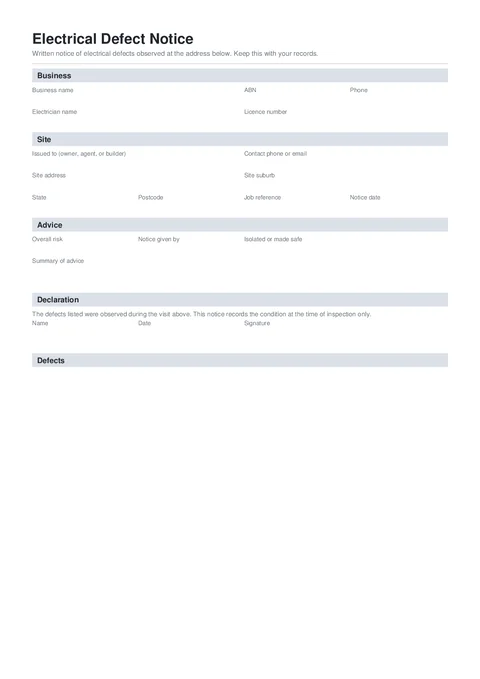
Records electrical defects found on a visit so the owner, agent, or builder has a clear written notice of what was found, the risk, any make-safe action, and what should happen next. You issue it as the licensed electrician who inspected the installation, and you leave with a signed PDF for the client and the job file. Measuring stick for non-compliance is AS/NZS 3000 (the Wiring Rules) as applied under the electrical safety rules in the state or territory where you work.
This is a Tradie Forms designed record, not a government form. There is no official layout to match, so the PDF is a clean notice that grows extra pages as you add defects and photo evidence.
Recording a visual assessment of an existing switchboard rather than putting defects into a standalone notice? Use Switchboard Report
Confirm first that a standalone defect notice suits the job. Some jurisdictions, networks, or urgent hazards need a different form or a report to the authority. Then gather what you need on site so the notice is filled from what you saw, not from memory later.
Who can act on the defects
The owner, agent, builder, or other person in control of the installation. Tenants and site contacts often cannot authorise repairs.
Site identity
Full address, and which board, building, or meter when a property has more than one installation.
Each defect while you can see it
Plain-language condition, exact location, and risk rating written at the board or fitting, not back in the ute.
Make-safe outcome
What you isolated, tagged, or left in service, and any verbal advice already given.
Photos that show the fault
Clear shots of the defective item and its location before you close the board or leave the roof space.
Your licence details
Business name, electrician name, and licence number ready to stand behind the assessment.
Nine fields gate the download: business name, electrician name, issued to, notice date, at least one complete defect, overall risk, isolated or made safe, declaration name, and declaration date. High and Extreme defects also need a recommendation. Signature is expected on a finished notice even when the form does not treat it as a schema gate in the inventory.
Who is issuing the notice. These details sit at the top of the PDF so a client, quote electrician, or inspector can see who found the defects and how to reach them.
Business Logo (Shown top right on the downloaded notice)PhotoOptional
Upload a clean JPG or PNG. It stamps top right on the downloaded notice. Skip it if you do not have a usable file on the phone; blank is better than a stretched screenshot.
Business NameTextRequired
The trading or legal name the client already knows you by. Use ABN lookup from the name when you want the ABN filled from the register, then check the result against your invoices and licence card.
ABNTextOptional
From your ABN record or a current invoice. Use ABN lookup on this field to fill the business name, or the other way around from Business Name. Confirm the returned entity matches the licensed business on this job, not a related group company.
Electrician NameTextRequired
The licensed person who inspected the installation and stands behind the risk ratings and advice. Use the name on the licence, not a workshop nickname.
Licence NumberTextOptional
The number on your electrical licence card, for example EC 12345. Fill it whenever you have it: a defect notice is a licensed person's assessment, and the number is what backs the name when the client or an inspector follows up.
PhoneTelOptional
A number that reaches the electrician or the office for repair follow-up, for example 0412 345 678. Prefer a mobile that is answered on site days over a switchboard that only takes messages.
Save this section as Business to prefill it on your next defect notice for this business.
Who received the notice, when you gave it, and which installation the defects sit on. Getting Issued To right is what makes the notice actionable: state electrical safety rules place obligations on the person in control of unsafe equipment, so name the person who can authorise repairs.
Issued ToTextRequired
The person responsible for the installation: owner, agent, property manager, or builder. Do not put only a tenant who cannot authorise work. If the person who called you is not the decision-maker, still name the responsible person and say in the advice who else needs a copy.
Useful
Harbourview Property Management
Too vague
Priya at the unit
Contact Phone or EmailTextOptional
How to reach that person for repair follow-up, for example Priya Nair, 02 4955 0100 or an email that is monitored. Without it, the notice is harder to act on after you leave.
Job ReferenceTextOptional
Your work order, quote, or job number, such as HV-24071. Use the same reference on any separate rectification quote so the safety record and the commercial document stay linked in the file without being the same document.
Notice DateDateRequired
The day you gave the notice. Today and Yesterday shortcuts are there for on-site issue. The field does not accept a future date, so you cannot pre-date a notice for a visit that has not happened.
Street addressAddressOptional
The installation address. Address search works Australia-wide and fills the street line, suburb, state, and postcode. Check the result when the property has multiple boards, meters, or buildings, and name the specific installation in the defect locations if the street address alone is ambiguous.
StateAddressOptional
Fills from address search. Confirm it when you type the address by hand, because the state decides which electrical safety rules and reporting paths apply.
PostcodeAddressOptional
Fills from address search. Edit it only when the search result is wrong or you entered the street line without search.
The core of the notice. Add one card per defect observed during the visit. Leave unused cards out rather than adding blanks. Long defect lists continue onto extra PDF pages. The notice records the condition observed during the visit; it does not certify that no other defects exist.
Each card uses Defect, Location, Risk Rating, and Recommendation, plus optional photos. High and Extreme risk force a recommendation before download. There is no row duplicate action on this form; add a new card for each finding.
Defects ObservedRowsRequired
Add at least one complete defect. Fill the card while the board or fitting is still open so the location and condition match what you can see.
Defect - the condition in plain English. Name the item and what is wrong so the next person can walk to it and see what you saw. Energy Safe Victoria guidance on documenting defects is a useful shape: accurate, legible, plain English, naming the item, location, and detail of the defect.
Location - exactly where it was found, specific enough on a multi-board site that nobody has to guess which board or space, for example Roof space above kitchen or Main switchboard, meter cupboard.
Risk Rating - Low, Medium, High, or Extreme. Low is a minor non-compliance worth noting. Medium should be repaired but is not an immediate danger (for example no RCD protection on power circuits). High and Extreme carry a real risk of fire or electric shock and usually need isolation until repair.
Recommendation - what should happen next. Required when the risk is High or Extreme. Write the next step a non-electrician can act on, such as rewiring, isolation until repair, or installing RCD protection. Do not put prices here; keep quotes separate from the safety record.
Photos - up to 3 per defect. The first appears beside the defect on the notice. Extra photos are added as evidence pages. Shoot the fault with enough context that the client and the next electrician see the same thing without a return visit.
Useful
Deteriorated rubber-insulated cabling in the roof space above the kitchen; High; rewire affected circuits before re-energising
Pulls the visit together after the individual defects: the highest risk on the installation, how you left the site, how the notice was delivered, and a short written summary for the client.
Overall RiskSelectRequired
The highest risk across the defects listed: Low, Medium, High, or Extreme. Do not rate the overall notice lower than any single defect. The PDF prints this as the summary risk for the visit.
Isolated or Made SafeComboboxRequired
How the installation was left when you walked away. Choose a suggested value or type your own. Suggested values are Isolated and tagged out, Made safe, repair required, Left in service, monitor, and No immediate hazard. For an unsafe defect, isolation and tagging is the expected path. If you choose Left in service, monitor against a High or Extreme defect, review the notice carefully before you sign, because you are recording that a serious fault was left energised.
Notice Given ByComboboxOptional
How you delivered the notice: In person on site, Phone, Email, or Left at premises, or type another method. Recording delivery cuts later argument about whether the responsible person was told.
Summary of AdviceTextareaOptional
The main next step in plain language: circuits isolated, work needed before re-energising, and who should act. Keep it short; the PDF allows about 220 characters, and longer text is truncated. Energy Safe Victoria's sample defect letter is a useful shape: name the unsafe wiring or equipment, urge correction by a licensed electrical contractor, and ask for the relevant safety certificate after repair when that applies in your state.
Useful
Roof space circuits isolated at the switchboard. Obtain a repair quote before re-energising.
Too vague
Needs attention
Review a High or Extreme notice carefully when the site was left in service. Making the installation safe comes before paperwork when there is immediate danger; record the isolation on this section after the hazard is controlled.
You stand behind the assessment. Sign after the defects, ratings, and advice are complete and correct, not before.
NameTextRequired
The person issuing the notice, usually the same licensed electrician named in Business. Use the name you put on other electrical paperwork for this business.
DateDateRequired
The day you signed. Today and Yesterday shortcuts are available. The field does not accept a future date.
SignatureSignatureOptional
The licensed person's mark that the listed defects were observed during the visit and that the notice records the condition at that time. Sign last, once every High or Extreme defect has a recommendation and the made-safe status matches what you left on site. You can use a saved signature; check the preview so the stamp sits cleanly in the signature box.
Addressing the notice to someone who cannot authorise repairs.
A tenant or site contact often cannot approve isolation follow-up or board work. Name the owner, agent, or builder who is in control of the installation, and say who else needs a copy.
Writing vague defects such as dodgy wiring.
The next electrician and the client cannot find or prioritise the fault. Name the item, the observed condition, and the exact location.
Leaving High or Extreme defects without a recommendation.
The form blocks download until those defects have a next step. Write the repair or isolation action while you are still at the board.
Setting overall risk lower than the highest defect.
A Medium overall risk with an Extreme defect on the list misrepresents the visit. Match overall risk to the worst finding.
Leaving a serious fault in service without recording why.
If supply stays on against a High or Extreme defect, the made-safe field and the advice summary need to say so clearly, and you should be sure that is the right call before you sign.
Bundling prices into the defect notice.
A safety warning that also quotes the fix is easy for a client to read as an upsell. Keep the notice as the safety record and issue the rectification quote as a separate document with the same job reference.
Filling the notice later from memory without photos.
Locations blur, risk ratings soften, and there is no evidence for the client or the next electrician. Capture each defect and a photo before you leave site.
Give the signed notice to the responsible person and keep a copy against the job with the photos and any test notes that support it.
Name the file so the site and date are obvious, for example Defect notice - 12 Wharf Road - 22 Jul 2026.pdf.
Record how it was delivered. If you emailed it, keep the email with the job. If you handed it over on site, note that with the notice date.
Keep quotes separate. Use the same job reference on any rectification quote so the pair sits together without merging safety wording and prices into one PDF.
Follow any separate process. Isolation of unsafe equipment, network or regulator reporting, and certificates after repair sit outside this notice. Check the current requirements for the state or territory where the installation is.
Energy Safe Victoria publishes a sample installation defect letter for Victorian electricians. For work elsewhere, check the relevant state or territory regulator. Reporting obligations for unsafe installations differ between jurisdictions.