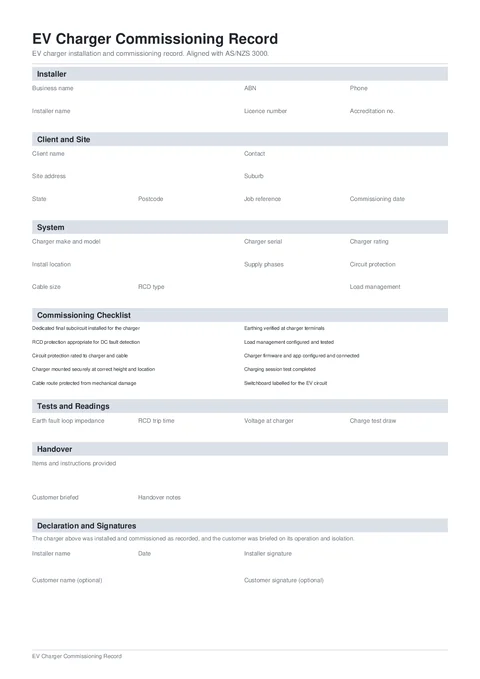
Records the EV charger, circuit protection, commissioning checks, measured readings, customer handover, and installer sign-off in one PDF for the customer and your job file. Electricians complete it when the charger is ready for final testing, after the install and protection work, so the site leaves with a clear record of what was fitted and tested. It is not a certificate of electrical safety and does not replace the compliance certificate required where the work was done.
This is a Tradie Forms designed record, not a government form. There is no official layout to match, so the PDF is a clean commissioning report of the charger identity, protection, checks, readings, and handover.
Commissioning a solar PV system rather than an EV charger? Use Solar Commissioning
Commissioning a battery storage system rather than an EV charger? Use Battery Commissioning
Almost every incomplete EV commissioning record comes from filling it after you have left site without the plate, test instrument readings, or handover materials in hand. Have these ready.
Charger identity and instructions
Make, model, serial, rating, and the manufacturer's installation instructions, including any built-in DC fault protection statement.
Circuit and protection details
Supply phases, circuit protection rating, cable size, RCD type fitted, and how load management is set up on this charger.
Test equipment and a charge session
Your loop and RCD tester, a multimeter or equivalent for voltage at the charger, and a vehicle or suitable test adapter for the charge test.
One charger decision
Create one record per charger. On multi-charger sites, name each install location so the PDFs cannot be mixed up later.
Handover materials
Operating instructions, app access, warranty documents, isolation procedure, and load-management behaviour to brief the customer on.
Sixteen fields gate the download: business and installer names, client name, commissioning date, charger make and model, install location, supply phases, RCD type, load management, the four measured readings, customer briefed, and the declaration name and date. Answer every checklist item as well; an empty Yes, No, or N/A blocks the PDF.
Identifies the electrical business and the installer named on the record header. These details print at the top of the finished PDF so the customer and any later reader can see who commissioned the charger.
Business Logo (Shown top right on the downloaded record)PhotoOptional
Optional logo for the top right of the PDF. Use a clear horizontal image; check the preview so it is not cropped.
Business NameTextRequired
Trading name of the electrical business commissioning the charger, as you want it on the customer PDF. Use ABN lookup from this field to fill the ABN when you have the name. Example: Bright Spark Electrical Pty Ltd.
ABNTextOptional
Eleven-digit ABN for the business. Use ABN lookup to fill the business name when you start from the ABN instead. Leave blank only when the customer does not need it on this record.
Installer NameTextRequired
The licensed person who carried out the install and commissioning checks, for example Alex Smith. This is the name in the header, separate from the declaration signature block later.
Licence NumberTextOptional
Electrical licence number in the format your state issues, such as EC 12345. Include it when the customer, builder, or network paperwork expects a licence on the record.
Accreditation No.TextOptional
Scheme or manufacturer accreditation when the job needs it, for example SAA 123456. Leave blank rather than inventing a number.
PhoneTelOptional
Contact number for follow-up on the install, app setup, or a retest. A mobile that reaches the installer or office is enough.
Save this section as Business to prefill it on your next EV charger commissioning record.
Captures who the record is for, when commissioning happened, and where the charger sits. Fill this so the PDF can be filed against the right job without opening the photos.
Client NameTextRequired
The customer or site contact the record is prepared for, as they expect to see it on the PDF, for example Sam Taylor or Harbour View Apartments Pty Ltd.
ContactTextOptional
Phone or email for handover follow-up. Useful when the person briefed on site is not the same as the client name on the invoice.
Job ReferenceTextOptional
Your job, work order, or quote number, such as EV-24072. Helps match this PDF to the compliance certificate and warranty file.
Commissioning DateDateRequired
The day the commissioning checks and readings were completed. Today and Yesterday shortcuts are there for on-site work. The field does not accept a future date.
Street addressAddressOptional
Site street line. Address search works Australia-wide and fills the street line, suburb, state, and postcode together. Confirm the result when the site is a new estate or a multi-building complex.
StateAddressOptional
Filled by address search. Confirm it when you type the address by hand, because the compliance certificate path depends on the state.
PostcodeAddressOptional
Filled by address search. Confirm it against the job file when typing manually.
Identifies the charger, where it is mounted, and the protection and load-management setup you assessed. Create one record per charger so serials, locations, and readings cannot be mixed.
Charger Make and ModelTextRequired
From the charger nameplate or packaging, specific enough to reorder parts or check a firmware note later. Include the generation when the maker uses one, for example Tesla Wall Connector Gen 3, not only Tesla charger.
Charger SerialTextOptional
Serial from the nameplate. Fill it whenever it is readable; it is how warranty and manufacturer support identify this unit.
Charger RatingTextOptional
Rated capacity as marked or configured, with phase context when it helps, for example 7 kW single phase or 22 kW three phase.
Install LocationTextRequired
Exact mount location on the site so a later sparkie can find the same unit without a phone call. Name the building, level, bay, or wall face when there is more than one charger or parking space.
Useful
Garage, left wall beside roller door
Too vague
Garage
Supply PhasesSelectRequired
Single phase or Three phase, matching the supply the charger is connected to, not the house main if they differ.
Circuit ProtectionTextOptional
Protective device for the charger circuit, for example 32 A MCB. Take it from the switchboard, not from memory of the design.
Cable SizeTextOptional
Conductor size and type used for the final subcircuit, for example 6 mm² twin and earth. Useful when the next person needs to confirm capacity.
RCD TypeComboboxRequired
RCD protection actually fitted for this circuit, checked against the charger's built-in DC fault detection. Suggested values are Type A + DC detection in charger, Type B RCD, and Type A RCD, or type a custom value when the install uses another compliant combination. Wrong RCD type is the highest-risk entry on this section.
Load ManagementComboboxRequired
How the charger is prevented from overloading the supply: None, Static limit, Dynamic load management, or a short custom description of the scheme used. Choose None when no load management is fitted; do not leave this blank.
The form records the protection and setup you assessed. It does not validate the design against AS/NZS 3000 or the charger instructions.
Ten fixed installation and commissioning checks. Each item takes Yes, No, or N/A. The inventory treats the checklist block as optional as a whole, but every item must still have a result before download, and every No needs a short note (62 characters or fewer on the PDF).
The checks are:
Dedicated final subcircuit installed for the charger
RCD protection appropriate for the charger's DC fault detection
Circuit protection rated to charger and cable
Charger mounted securely at correct height and location
Cable route protected from mechanical damage
Earthing verified at charger terminals
Load management configured and tested (N/A if none)
Charger firmware or app configured and connected
Charging session test completed with a vehicle or test adapter
Switchboard labelled for the EV circuit
Commissioning ChecklistChecklistOptional
Use Yes when the item was completed and verified on this job. Use No when it was not met, and add a short note that says what failed or what remains. Use N/A only when the item does not apply, such as load management on a charger with None selected above. Bulk pass is available when every item is a clean Yes; re-check the N/A rows before you use it. Notes for No results print on the PDF, so write them for the next reader, not as private shorthand.
Records the four measured values from the commissioning session. Enter what the instrument showed, with units, so the finished PDF is readable without the instrument screenshot.
Earth Fault Loop ImpedanceTextRequired
Measured earth fault loop impedance at the charger circuit, for example 0.6 ohm or 0.6 Ω. Use the reading and unit your tester reports; do not copy a design maximum in place of a measurement.
RCD Trip TimeTextRequired
Measured trip time from the RCD test, such as 28 ms at the test current you used. Enter >300 when that is what the instrument reported.
Voltage at ChargerTextRequired
Supply voltage measured at the charger terminals during commissioning, for example 236 V. On three phase, note the value you rely on for the record, or the range if you record more than one phase in the notes elsewhere.
Charge Test DrawTextRequired
Power drawn during the commissioning charge test with a vehicle or test adapter, for example 6.8 kW. This is the observed draw, not only the nameplate rating.
Records what the customer received and whether they were briefed before you left. Tick only what actually happened on this job.
Items ProvidedCheckboxesOptional
Tick each item completed: Operating instructions provided, App configured for the customer, Warranty documents provided, Isolation procedure explained, and Load management behaviour explained. Leave a box unticked when it does not apply or was not done; do not tick ahead of the conversation.
Customer BriefedChoiceRequired
Yes or No. Choose Yes only when someone on site received the operating and safety briefing. Choose No when handover was documents-only or the customer was absent, and say so in the notes.
Handover NotesTextareaOptional
Follow-up the customer or the next installer needs, such as app login still pending or a retest date. The PDF holds about 120 characters here, so keep it short and concrete, for example Customer completed test charge and app sign-in.
Installer sign-off for the commissioning record, with an optional customer name and signature. The declaration name and date are required before download.
Installer NameTextRequired
Name of the person signing the commissioning record. Usually the same person as the header installer name; re-enter it here when the signatory differs from the installer named above.
DateDateRequired
Date of the installer sign-off. Today and Yesterday shortcuts are available. Do not use a future date.
Installer SignatureSignatureOptional
Signature that stands behind the checks and readings. Capture it on site or use a saved signature, then check the preview so it sits cleanly in the signature box.
Customer NameTextOptional
Customer name when they sign the record, for example Sam Taylor. Leave blank when only the installer is signing.
Customer SignatureSignatureOptional
Optional customer acknowledgement. Capture it on the spot, or send the finished PDF with a share link for later signing. The record can download without it.
Choosing RCD type from habit instead of the charger instructions.
EV supply equipment needs DC fault protection matched to what the charger already provides. Read the charger documentation and the RCD actually fitted before you pick Type A, Type B, or Type A + DC detection in charger.
One PDF covering every charger on a multi-bay site.
Serials, locations, and readings get mixed, and a later fault cannot be tied to one unit. Create one record per charger and put the bay or wall face in Install Location.
Marking load management N/A when a static or dynamic limit is active.
The checklist item is only N/A when load management is genuinely none. If you selected Static limit or Dynamic load management on System, the checklist should be Yes or No after you test it.
Entering design values instead of instrument readings.
Loop impedance, trip time, voltage, and charge draw are measured results. A design maximum or nameplate rating in those boxes misleads the next person who trusts the PDF.
Leaving No results without a note.
A bare No tells the customer something failed without saying what. Add a short note for every No before download.
Vague install location on multi-charger sites.
Garage or Car park does not identify which unit was commissioned. Name the wall, bay, or apartment so the PDF matches the hardware.
Ticking Customer Briefed Yes when only documents were left.
Briefed means someone on site received the operating and isolation explanation. Use No and a handover note when the customer was not present.
Give the finished PDF to the customer and keep a copy with the job file, warranty documents, instrument results, and the electrical compliance certificate required where the work was done. Tradie Forms does not lodge this record with any network, scheme, or safety authority.
Name the file so the charger is obvious. On multi-charger sites, include the location or serial, for example EV commissioning - 12 Wharf Rd - garage left.pdf.
File it with the compliance certificate and test screenshots. The commissioning PDF alone does not prove the legal certification path for the state.
Keep manufacturer warranty and app account details with the same job folder so a later service call does not start from a blank.
Reuse the Business saved detail on the next EV commissioning job, then re-check the installer name and licence before you download.
Check the current state and network requirements for the install. Retention and any scheme paperwork sit with the certificates those schemes require, not with this record alone.