Documentation page
Documentation page
Help for electricians completing an RCD test record in Tradie Forms.

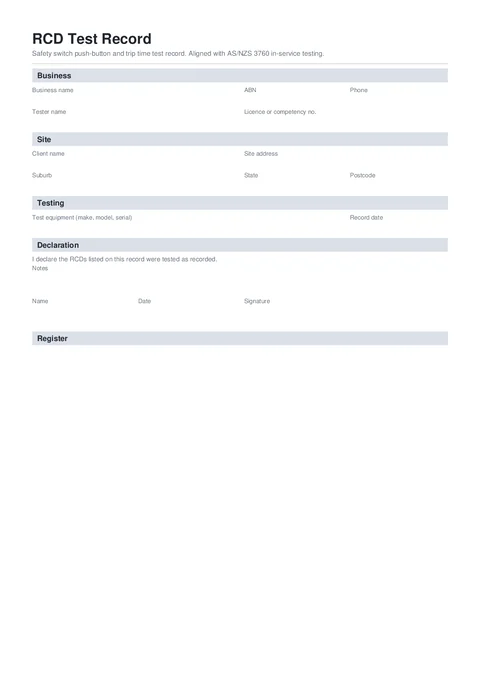
Records push-button and trip time testing of residual current devices, aligned with AS/NZS 3760. Add each RCD as you test it, capture the result, and download a signed PDF for the client and your job file. Testing frequencies and acceptable results depend on the RCD, test method, workplace, jurisdiction, and applicable standard.
This is a Tradie Forms designed record, not a government form. There is no official layout to match, so the PDF is a clean register that grows extra pages as you add RCDs.
Client and site details
Who you tested for, and the address of the board or equipment under test.
Licence or competency details
Include them when the client or site requires them on the test record.
RCD tester identity
Make, model, and serial of the instrument you will use, plus any verification date you keep for calibration.
Testing basis and retest interval
The standard or site procedure for this visit, and the interval that applies to push-button versus trip-time checks in this environment.
Board and circuit labels
Enough identity to find each RCD again: board name, circuit numbers, or face labels, especially on multi-board sites.
A decision on visit type
Push-button only, trip time, or both. That choice drives which readings go on each row and how you set next-due dates.
Five fields gate the download on an empty form: Business Name, Tester Name, Record Date, declaration Name, and Date. Every RCD you add also needs its own identity, readings, and outcome before the PDF will download.
Your business and tester details. These fill the record header on every page of the PDF.
Upload your logo if you want it on the finished PDF. It lands top right on the downloaded record.
Your trading name as the client and site file should recognise it. Use ABN lookup to fill the business name and ABN together when you have either value.
Optional trading number. ABN lookup fills the matching business name when you enter a valid ABN.
The person who did the testing. This is the name the declaration can mirror later with Same as tester above.
Fill when the client, principal contractor, or site procedure wants a licence or competency reference on the record. Leave blank rather than inventing a number.
Contact number for follow-up or retest bookings. Useful when the site will call you about a fail or a next-due visit.
Save this section as Business to prefill it on your next RCD test record.
Who and where the record covers. Keep this tied to the job so multi-board sites do not blur together later.
The business or person you tested for. On construction sites this is often the principal contractor or the site manager who keeps the electrical file.
Your work order, purchase order, or site job number. It also appears in the PDF register summary, so use the same reference you put on photos and other records for this visit.
Use address search for the site address. It fills the street line, suburb, state, and postcode for Australia-wide sites. Confirm the result against the site entry or job sheet when the postal address differs from the worksite name.
Instrument, testing basis, retest helper, and the date this record covers.
Make, model, and serial of the RCD tester used, for example Metrel MI 3152, SN 21054411. Take it from the instrument label or your calibration sheet so the next person can see which kit produced the readings.
Last calibration or verification check for that instrument. The form will not accept a future date. It also appears in the PDF register summary when filled.
The date this record covers. Use Today or Yesterday on site. No future date is accepted. This is the register date on the finished PDF header, separate from each row's test date when you retest over more than one day.
The standard or site procedure used for the work. Common picks are AS/NZS 3760:2022, AS/NZS 3760:2022 + site procedure, or workplace and electrical safety regulations. You can type a site-specific basis. State the basis that matches the checks you actually did so the next tester does not treat a push-button visit as a full trip-time round.
Suggests the next-due date when you add a new register row: 6 months, 12 months, or 2 years. Push-button tests are often more frequent than trip time tests. Treat the suggested next-due date as a helper and check it against this visit type and environment before download.
One card per residual current device. This is the body of the record: identity, type and rating, push-button and trip time results, overall pass or fail, dates, and fail actions.
The register itself is optional if you open the form and download with no RCDs, but every row you add has its own required fields. Leave unused rows out rather than adding blanks.
What one row is. One RCD or circuit you tested on this visit: fixed board RCD, socket RCD, or portable RCD on a lead set.
RCD ID / Circuit and Location - required on each row. Use a label the next person can walk to, including the board name on multi-board jobs. MSB RCD 2, circuits 5-8 at Main switchboard beats kitchen RCD when the site has three kitchens.
MSB RCD 2, circuits 5-8
Safety switch downstairs
Description - optional detail about what the RCD protects, for example Main switchboard RCD or Portable RCD on extension set.
RCD Type and Rating - required. Type is Fixed RCD, Socket RCD, or Portable RCD (or a custom value). Rating is the residual current in mA from the device face, such as 30. Type and milliamps matter when someone later judges a trip result against the right limit.
Push-Button Test - required. Mechanical trip on the test button: Pass or Fail.
Trip Time - optional in milliseconds at rated current, such as 24. Leave it blank for a push-button-only check. Enter >300 when the instrument reports that the device did not trip inside its measurement window. Do not invent a trip time from memory or from a photo of the screen later.
Result - required Pass or Fail for the overall outcome of this row. Mark Fail when push-button, trip time, or both failed against the basis you are using.
Test Date - required. Defaults to today on new rows and can carry forward from the previous row. Use Today while you are still at the board.
Next Due - required when Result is Pass. Suggested from the default retest interval and the test date. Edit it so it matches the interval for this visit type and environment. A pass with no next-due date leaves the site guessing when the device is up again.
Action taken and failure details - required when Result is Fail. Action options include Isolated and tagged out, RCD replaced, Scheduled for repair, and Client notified. Put what failed and what you did in the note, for example that trip time exceeded the applicable limit and the unit was isolated pending replacement. Optional fail photos are available when you want supporting evidence.
Duplicate copies description, type, rating, and location. It clears the RCD ID, result, test readings, dates, actions, and notes so you do not reuse another device's outcome by accident. New rows can also carry the previous location and test date.
The PDF shows each RCD as a stacked record rather than a wide table: identity and result on the first line, button and trip readings with dates on the second, action and notes on the third. Long registers continue across pages with one footer and page count.
Fill each row while the device and instrument are still in front of you. Finish one board before you start the next on multi-board sites.
Sign off the record after the register is closed. The declaration confirms the listed RCDs were tested as recorded.
Anything the client or site file should see at record level, such as RCDs replaced on site or a portable unit isolated and tagged out. Keep per-device detail on the row; notes are for the visit summary. The PDF notes field is limited to about 220 characters, so put long failure narratives on the row that failed.
Who is signing the record. Use Same as tester above when the signatory is the tester named in Business.
Copies Tester Name into Name and locks the name field while it is on. Turn it off if someone else is signing.
The date you sign. Today and Yesterday shortcuts are available. No future date is accepted.
Sign on screen, upload an image, or use your saved signature. Add it after the register is complete so you are not signing a half-finished fail list.
Writing trip times later from memory or a photo of the screen.
Milliseconds get rounded, boards get swapped, and a fail lands on the wrong circuit. Enter the reading while the instrument still shows it, or leave trip time blank for a push-button-only visit.
Vague RCD identity on multi-board sites.
Kitchen RCD cannot be matched when the site has three kitchens and four boards. Put the board name plus circuit or face label on every row, not only the first.
Treating a push-button visit as a full trip-time round.
Auditors and the next tester then apply the wrong expectation to next-due dates. State the testing basis, always capture push-button, fill trip time only when you measured it, and set next due from the interval that applies to the check you actually did.
Passing an RCD without a next-due date.
The site then has no driver for the next visit. Set the default retest interval for this visit type, then confirm next due on every pass before you sign.
Recording a fail with no action.
A fail with an empty action leaves an open safety question about whether the circuit is still live. At the moment of fail, record isolated and tagged out, replaced, scheduled for repair, or client notified, plus the failure detail.
Skipping type or rating from the device face.
Without Fixed, Socket, or Portable and the mA rating, the next person cannot judge a trip result against the right limit. Read the face every time, including portable RCDs on lead sets that look identical until you check the label.
Batching every board into one write-up at the end of the day.
Sub-boards get missed, circuit labels collide, and the PDF implies a full site round that never happened. Finish one board's rows before you open the next.
Give a copy to the client or site manager who keeps the workplace electrical file, and keep one with your job records. Tradie Forms does not lodge RCD records with any regulator.
RCD - 12 Wharf Rd Newcastle - 2026-07-14.pdf is easier to find than a generic download name when the next visit is six months away.Check AS/NZS 3760:2022, the site procedure, and your state or territory regulator for the testing and record requirements that apply to this workplace.
Portable appliances and leads under the same AS/NZS 3760 family of records.
Visual board assessment and defects when the job is not an RCD test visit.
How in-service inspection and testing records sit under AS/NZS 3760.
The regulator publications this guide is based on. Always check the current official form before you lodge.
Emergency Lighting Test Register
Help for electricians completing an emergency lighting test register in Tradie Forms.
Smoke Alarm Service Record
Help for electricians completing a smoke alarm service record in Tradie Forms.