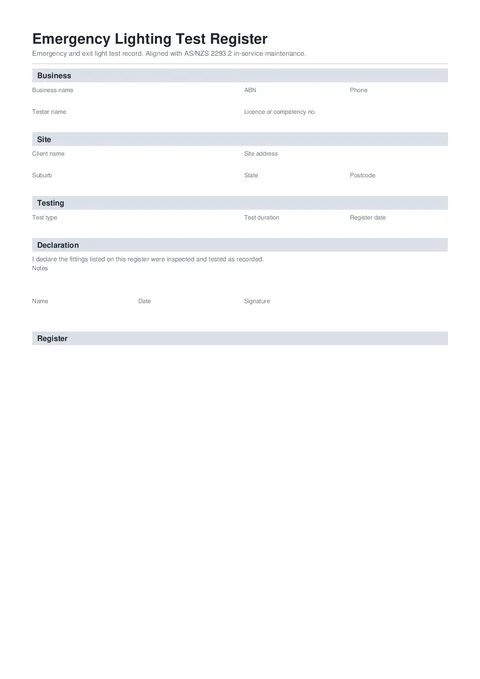
This register records discharge testing of exit and emergency lights, aligned with AS/NZS 2293.2. You log each fitting as you test it, record the result, and download a signed PDF for the client and your records. The standard expects a discharge test at least every six months; confirm the current standard, building requirements, and site procedure for the interval and duration that apply.
This is a Tradie Forms designed record, not a government form. There is no official layout to match, so the PDF is a clean register that grows extra pages as you add fittings.
Almost every thin register comes from writing it up later from memory instead of at the fitting. Have these ready before you open the form.
Licence or competency details
Your business name, tester name, and licence or competency number if the client or site expects them on the record.
Client and site
Who the register is for and the building address so the finished PDF files against the right property.
Fitting list or asset schedule
IDs, descriptions, and locations for every emergency and exit fitting on this service, so none are missed.
Test type and rated duration
Six-monthly discharge, twelve-monthly, or commissioning, and the minutes each fitting must sustain on battery.
Retest interval decision
The interval the building uses for next-due dates, usually six months under AS/NZS 2293.2, before you accept any suggested date.
Access and isolation plan
How you will interrupt supply for the discharge test, and who has authorised the outage if the building is occupied.
Seven fields gate the download on an empty form: Business Name, Tester Name, Test Type, Test Duration, Register Date, declaration Name, and declaration Date. Every fitting you add also needs a complete result line before download.
Your business and tester details. These fill the register header so anyone reading the PDF can see who stood behind the results.
Business Logo (Shown top right on the downloaded register)PhotoOptional
Upload a clean JPG or PNG of your logo. It stamps top right on the finished PDF. Skip it rather than using a stretched screenshot.
Business NameTextRequired
Your trading name as the client knows it. Use ABN lookup to fill the ABN when you search by name, then check the result against your licence record if the group structure can return a related entity.
ABNTextOptional
From your ABN record or letterhead. ABN lookup can fill the business name from the number. Include it when the client or managing agent files registers by contractor.
Tester NameTextRequired
The competent person who did the discharge testing, for example Alex Smith. This is the name that has to stand behind every result on the register.
Licence or Competency No.TextOptional
Electrical contractor licence or other competency reference when the client or site procedure requires it, for example EC 12345. Leave blank only when the site does not ask for it.
PhoneTelOptional
A number the client can use for retest bookings or follow-up on failed fittings. Mobile is usually better than a desk line you will not answer from site.
Save this section as Business to prefill it on your next emergency lighting register.
Who and where this register covers. Managing agents often file by building, so a wrong suburb or half-written address is hard to match later.
Client NameTextOptional
The business, body corporate, or person you tested for, such as Harbourview Constructions. Fill it whenever the client is not obvious from the site address alone.
Job ReferenceTextOptional
Your job, work order, or site reference, for example HV-24088. It does not sit on the static header of the PDF; it appears in the register page summary so you can still match the file to the job.
Street addressAddressOptional
The building where the fittings sit. Address search works Australia-wide and fills the street line, suburb, state, and postcode. Check the result against the building schedule, because search returns the current postal address and a schedule can use a tower or campus name.
StateAddressOptional
Filled by address search. Confirm it when you type the address by hand.
PostcodeAddressOptional
Filled by address search. Confirm it against the building record when typing manually.
Frames every fitting result that follows: what kind of service this was, how long fittings had to hold, and the date of the register.
Test TypeComboboxRequired
Choose 6 monthly discharge test, 12 monthly discharge test, or Commissioning test, or type a custom value when the site procedure uses different wording. AS/NZS 2293.2 requires a discharge test at least every six months for routine service; pick the option that matches the work you actually did.
Test DurationNumericRequired
Rated minutes the fittings must sustain on battery, such as 90. This value also becomes the default Minutes Sustained on each new fitting row, so set it before you start adding fittings. Change a row when a fitting is rated differently.
Register DateDateRequired
The date this service covers, usually the day you walked the building. Today and Yesterday shortcuts are there for on-site close-out. The field does not accept a future date. Next service is measured from this date, so do not use the day you typed the paperwork if that is later.
Testing BasisComboboxOptional
The standard or procedure you worked to. Suggested values include AS/NZS 2293.2:2019, AS/NZS 2293.2:2019 + site procedure, and AS/NZS 2293.2 (in-service maintenance). Fill it so a later reader can tell this was a full discharge service, not a lamp-only check.
Default Retest IntervalSelectOptional
6 months or 12 months. Used only to suggest Next Due on new pass rows. It is a date helper, not a compliance decision. Override any suggested next-due date when the building schedule or applicable requirement is different.
Every emergency and exit fitting inspected on this service. One card is one fitting. There is no row cap: add as many fittings as the building needs. Leave unused cards out rather than padding blanks.
Add a card with Add fitting as you finish each unit. New cards can carry forward the previous Location and Test Date, and prefill Minutes Sustained from Test Duration above. Duplicate copies description, fitting type, minutes sustained, and location, and clears fitting ID, result, dates, action, and notes so you do not accidentally reuse a pass.
On the finished PDF each fitting is a stacked record (identity and result on the first line, type and duration with dates on the second, action and notes on the third). Long lists continue onto extra pages with the same footer and page count. Optional fail photos land on a photo-evidence appendix, not inside the register rows. Job reference, test type, duration, and testing basis also print in the register summary on those pages.
The register field itself does not block download when empty, but a register with no fittings is useless to the client. Every fitting you add must be complete before download: ID, description, location, type, minutes sustained, result, and test date; passes need next due; fails need action and failure details.
Fitting RegisterAssetRegisterRowsOptional
Each Fitting card holds:
Fitting ID - your reference for the unit, for example EX-014 or the number on the building schedule. Without a stable ID, identical exit signs cannot be found next round.
Fitting Description - what the unit is, such as Maintained LED exit sign. Specific enough that the next tester can pick it from a corridor of similar signs.
Location - where it sits, for example Level 1 lobby or Fire stair 2, above door 2.14. This is what the next person walks to in six months.
Fitting Type - Exit sign, Emergency batten, Oyster, Spitfire, Floodlight, or a custom type when the schedule uses different names.
Minutes Sustained - how long the fitting held illumination on battery during the discharge test, such as 90. Enter the measured hold time, not a tick. A pass with a blank duration does not show the discharge test happened. New rows default from Test Duration.
Result - Pass or Fail. Pass means the fitting held to the required duration at the required level. Fail means it dropped out early or did not perform.
Test Date - the day that fitting was tested. Defaults to today on new rows; change it when you are closing out a multi-day walk.
Next Due - required on a pass. The date the fitting is due again. Suggested from Default Retest Interval when set; always check it against the building schedule before you leave it.
Action taken - required on a fail. Choose Battery replaced, Lamp or fitting replaced, Scheduled for repair, Client notified, or type the real action when none of those fit.
Failure details - required on a fail. What failed and what happens next, for example that it only held 40 minutes and a battery replacement is booked. Optional photo evidence can be attached on a fail; it prints on a photo appendix page.
Useful
EX-014, maintained LED exit sign, Level 1 lobby east end above door 1.04, Exit sign, 90 min, Pass, next due six months out
Sign-off for the whole register. Complete every fitting line first; signing early is how blank durations and missing next-due dates slip through.
NotesTextareaOptional
Anything the client should know that is not already on a fitting line: batteries replaced on site, fittings that could not be reached, or a return visit booked. The PDF truncates long notes around 220 characters, so keep them short and specific.
NameTextRequired
Who is declaring the service. Use Same as tester above when that person is the tester named in Business; the name field then mirrors Tester Name and locks until you turn the toggle off.
Same as tester aboveMirrorFieldsOptional
Copies Tester Name into Name. Turn it off when someone else is signing the register.
DateDateRequired
The date of the declaration, usually the day you finish the walk. Today and Yesterday shortcuts are available. The field does not accept a future date.
SignatureSignatureOptional
Sign on screen or drop in a saved signature. The signature attests that the listed fittings were inspected and tested as recorded. Check the preview so it sits cleanly in the declaration box.
A pass with no hold time does not show the discharge test happened. Enter the measured minutes, even when the fitting obviously held for the full rating.
Failing a fitting with no action or failure details.
A fail with no next step is a problem with no owner. Choose the action taken and write what failed so the unit is being dealt with, not forgotten.
Leaving next due blank on a pass.
Without a next-due date the six-monthly cycle stops on that fitting. Set the date as you close each pass, then check the suggestion against the building schedule.
Writing the register later from memory.
Corridors get missed, durations get guessed, and IDs swap between identical exit signs. Log each fitting at the fitting while the timing is in front of you.
Vague identity with no location.
Exit sign is unusable the moment the building has more than one. Use a fitting ID from the schedule and a location the next tester can walk to.
Accepting every suggested next-due date.
The interval is only a helper. Building schedules, tenancy rules, and commissioning follow-ups can demand a different date than six or twelve months from today.
Missing fittings that are on the building schedule.
An inspector will compare fitting count and locations to the schedule. Walk the list, not only the units that were easy to reach.
Give a copy to the client or site manager and keep one with the site or job records. Records of testing should be kept on site and made available for auditing. Tradie Forms does not lodge this register with any authority.
Name the file with the site and date so it files against the right building, for example Emergency lighting - 12 Wharf Rd Newcastle - 2026-07-14.pdf.
File it with the building's emergency lighting schedule so the next service starts from a complete list rather than a rebuild from memory.
Track failed fittings to close-out until battery replacement, retest, or client acceptance is done. The PDF alone does not fix a failed unit.
Carry forward IDs and locations on the next six-monthly round so fitting references stay stable across services.
Check AS/NZS 2293.2:2019, current building requirements, and the site maintenance plan for the testing and record-keeping rules that apply to this building.