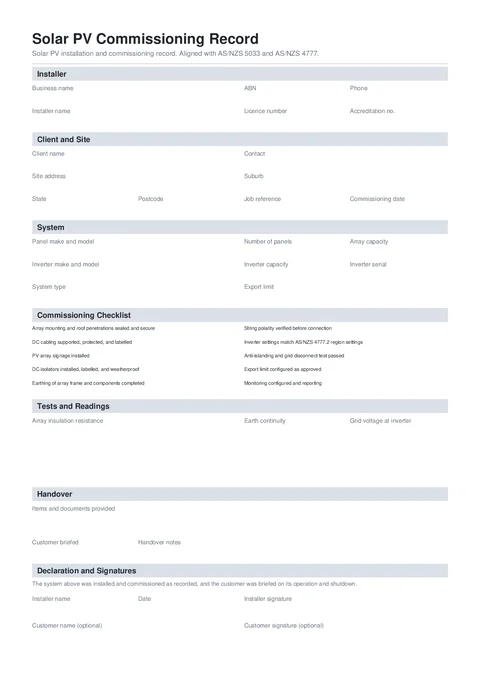
This record keeps the installed solar PV system, commissioning checks, per-string readings, customer handover, and signatures in one PDF. The installer fills it when the array and inverter are ready for final testing, and the finished file sits with the job, warranty pack, and network paperwork. It is not a certificate of electrical safety, network approval, or STC assignment form.
This is a Tradie Forms designed record, not a government form. There is no official layout to match, so the PDF is a clean report that grows extra pages as you add string rows.
Commissioning a battery storage system rather than the solar array? Use Battery Commissioning
Almost every incomplete solar commissioning PDF comes from filling it after leaving site. Have these in front of you before you open the form.
Panel and inverter identity
Make, model, quantity, array capacity, inverter capacity, and inverter serial from the plates and packing labels, not from the quote alone.
Network export limit
The approved export limit for the site when the network has set one. Leave the field blank only when the system is unlimited.
Test equipment and readings
Insulation resistance, earth continuity, grid voltage at the inverter, and Voc and Isc for every string, taken with the instruments you used on site.
System type decision
Grid-connect, grid-connect with battery, or off-grid, matching what was actually installed.
Handover pack
Manuals, warranty documents, shutdown and isolation steps, monitoring access, and the network or meter application status to brief the customer on.
Business and installer details
Trading name, ABN, electrical licence, solar accreditation number, and phone as they should appear on the record.
Fourteen fields gate the download: business and installer names, client name, commissioning date, panel and inverter make and model, system type, the three array readings, at least one PV string row, customer briefed, and the declaration installer name and date.
Identifies the business and the person commissioning the system. These values print at the top of the PDF and should match your electrical compliance certificate for the same job.
Business Logo (Shown top right on the downloaded record)PhotoOptional
Upload a clear JPG or PNG. It stamps into the top-right logo slot on the finished PDF. Skip it if you do not have a clean file on the phone; blank is better than a stretched screenshot.
Business NameTextRequired
Your trading name as customers and the network know it. Use ABN lookup to fill the business name and ABN together when you have the number. Check the result against your licence, because a group structure can return a related entity.
ABNTextOptional
From your ABN record or letterhead. ABN lookup can fill this from the business name, or fill the name from the number. Confirm it matches the entity that did the install.
Installer NameTextRequired
The person who commissioned the system, for example Alex Smith. Use the same spelling you will use again in Declaration and Signatures so the header and sign-off read as one person.
Licence NumberTextOptional
Your electrical licence number as printed on the card, such as EC 12345. Fill it whenever the network or customer expects it on the job file.
Accreditation No.TextOptional
Clean Energy Council or equivalent solar accreditation number when the install requires it, for example SAA 123456. Leave blank on work that does not use that scheme rather than inventing a number.
PhoneTelOptional
A number that reaches the installer or office for follow-up on this job.
Save this section as Business to prefill it on your next solar commissioning job.
Pins the record to one customer, one site, and one commissioning day. Get these from the job booking and the address on the network paperwork, not from memory after the ute leaves.
Client NameTextRequired
The customer or site contact the system was commissioned for, for example Sam Taylor. Match the name on the job and warranty pack so the PDF files with the right install.
ContactTextOptional
Email or mobile for handover follow-up, such as sam.taylor@example.com or 0412 345 678.
Job ReferenceTextOptional
Your internal job or work-order number, for example SOL-24072. Useful when the client name is common and you need to find the file later.
Commissioning DateDateRequired
The day commissioning tests were completed on site. Today and Yesterday shortcuts are there because this is usually filled the same day. The field does not accept a future date.
Street addressAddressOptional
The install address. Address search works Australia-wide and fills the street line, suburb, state, and postcode together. Check the result against the network application, because search returns the current postal address and a new estate can lag.
StateAddressOptional
Filled by address search. Confirm it when typing the address by hand, especially near a state border.
PostcodeAddressOptional
Filled by address search. Confirm it against the network or meter paperwork when entering manually.
Identifies the panels, inverter, connection type, and export arrangement actually installed. Copy from nameplates and the approved design, not from an early quote that may have changed.
Panel Make and ModelTextRequired
The module make and model on the panel label, specific enough that a future service call can order the same part. Include wattage when the label shows it.
Useful
Trina Vertex S+ 440W
Too vague
Trina panels
Number of PanelsTextOptional
Count of modules installed, such as 20. Fill it whenever the array is more than a single string so capacity can be checked against the design.
Array CapacityTextOptional
Total DC array capacity as installed, for example 8.8 kW. Use the units you would put on the network paperwork.
Inverter Make and ModelTextRequired
From the inverter nameplate, for example Fronius Primo GEN24 8.0. Do not shorten to brand only; model is what warranty and settings depend on.
Inverter CapacityTextOptional
AC rating of the inverter, such as 8 kW.
Inverter SerialTextOptional
Serial number on the inverter plate, for example FRN-24072001. Capture it before the cover goes back on if the plate is hard to reach later.
System TypeComboboxRequired
Choose Grid-connect, Grid-connect with battery, or Off-grid, or type a custom value when none of those fit. Match what is on the roof and at the switchboard, not what was quoted. For hybrid installs, complete the battery side on the Battery Commissioning record as well.
Export LimitTextOptional
The network-approved export limit for this site, for example 5 kW. Leave blank when the system is not limited. If you configured a limit in the inverter, the figure here should match that setting and the approval letter.
Records ten installation and commissioning checks against the array, cabling, protection, and inverter settings. Answer every item with Yes, No, or N/A. The form records what you verified; it does not decide whether the install complies with AS/NZS 5033 or AS/NZS 4777.2.
Commissioning ChecklistChecklistOptional
The ten items are: array mounting and roof penetrations sealed and secure; DC cabling supported, protected, and labelled; PV array signage at switchboard, meter box, and inverter; DC isolators installed, labelled, and weatherproof; earthing of array frame and components; string polarity verified before connection; inverter settings match AS/NZS 4777.2 region settings; anti-islanding and grid disconnect test passed; export limit configured as approved (N/A if unlimited); and monitoring configured and reporting.
Use Yes when the item was completed and verified. Use No when it was not met, and add a short note (62 characters or fewer) explaining the result. Notes print next to the result on the PDF. Use N/A only when the item genuinely does not apply, such as export limit on an unlimited system. Bulk pass is available when every remaining item is a clear Yes; do not bulk-pass items you have not checked.
Captures the measured commissioning results and one row per PV string. Enter values as your instrument reported them, with units, so a later reader does not have to guess.
Array Insulation ResistanceTextRequired
Measured insulation resistance of the array, for example >1 MΩ or the instrument reading in megohms. Use the same format your tester shows so the PDF matches the tool memory.
Earth ContinuityTextRequired
Measured earth continuity of the array bonding path, for example 0.12 Ω.
Grid Voltage at InverterTextRequired
Voltage measured at the inverter AC terminals during commissioning, for example 238 V. Take it at the inverter, not at a distant outlet.
PV StringsTableRowsRequired
One row per PV string. Add a row with Add string. You can add up to 50 rows; long lists continue onto extra PDF pages. Leave unused rows out rather than adding blanks. Duplicate copies the row so you can adjust only the string id and readings. Columns are:
String - which string this is, for example String 1 or East roof A.
Voc - measured open-circuit voltage, for example 445 V.
Isc - measured short-circuit current, for example 13.9 A.
Expected Voc - optional design or calculated Voc, for example 448 V, when you want the comparison on the record.
At least one string row with String, Voc, and Isc is required before download. Check the preview when you have many strings so pagination and units still read cleanly.
Records what the customer received and whether they were briefed. Tick only what actually left with them on the day.
Items ProvidedCheckboxGroupOptional
Tick each item the customer received: Manuals and datasheets provided, Warranty documents provided, Shutdown and isolation procedure explained and displayed, Monitoring app configured for the customer, and Network or meter application status explained. Unticked items print as not provided, so leave a box clear when it was not done rather than guessing.
Customer BriefedRadioGroupRequired
Yes or No. Choose Yes only when you walked the customer through shutdown, isolation, monitoring, and any live network or meter steps. Choose No when briefing is still outstanding and use Handover Notes to say what remains.
Handover NotesTextareaOptional
Anything the customer or the next visit needs to know, for example monitoring login details still to send, or a network application still pending. The PDF field holds about 120 characters; keep it short and concrete.
Installer sign-off for the commissioning record, with optional customer name and signature. Sign when the checks, readings, and handover answers are correct, not as a blank stamp before testing.
Installer NameTextRequired
The person signing the record. Match the spelling used in Installer so the header and sign-off agree, for example Alex Smith.
DateDateRequired
The date the installer signs. Usually the same as Commissioning Date when you sign on site. Today and Yesterday shortcuts are available. The field does not accept a future date.
Installer SignatureSignatureOptional
The installer's signature on the record. Capture it on site when you can, or use a saved signature. Check the preview so the signature sits cleanly in its box.
Customer NameTextOptional
The customer who acknowledges the handover, when they are available to sign, for example Sam Taylor.
Customer SignatureSignatureOptional
Optional. Capture it on the spot, or send the finished PDF with a share link for later signing. Leaving it blank does not block download.
Quotes change before install. Take make, model, quantity, and serial from the plates on the gear you commissioned.
Leaving System Type on grid-connect when a battery is fitted.
Hybrid installs need Grid-connect with battery here, and a separate Battery Commissioning record for the storage side.
Writing an export limit that does not match the approval.
The figure on the PDF should match the network approval and the inverter setting. A wrong limit looks like a failed commissioning when the next person audits the file.
Bulk-passing checks that were not verified.
Bulk pass is for a clean run of real Yes answers. An unchecked export limit or monitoring item marked Yes becomes a false record.
Marking No without a note.
Every No needs a short note (62 characters or fewer) so the PDF shows what failed. Download blocks until the note is there.
Combining several strings into one row.
One row is one string. Merged rows hide which string drifted and make retest impossible without going back on the roof.
Ticking Customer Briefed Yes when only a brochure was left.
Briefed means you walked through shutdown, isolation, monitoring, and network status. Use No and a handover note when that conversation still has to happen.
Signing before readings and checks are finished.
The signature sits on a complete record. Save a draft if you need to leave site, then sign when the last Voc and checklist answers are in.
Give the finished PDF to the customer and keep a copy with the job file, warranty documents, network and retailer paperwork, and the electrical compliance certificate required where the work was done.
Name the file so the site is obvious.Solar commissioning - 12 Wharf Rd Newcastle - 2026-07-28.pdf is easier to find than a generic download name.
File string photos and instrument screenshots with the PDF when you took them. The readings alone do not show probe points or string layout.
On hybrid installs, keep the battery commissioning record in the same job folder so the solar and storage sides stay one package.
Track outstanding handover items. If Customer Briefed is No, or monitoring access is still pending, note the follow-up against the job so it is not lost after payment.
Check current network, retailer, and scheme requirements for your state. Retention and lodgement for those certificates sit with those processes, not with this record alone.