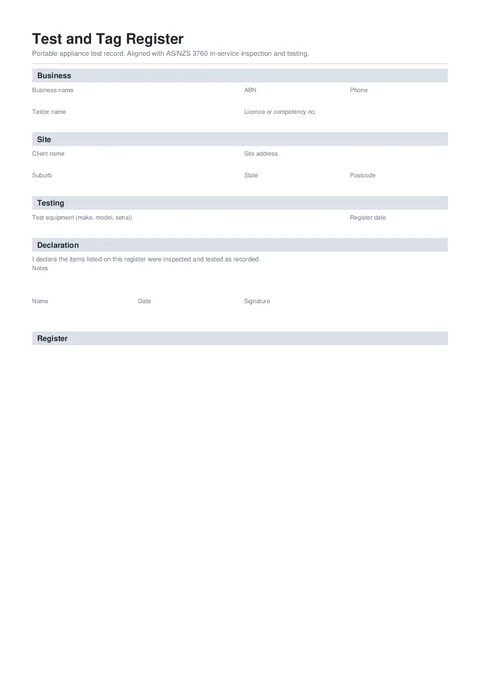
This register records in-service inspection and testing of portable appliances, leads and related gear, aligned with AS/NZS 3760. You fill one row per item as you test it, then download a signed PDF for the client and your job file.
This is a Tradie Forms designed register, not a government form. There is no official layout to match, so the PDF is a clean register that grows extra pages as you add assets.
Need the SafeWork NSW Housing Industry Site Safety Pack electrical test and tag register (Form 08) for a residential construction site pack, not a multi-page fleet register? Use NSW WHS Test and Tag Register
Almost every incomplete register comes from typing it later from memory instead of from the gear and instrument readings in front of you. Have these ready.
The equipment you will test this round
Tools, leads, portable appliances and other plant that belong on this register, with tag numbers, serials or plates you can read off the item.
Your PAT tester details
Make, model and serial of the instrument in use, plus its last calibration or verification date if you record that on registers.
Business and tester identity
Trading name, ABN if you put it on client paperwork, your name, and licence or competency number when the client or site requires it.
Client and site
Who the register is for and the address the testing covers, plus any job or work-order reference.
Environment, basis and retest interval
Construction, office, hire and similar environments drive different cycles. Confirm the standard or site procedure and the interval you will use for next-due dates before you open the first row.
Tag colour for this period
Only if the site colour-codes tags by quarter or cycle. Leave it blank when the site does not use colour periods.
Five fields gate the download on an empty form: Business Name, Tester Name, Register Date, Name and Date. Each asset you add also needs a result and test date; every pass needs a next-due date; every fail needs an action and failure details.
Captures who tested the gear and which business stands behind the register. These values fill the PDF header on every page.
Business Logo (Shown top right on the downloaded register)PhotoOptional
Upload your logo when the client expects branded paperwork. It stamps top right on page 1 of the finished PDF. Skip it when you are only keeping an internal record.
Business NameTextRequired
Your trading name as the client and site know it, for example Bright Spark Electrical Pty Ltd. Use ABN lookup on the business name to fill the ABN when you have one on record. Match letterhead and previous registers for the same client so their file reads as one contractor.
ABNTextOptional
Eleven digits in the usual spaced form, such as 12 345 678 901. Fill it when client or principal paperwork expects it. ABN lookup can fill the business name from a known ABN and the other way around.
Tester NameTextRequired
The competent person who did the inspection and testing on this register, for example Alex Smith. This is the name that has to stand behind the results, not a dispatcher or office contact.
Licence or Competency No.TextOptional
Electrical contractor licence, test-and-tag competency reference, or whatever the client or site procedure asks for. Include it when they check competence on the PDF. Leave blank rather than inventing a number.
PhoneTelOptional
A contact number for retest bookings or questions about a fail, such as 0412 345 678.
Save this section as Business to prefill it on your next test and tag register.
Identifies who and where the testing covers. The header on the PDF shows client, job reference and site address so the register cannot be filed against the wrong job.
Client NameTextOptional
The business or person you tested for, for example Harbourview Constructions. Fill it whenever the PDF will leave your van. Without it, the register is hard to file in a multi-contractor site pack.
Job ReferenceTextOptional
Work order, PO or internal job number such as HV-24071. Useful when the same client has several sites or rounds on the same day.
Street addressAddressOptional
The site where the equipment was tested, not your workshop unless that is where the round happened. Address search is Australia-wide and fills the street line, suburb, state and postcode. Check the result against the job sheet when the site is a new estate or a multi-building complex.
StateAddressOptional
Filled by address search. Confirm it when you type the address by hand.
PostcodeAddressOptional
Filled by address search. Confirm it against the job record when typing manually.
Records the instrument, the rules you tested under, and the date this register covers. Set these before the first asset so new rows can suggest a sensible next-due date.
Test EquipmentTextOptional
Make, model and serial of the PAT tester used on this round, for example Metrel DeltaPAT 3309, SN 20481234. Clients and auditors use this to tie readings to a known instrument.
Tester Verification DateDateOptional
Last calibration or verification check on that instrument. The field does not accept a future date. Fill it when your procedure or the client expects proof the tester was in date.
Register DateDateRequired
The date this register covers, usually the day of the round. Today and Yesterday shortcuts are there for on-site fill. The field does not accept a future date.
Work EnvironmentComboboxOptional
Suggested values include Construction, Manufacturing, Service work, Office and Hire equipment, or type a site-specific label. This is the environment you use to pick the retest interval. A soft office interval on a construction site is the common way a whole fleet ends up overdue.
Testing BasisComboboxOptional
The standard or site procedure you worked to. Suggestions include AS/NZS 3760:2022, AS/NZS 3760:2022 + site procedure and AS/NZS 3012 (construction sites). Construction, demolition and mining rounds usually need the construction basis, not office AS/NZS 3760 alone.
Default Retest IntervalSelectOptional
Options are 3 months, 6 months, 12 months, 2 years and 5 years. New asset rows use this to suggest Next Due from the test date. Always check each suggested date against the environment and site rules before you download.
Tag ColourComboboxOptional
Colour period for construction and mining colour-code systems, for example Blue for this quarter. Leave blank when the site does not use colour tags. The value appears in the PDF summary band with the job and environment.
The PDF summary on the register pages also shows job reference, work environment, testing basis, tag colour and instrument verification date when you filled them. Dates print in Australian format.
One card per appliance or lead. Add each item with Add asset while it is still in your hands so the tag, readings and result stay aligned.
You can add up to 50 assets on one register. Leave unused rows out rather than padding blanks. New rows can carry forward Location and Test Date from the previous card, and the default retest interval suggests Next Due. Use Duplicate for similar gear: it copies description, manufacturer, model, serial, equipment type, class and location, and clears the tag ID, result, readings, actions, notes and photos so you do not stamp yesterday's pass onto the next lead.
On the finished PDF each item is a stacked record (identity, dates, readings, action and notes), not a single-line table row. Long registers continue onto extra pages with the same record layout, a footer showing the business name, and a page count. Optional fail photos go into a photo appendix rather than squeezing into the main row. Check the preview so long notes and multi-page lists still read cleanly.
Asset RegisterAssetRegisterRowsOptional
Each Asset card is one tested item. The form does not force you to add rows before download, but a register with no assets is useless on site. Columns on the card, and what the PDF record shows, are:
Asset ID - your tag or asset number, for example TT-0041. Match it to the physical tag so next quarter's tester can find the same item.
Description - what the item is, specific enough to pick it from a rack, for example Angle grinder or Extension lead 15m heavy duty. Required on every row you add.
Location - where the item lives or is used, such as Workshop bench 2 or Van 1. Carries forward to the next new row so a rack of tools stays consistent.
Result - Pass or Fail. Required on every row. A blank result is unfinished work.
Test Date - the day this item was inspected and tested. Defaults to today on new rows. The field does not accept a future date. Required on every row.
Next Due - required when the result is Pass. The default retest interval suggests a date from the test date; edit it when that item needs a different cycle. On a fail that is out of service, prefer a clear action over a next date that implies the item is still in the fleet.
Equipment Identity - manufacturer, model, serial number, equipment type and class. Fill serial whenever the plate or moulding carries one so identical leads can be told apart.
Inspection and Test Results - visual inspection, polarity, earth continuity (Ω), insulation resistance (MΩ), leakage current (mA), RCD push-button and trip time (ms) where those tests apply. Only enter readings for tests you carried out. Do not invent a number to fill a box. Examples of realistic readings: earth 0.18, insulation >200, trip time 24.
Failed items - when result is Fail, choose Action Taken (for example Tagged out and removed from service, Sent for repair, Disposed of, Client notified), add failure details in Note, and set Retest Status when useful. Photos of the fail are optional and land in the PDF appendix.
Useful
TT-0042; Extension lead 15m heavy duty; HPM; EL-88314; Fail; Tagged out and removed from service; damaged insulation near plug
Too vague
Lead; Fail
Every durable tag on a tool needs a matching row here with the same identity trail and next test date. Record fails as well as passes; a pass-only list hides the work the register is meant to prove.
Sign off the register before download. This is who stands behind the completed PDF.
NotesTextareaOptional
Anything the client should know in one place, such as items withdrawn from service or gear left for repair. The PDF caps this block at about 220 characters, so keep it short and put detail on the failed rows. Example: Failed lead withdrawn from service and client advised on site.
NameTextRequired
Who is signing the register. Usually the same person as Tester Name. Turn on Same as tester above to copy that name automatically so the two cannot drift.
Same as tester aboveMirrorFieldsOptional
Copies Tester Name into Name and locks the name field while the toggle is on. Use it when the tester is the signatory.
DateDateRequired
The date of sign-off. Today and Yesterday shortcuts are available. The field does not accept a future date. It can differ from Register Date when you finish the PDF the morning after the round.
SignatureSignatureOptional
Draw, upload or use a saved signature. Layout treats this as part of the sign-off block, and the image stamps on the declaration area of the PDF. Sign when the results and fail actions are correct, not as a blank stamp before the last row is done.
Serials swap, fails lose their isolation note, and the PDF no longer matches the tools. Complete each row while the item is still in front of you.
Setting an office interval on a construction site.
Portable equipment on construction and demolition work is typically on a three-month cycle under AS/NZS 3012-related rules. A twelve-month next date puts the tag and the register out of step with the site.
Vague descriptions with no asset ID or serial.
Ten orange leads all entered as Extension lead cannot be found next quarter. Put a tag number on the row and capture the serial or model on the item.
Pass with no next-due date.
A pass without a retest date leaves the site guessing when the tag expires. Set Default Retest Interval in Testing, then confirm Next Due on every pass before download.
Fail with no action or isolation note.
A fail that still looks available for use is the hazard the register is meant to close. Choose Action Taken, write what failed in Note, and take the item off the work face.
Inventing readings for tests you did not run.
Empty earth or insulation fields are honest when that test did not apply. A made-up number is not. Only enter values the instrument actually reported.
Using this national register for the HISSP Form 08 pack.
NSW Housing Industry Site Safety Pack sites need the official SafeWork NSW Form 08 layout and its twelve-row table. Use that form for the pack, and use this register for multi-page fleet or non-HISSP work.
Give a copy to the client or site manager and keep one with the job records. Tradie Forms does not lodge this register with a regulator.
Name the file with the client and date so it sits with other rounds for the same site, for example Test and Tag - Harbourview - 2026-07-13.pdf.
File it with the test equipment verification record when you keep calibration certificates for the PAT tester. The register alone does not prove the instrument was in date.
Track failed items to repair or disposal. A fail row is not isolation. Keep the physical quarantine until repair and retest, then record the return as a fresh pass with a new next-due date.
Reuse the Business saved detail on the next round, then re-check tester name, site and retest interval before you add new assets.
Check AS/NZS 3760:2022, the site procedure, and your state or territory regulator for the requirements that apply. Retention and competence rules sit with the workplace and the authority, not with this page.