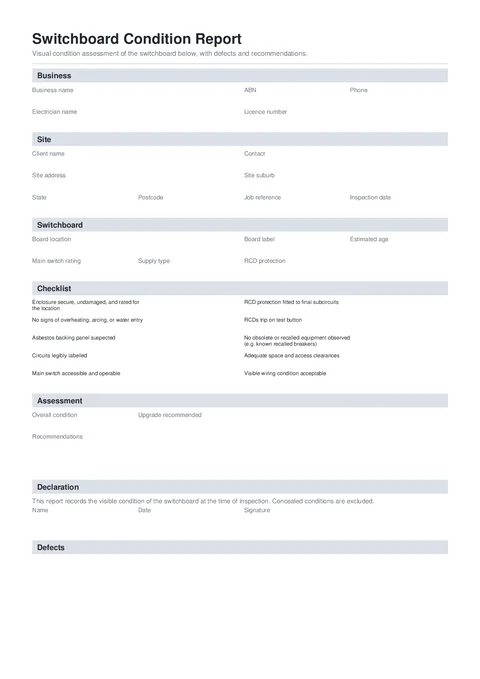
Records a visual assessment of an existing switchboard: what you checked, defects with risk and photos, and the work you recommend to the client. A licensed electrician completes it on site for pre-purchase checks, landlord files, or to sit behind a quote for board work. The finished PDF is a signed condition report for the client and your job file, not a certificate of compliance.
This is a Tradie Forms designed report, not a government form. There is no official layout to match, so the PDF is a clean report that grows extra pages as you add defects and photos.
Issuing a written defect notice to the owner, agent, or builder rather than a board condition report? Use Defect Notice
Weak reports come from filling them in the ute from memory. Gather these before you open the cover.
Client, site, and inspection date
Who engaged the visit, the property address, and the day you inspected.
Which board you are assessing
Location, any board label, and how many boards are on site so the report cannot be filed against the wrong one.
Board plate and visible supply details
Main switch rating, supply type, and any age or RCD coverage you can read without dismantling the board.
Clear photos before you change anything
As-found shots of the board face, labelling, and any defect you will list.
A decision on the next document
Whether this job also needs a defect notice, compliance certificate, or full periodic verification under AS/NZS 3019.
Your business and licence details
Business name, electrician name, and licence number as you want them on the PDF header.
Business name, electrician name, client name, inspection date, board location, overall condition, the Yes or No board-work recommendation, declaration name, and declaration date gate the download. Answer all ten checklist items in practice even though the form will not block on an empty checklist alone.
Puts your identity on the report header so the client and any later reader know who stood behind the assessment.
Business Logo (Shown top right on the downloaded report)PhotoOptional
Optional logo for the top right of the PDF. Use a clean square or landscape mark; check the preview so it is not cropped.
Business NameTextRequired
Trading name as the client knows it. Use ABN lookup from the name to fill the ABN when you have an Australian business number on file. Example: Bright Spark Electrical Pty Ltd.
ABNTextOptional
Eleven-digit ABN when you print it on customer paperwork. ABN lookup from this field can fill the business name the other way.
Electrician NameTextRequired
The licensed electrical worker who inspected the board and will stand behind the declaration. Use the name on the licence, not a call-centre or admin name. Example: Alex Smith.
Licence NumberTextOptional
Electrical licence number for the state you worked in, for example EC 12345. Fill it whenever the client or a later assessor will need to identify the licensed person.
PhoneTelOptional
A number the client can reach for follow-up quotes or questions about the findings.
Save this section as Business to prefill it on your next switchboard condition report.
Ties the report to the right client, job, and day. Get this wrong and a solid inspection is filed against the wrong property.
Client NameTextRequired
Who engaged the inspection: owner, agent, builder, or property manager. Use the name that will appear on the quote and the job file. Example: Harbourview Property Management.
Contact Phone or EmailTextOptional
The person to call or email about defects and the recommended work, for example Priya Nair, 02 4955 0100. Fill this when the client name is a company or trust.
Job ReferenceTextOptional
Your work order, quote, or CRM reference so this PDF matches the rest of the job. Example: HV-24072.
Inspection DateDateRequired
The day you actually inspected the board, not the day you typed the PDF up. Today and Yesterday shortcuts are there for on-site use. The field does not accept a future date.
Street addressAddressOptional
Site street address. Address search is Australia-wide and fills the street line, suburb, state, and postcode. Confirm the result against the job sheet when the property has a unit, shop, or recent street rename.
StateAddressOptional
Filled by address search. Confirm it when you type the address by hand so multi-state clients do not get the wrong state on the PDF.
PostcodeAddressOptional
Filled by address search. Confirm it when typing manually.
Identifies which board you assessed and the visible setup a later electrician needs before opening it.
Board LocationTextRequired
Where the board sits on the property, specific enough that the next person can find it without a phone call. On multi-board sites this is what stops two reports from looking like the same board.
Useful
Garage wall, left of roller door
Too vague
Switchboard
Board LabelTextOptional
The label on the enclosure or schedule, such as MSB, DB-1, or Meter board. Fill it whenever the board is labelled so the PDF matches the plant schedule.
Estimated AgeComboboxOptional
Best estimate: Under 10 years, 10-25 years, 25-40 years, Over 40 years, or Unknown. Age frames the recommendations for the client. Choose Unknown rather than guessing when nothing on site supports a band.
Main Switch RatingTextOptional
Rating from the main switch, for example 63 A. Read it off the device; do not invent a value from the service fuse alone.
Supply TypeSelectOptional
Single phase or Three phase, from the supply arrangement you can see.
RCD ProtectionComboboxOptional
Coverage on final subcircuits: All circuits, Partial, None, or Unknown, or a short custom note. This is one of the first facts a client remembers, so match it to what is actually fitted.
Ten fixed visual checks for this board. Work them in order at the enclosure so nothing is skipped.
This is a visual condition assessment. Record only what you inspected. Complete any testing and verification the actual work needs on the certificates that apply.
Switchboard ChecklistChecklistItemsOptional
Answer every item OK, Attention, or Defect. Use Attention when the client needs awareness or further investigation. Use Defect for a defect you observed, and add a short note (52 characters or fewer on the PDF). Bulk pass marks remaining blank items OK when the rest of the board is sound.
The ten items are: enclosure secure and rated for the location; no signs of overheating, arcing, or water entry; asbestos backing panel suspected; circuits legibly labelled; main switch accessible and operable; RCD protection on final subcircuits; RCDs trip on test button; no obsolete or recalled equipment observed; adequate space and access clearances; visible wiring condition acceptable.
For a suspected asbestos backing panel, choose Attention or Defect and note what you saw. Do not drill or disturb the panel. Follow your state asbestos requirements before any repair work.
Every item marked Defect should get a matching row in Defects so risk, recommendation, and photos sit together. The form does not auto-create those rows.
One row per defect observed. Rows are optional because a clean board is a valid report. Every row you add must be complete.
On the PDF, the first photo for a defect sits beside that row. Extra photos (up to three per defect) continue as evidence pages. Leave unused rows out rather than adding blanks.
Defects ObservedAssetRegisterRowsOptional
Add a row with Add defect for each condition. Each row has:
Defect - the condition in plain language, specific enough that a client or later sparky can find it. Example: Two recalled circuit breakers fitted on lighting circuits.
Location - where on or in the board, for example Main switchboard, right bank.
Risk Rating - Low, Medium, High, or Extreme. High and Extreme block download until Recommendation is filled.
Recommendation - what should happen next, for example Replace recalled breakers immediately. Keep it about the work, not a sales pitch.
Photos - up to three per row. Shoot them at the board while the cover is off; photos taken later from memory lose detail.
Useful
Burnt terminal on main switch, active side; High; isolate, replace terminations and main switch, retest
The summary the client reads first even though you fill it last. Condition and recommended work must match the checklist and defect rows above.
Overall ConditionSelectRequired
One call for the board as found: Good, Fair, Poor, or Unsafe. Base it on the checks and defects, not on whether the client wants a quote. Unsafe is for a board that should not stay in service as found.
Upgrade RecommendedRadioGroupRequired
Yes or No. Choose Yes when you recommend replacing the board or bringing protection and equipment up to a modern standard. Choose No when the board is sound for continued use with only minor repairs, or when no board-level replacement is warranted from this visit.
RecommendationsTextareaOptional
The concrete work you want the client to act on. Required before download when Overall Condition is Poor or Unsafe, or when the Yes or No answer above is Yes. Keep the scope specific: safety switches on final subcircuits, replace recalled breakers, full RCD protection, or a full board replacement where age and condition justify it. The PDF holds about 260 characters; put the short action list here and leave long quote detail for the quote.
Example: Replace recalled breakers and fit RCD protection to all final subcircuits. Quote to follow.
You standing behind the visual assessment. Sign only when the checklist, defects, condition, and recommendations match what you found.
The declaration wording on the form confirms that the report records visible conditions at the time of inspection and that concealed conditions are excluded.
NameTextRequired
The person signing, usually the same as Electrician Name. Example: Alex Smith.
DateDateRequired
The date of the declaration. Today and Yesterday shortcuts are available. Often the same as Inspection Date when you complete the report on site; use the real declaration day if you finish the PDF later.
SignatureSignatureOptional
Sign after the findings are correct. You can use a saved signature; check the preview so the mark sits cleanly in the signature box on the PDF. A signed report is the record with your licence attached.
Give the signed report to the client and keep a copy with the job file and any quote that follows.
Name the file with client and date so it is findable later, for example Switchboard Report - Harbourview - 2026-07-22.pdf.
File it with photos and the quote so the condition record, evidence, and proposed work stay together.
Issue the right next document when the findings need a formal defect notice, compliance certificate, or network report. This PDF does not replace those.
Use AS/NZS 3019 when the job needs a periodic assessment of the installation, not only a visual board report. See AS/NZS 3019:2022.
Retention and any lodgement sit with your state licence conditions and the client agreement. Check the current requirements that apply to the job.