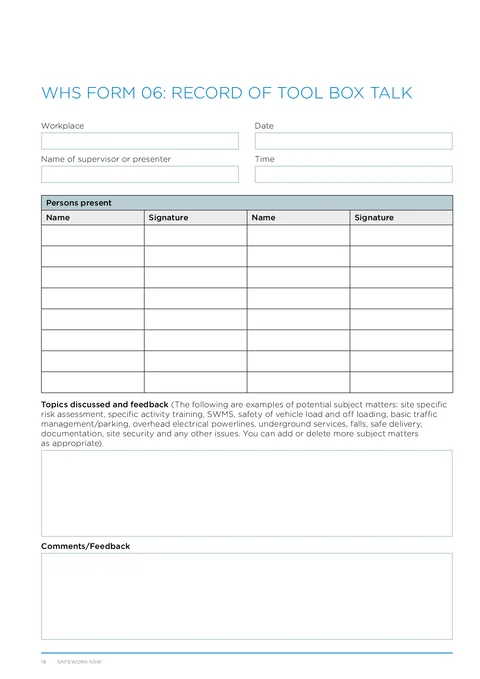
WHS Form 06 records a toolbox talk for the Housing Industry Site Safety Pack: who ran it, when and where, who attended, what was discussed, and what the crew said back. Supervisors and PCBUs complete it after the talk so the site file shows real consultation, not a blank attendance sheet. Keep the finished PDF with Form 04 and Form 05 for the same job; the three should tell one consistent story about hazards, method, and the talk.
This is the current SafeWork NSW WHS Form 06 from the Housing Industry Site Safety Pack. Tradie Forms follows the official section order and maps your answers onto the official PDF layout.
Writing the high risk method statement rather than recording the talk? Use NSW WHS SWMS
Captures where and when the talk ran, and who led it. These four lines head the official PDF.
WorkplaceTextRequired
The site or workplace where the talk was held, written so a principal reading the pack can match it to Form 04 and Form 05 for the same job. Use the street address and enough detail to tell stages or blocks apart when several packs sit in one file, for example 12 Builder Street, Parramatta. If you are filling off site, take it from the job board or the same address already used on the risk assessment, not from a suburb nickname the site file will not recognise.
DateDateOptional
The day the talk actually happened. Today and Yesterday shortcuts are there because this is usually filled on site or the next morning. The field does not accept a future date, so you cannot pre-date a talk that has not run. Fill it whenever the talk is real; a blank date on a signed attendance list weakens the record.
TimeTimeOptional
The time the talk started, in 24-hour form on the PDF, for example 07:30. Use the actual start, not a rounded shift time, so the record matches when people were present.
Name of Supervisor or PresenterTextRequired
The person who ran the talk. Match the name the crew heard introduce themselves, and the same spelling you use on other HIISP forms for this business when the presenter is a regular site lead.
Save this section as Presenter to prefill it on your next toolbox talk record for this presenter or site lead.
Records who was present. Each app row is one person: a name and a signature. Add only people who attended; leave unused rows out rather than padding with blanks.
You can add up to 16 attendees. The finished PDF has eight printed rows with two people across each row (name and signature on the left, then name and signature on the right). App rows fill left to right, top to bottom. Extra names beyond 16 do not fit the official layout, so run a second record if the crew is larger.
attendeesRowsOptional
One row per person who attended. Each row has Name and Signature. Type the name the person is known by on site, then have them sign at the talk. You can use a saved signature only when that person is signing for themselves on the device; do not stamp someone else's mark. Signatures land in the matching PDF boxes beside each name. A full list of names with empty signature boxes looks unfinished when a principal checks the pack.
Collect signatures while people are still in the circle. If someone missed the talk, brief them separately and record that briefing on its own rather than adding them to this list. Workers who join mid-week get a talk when they arrive, dated for that day.
Records what the talk covered and what came back from the crew. The official form lists example subject matters in a notice above these fields: site-specific risk assessment, specific activity training, SWMS, vehicle load and off-loading, traffic and parking, overhead powerlines, underground services, falls, safe delivery, documentation, site security, and other site issues.
Topics should match Form 04 hazards and any Form 05 SWMS in force for this stage. A SWMS the talks never mention, or a serious hazard that never appears in topics, is the inconsistency a principal or auditor reads for.
Topics Discussed and FeedbackTextareaOptional
What you covered, written specifically enough that someone reading the pack next week knows what this talk was about. Cover what changed this week or stage, not a recital of the whole safety system. Name the hazard, location, or control, and pull from the site risk assessment and active SWMS where they apply.
Useful
Scaffold incomplete on east elevation, no access until builder confirms; trench at rear open, barriers in place; hot weather forecast Thursday
Too vague
Site safety
Comments/FeedbackTextareaOptional
What the crew raised, agreed, or still needs clarified. This is the most valuable part of the form when it is filled honestly, and the field most often left blank. Record issues, who will deal with them, and anything referred to the builder or principal when it is outside your control, for example Crew flagged delivery truck blocking rear gate; Alex to redirect loads to side lane until Friday. A blank comments box every week suggests either nobody speaks or nobody writes it down.
If a worker raises something you cannot fix on the spot, still write it down with who it was referred to. Recording nothing and letting it disappear trains the crew not to raise the next issue.
Every talk on every site could carry that line. Name the stage hazard, control, or SWMS item so the pack shows this crew was briefed on this job.
Adding people who were not at the talk.
Late arrivals and absent workers need their own briefing record. Signing them onto a talk they missed turns the page into false consultation evidence.
Chasing signatures after the shift.
People sign for a conversation they may not have heard. Collect names and signatures while the talk is still running.
Leaving Comments/Feedback blank every week.
Issues raised and actions owned are what show consultation worked both ways. If something was raised, write the owner and the next step.
Topics that do not match Form 04 or Form 05.
A fall risk on the risk assessment or a SWMS control the talk never mentions makes the pack look like three separate documents. Align the agenda with the hazards and method already on file.
Using a different workplace wording from Forms 04 and 05.
Principals file packs by site. Builder St unit 3 on one form and 12 Builder Street, Parramatta on another looks like two jobs.
Treating the signed PDF as proof the hazard is controlled.
Form 06 shows the talk occurred and who was there. Keep the related SWMS, risk assessment, and action records with it so the pack answers how the risk is managed.
Keep the finished PDF in the site safety file on site and retain a copy with your business records. Tradie Forms does not lodge Form 06 with SafeWork NSW or any other authority.
File it with Form 04 and Form 05 for the same stage so the pack shows hazards, method, and consultation together.
Name the file with site and date, for example WHS-06 - 12 Builder St - 2026-06-20.pdf, so weekly talks do not overwrite each other in the principal's folder.
Follow up open actions written in Comments/Feedback. The record alone does not close an issue; track who owns each action until it is done.
Brief late starters separately and keep that record with the pack rather than altering a signed talk they missed.
Reuse the Presenter saved detail on the next talk, then confirm workplace and date for the new meeting before download.
Check the current SafeWork NSW Housing Industry Site Safety Pack guidance for your job type. What the principal requires on that site sits with the principal and the authority, not with this page.