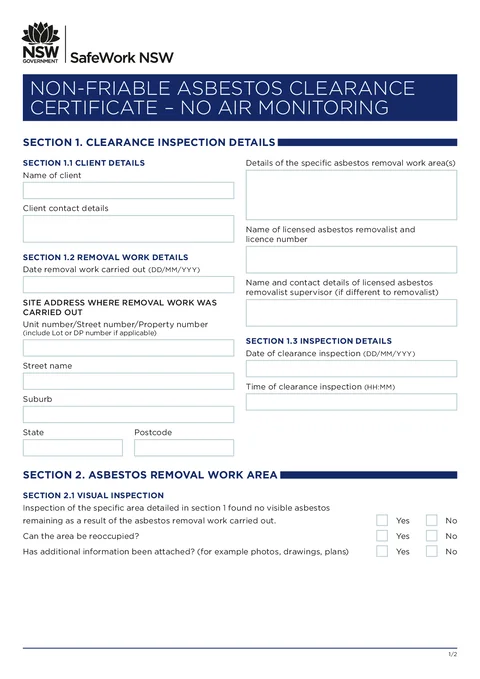
SW08272 records the visual clearance inspection after non-friable asbestos removal where the no air monitoring certificate is the right SafeWork NSW form. The competent person or asbestos assessor who inspected the area fills it, then downloads the official PDF for the licensed removalist and the job file. SafeWork NSW says a clearance inspection is required at the completion of licensed asbestos removal work before reoccupation, and for non-friable work a competent person or an asbestos assessor may issue the certificate.
This is the current SafeWork NSW Non-friable Asbestos Clearance Certificate - No Air Monitoring (catalogue SW08272). Tradie Forms follows the official section order and maps your answers onto the official PDF layout.
Planning how the asbestos will be removed before work starts, not recording clearance after inspection? Use NSW ARCP Class B
Almost every SW08272 problem comes from filling from memory instead of from the inspection and the removal records. Have these in front of you.
Client name and contact
Who engaged the removal or is receiving the clearance, as you would write on the paper form.
Removal job facts
Date the removal was carried out, the site address, and the specific work area or areas that were cleared.
Licensed removalist details
Business name and asbestos removal licence number, plus supervisor name and contact when that person differs from the removalist.
Clearance inspection timing
The date and time you actually carried out the visual clearance inspection.
Inspection outcome and attachments
Whether no visible asbestos remains, whether the area can be reoccupied, and any photos, drawings or plans that support the certificate.
Declarant identity and credentials
The competent person or asbestos assessor who inspected the area: name, contact, qualifications and experience, and readiness to sign.
Client name and contact, removal date, work area, removalist name and licence number, inspection date, and declaration name, qualifications and date gate the download.
Records who the clearance is for. Use the client on the removal engagement or booking, not a site contact who only met the crew at the gate.
Name of ClientTextRequired
The property owner, builder, principal contractor, project manager or business that engaged the work. Match the spelling used on the ARCP, quote and job booking so the clearance and the plan read as one job. If you are on site without the booking sheet, the removalist supervisor or the principal contractor can confirm the client name.
Client Contact DetailsTextRequired
Phone, email, or both, written as you would on the paper form, for example 02 9123 4567, facilities@harbourview.example. Put a number or inbox that reaches the person who needs the finished certificate, not a site-only burner that changes every job.
Records when and where the non-friable asbestos was removed, which areas were cleared, and who held the removal licence. These lines must match the removal records and the ARCP for the same job.
Use address search for the site address. Search is limited to New South Wales and fills property number, street name, suburb, state and postcode. Include lot or DP numbers in the property number field when they apply. Check the result against the ARCP or notification, because search returns the current postal address and a job can predate a street rename or subdivision. State defaults to NSW if you skip it.
On the finished PDF, the licensed removalist name and licence number share one line. Fill both fields in the app so that line is complete.
Date Removal Work Carried OutDateRequired
The date the licensed removal actually happened, taken from the job diary, ARCP or crew notes, not the booking date or the day you write the certificate. Today and Yesterday shortcuts are there because this is often filled on site or the next morning. The field does not accept a future date.
StateAddressOptional
Defaults to NSW. Confirm it when you type the address by hand. Address search fills this for NSW sites.
PostcodeAddressRequired
Filled by address search. Confirm it against the ARCP or rates notice when typing manually.
Details of the Specific Asbestos Removal Work Area(s)TextRequired
The exact areas you inspected, written so a later reader can identify them without the job file. Name the room, elevation, unit or storey, not only the trade room type. The declaration later refers to the work area and the surrounding area, so vague wording weakens the whole certificate.
Useful
Level 2 east wing store room and adjoining corridor
Too vague
Bathroom
Name of Licensed Asbestos RemovalistTextRequired
The licensed removal business that carried out the work, as on the asbestos removal licence and the ARCP. Use Licence check on the licence number field to search the NSW Asbestos and Demolition Register by number or business name, then confirm the returned name against the licence record for this job.
Licence NumberTextRequired
The removal licence number as printed on the licence, for example AD211234. Take it from the licence card or the current register result, not from a quote footer that may lag a renewal. Incomplete removalist details are one of the most common reasons a certificate is sent back.
Name and Contact Details of Licensed Asbestos Removalist Supervisor (If Different to Removalist)TextOptional
Fill this when the on-site supervisor is not the same person or entity as the named removalist. Use a name and number that reach them, such as Alex Morgan, 0412 345 678. Leave blank when the removalist entry already covers the supervisor.
Records when the clearance inspection was carried out. These values come from the inspection itself, not from the removal day unless both events really happened on the same day.
Date of Clearance InspectionDateRequired
The date you visually inspected the cleared area. Today and Yesterday shortcuts are there for on-site completion. The field does not accept a future date, so the certificate cannot be prepared ahead of the inspection.
Time of Clearance InspectionTimeOptional
The time of that same inspection, in 24-hour form such as 14:30. Fill it when you have it; the official PDF has a dedicated time line and it helps separate same-day removal and clearance events.
Captures the three yes/no outcomes from the visual clearance. Answer from what you found on the inspection, not from what the client hopes to hear. Nothing in this section blocks download on its own, which is why an empty or wrong answer still produces a PDF that looks finished.
Inspection of the Specific Area Detailed in Section 1 Found No Visible Asbestos Remaining as a Result of the Asbestos Removal Work Carried OutChoiceRequired
Yes or No. Answer after you have inspected the specific areas named in Removal Work. SafeWork NSW expects the area to be free of visible asbestos contamination before a clearance certificate is issued. If the answer is No, do not issue a positive clearance; re-clean, re-inspect, and record both rounds.
Can the Area Be Reoccupied?ChoiceRequired
Yes or No. This is the outcome the client, builder and principal contractor will act on. Only answer Yes when the inspection supports reoccupation. Leaving this blank still allows download, so treat it as a real decision, not a tick box.
Has Additional Information Been Attached? (For Example Photos, Drawings, Plans)ChoiceRequired
Yes when photos, drawings, plans or supporting notes travel with the certificate. Mark Yes only if those files are actually stored with the job record and will go out with the PDF. A Yes with nothing attached undermines the certificate later.
The official form declaration is: the asbestos removal work area and the surrounding area are free from any visible asbestos; the transit route and waste routes are free from any asbestos; and all asbestos in the scope of the removal work has been removed.
This section is completed by the person who carried out the clearance inspection and is issuing the certificate. SafeWork NSW says for non-friable removal that may be a competent person or an asbestos assessor, and the clearance inspection must be independent of the asbestos removal work for that specific job. Do not sign if you did the removal, or if you work for the business that did the removal, unless a regulator exemption applies.
NameTextRequired
The full name of the competent person or asbestos assessor who inspected the area and is issuing this certificate. Match the name on any assessor licence or competency record you would produce if asked.
ABNTextOptional
Your business ABN when you issue clearances under a business entity. Use ABN lookup to fill the name when the number is known, then check the result is the entity that should appear on this certificate.
Contact NumberTelOptional
A number that reaches the declarant, for example 0412 345 678. Prefer the mobile answered during site hours.
DateDateRequired
The date you make this declaration, usually the inspection day. Today and Yesterday shortcuts are there for on-site sign-off. The field does not accept a future date.
Qualifications and ExperienceTextRequired
Why you are the right person to issue this clearance. For a licensed asbestos assessor, state that licence. For a competent person, state the training, qualifications and relevant clearance experience. A blank or vague line does not show competency when the file is reviewed later.
Useful
Licensed asbestos assessor (NSW). 12 years clearance inspection experience on commercial refurbishment projects.
Too vague
Experienced with asbestos
SignatureSignatureOptional
Sign after the inspection and the visual outcomes are correct. The signature stamps into the signature box on page 2 of the PDF. You can use a saved signature; check the preview so the stamp sits cleanly. Do not sign for someone else, and do not sign before the inspection is finished.
Save this section as Declarant to prefill it on your next clearance you issue as the same competent person or assessor.
The ARCP is prepared before removal and sets out how the work will be done. SW08272 is the later clearance record after visual inspection. Use the control plan first, then this certificate when the inspection is complete.
Describing the work area as Bathroom or Eaves only.
The declaration refers to the specific work area and the surrounding area. Name the unit, elevation or storey so both can be identified later without the job file.
Leaving the removalist licence number blank.
The official form expects the licensed asbestos removalist name and licence number. Name alone is not enough when the certificate is checked against the licence record.
The clearance person is not independent of the removal.
SafeWork NSW requires the clearance inspection to be independent of the removal for that specific job. Check independence before you inspect, not after the PDF is filled.
Answering Yes on reoccupation when the area is not clear.
A positive clearance over a marginal area is the document you least want to hold later. Re-clean, re-inspect, and record both rounds instead.
Marking additional information attached when nothing is filed.
Photos, drawings and plans only support the certificate if they travel with it. Store them with the job record before you mark Yes.
Using this no air monitoring form for friable work.
This edition is the non-friable certificate without air monitoring. Friable removal and air monitoring clearances follow a different SafeWork NSW process.
SafeWork NSW says the licensed asbestos removalist must ensure a clearance inspection is carried out and a clearance certificate issued before the workplace or residential property is reoccupied. Give the finished PDF to the licensed removalist and any other recipients the job requires, rather than assuming one party will pass it on.
Name the file with the site and inspection date so it sits with the ARCP for the same job, for example SW08272 - 12 George St - 2026-06-10.pdf.
File it with the ARCP, notification, SWMS, waste records and photos. The certificate alone does not show what was planned or removed. The set is what answers a question later.
Keep supporting attachments with the PDF when the form says additional information is attached.
Start a new form for each separate clearance inspection. Do not reuse a signed certificate for another area or another day.
Tradie Forms does not lodge SW08272 with SafeWork NSW. Check the current SafeWork NSW asbestos guidance for your job. Retention and who must receive a copy sit with the licensed removalist, the person who commissioned the work, and the authority's current requirements.