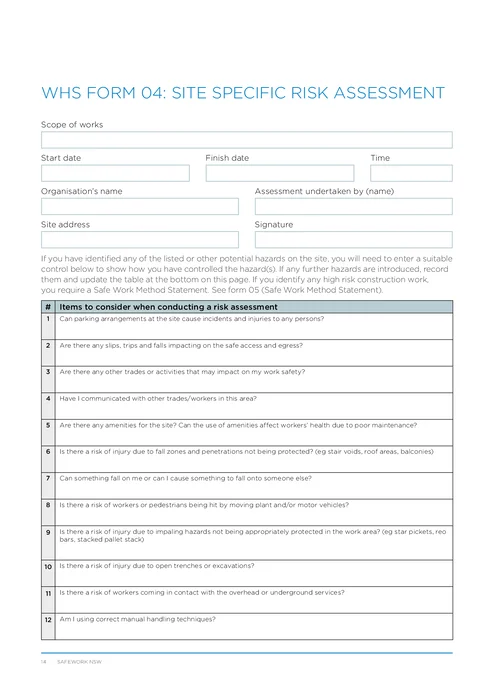
WHS Form 04 records the hazards on a particular residential construction site and the controls you will use for them. The PCBU or site supervisor completes it after walking the site, usually when the Housing Industry Site Safety Pack is opened for that job. The finished PDF is the SafeWork NSW layout for the site file; it feeds the Form 05 SWMS and Form 06 toolbox talk rather than replacing either of them.
This is the current SafeWork NSW WHS Form 04 from the Housing Industry Site Safety Pack. Tradie Forms follows the official section order and maps your answers onto the official PDF layout.
Need a method statement for high risk construction work rather than a site hazard scan? Use NSW WHS SWMS
Almost every weak Form 04 comes from filling it from the plan in the office instead of from the ground. Have these in front of you.
A walk of the current site
Access, voids, services, plant, weather exposure, neighbouring structures, and what other trades are doing today.
The scope for this stage
What work this assessment covers, and the start and finish window you are assessing.
Organisation and assessor names
The business on the pack and the person who walked the site and will sign.
Site address for this job
The residential address the principal's file expects, matching Forms 05 and 06.
Input from people who will do the work
They notice different hazards than a desk review, especially around access and handling.
A decision on high risk construction work
Whether anything you find needs a Form 05 SWMS before that activity starts.
Organisation's name and the assessor name gate the download. Checklist controls are optional in the form, but blank rows on hazards you saw on site leave the pack unfinished for a principal.
Captures what this assessment covers and when it was done: scope of works, start and finish dates, and time.
Scope of WorksTextOptional
The work this assessment applies to on this site, written so a principal or another trade reading the pack knows the stage without opening the contract. Name the residential work type and location, not a generic trade label.
Useful
Second-storey extension and roof framing
Too vague
Building work
Start DateDateOptional
The start of the period this assessment covers. Today shortcut is there for assessments filled on the day the stage opens. The field does not accept a future date.
Finish DateDateOptional
The end of the period this assessment covers, not a guess at final handover months away. Today and Yesterday shortcuts are available. The field does not accept a future date, so update and re-download when the stage window moves.
TimeTimeOptional
The time of the assessment walk or sign-off, such as 07:00. Useful when more than one assessment is filed for the same address in a day.
Names who owns this pack entry, who assessed the site, where the site is, and the assessor signature. Keep the business name consistent with Forms 01, 05 and 06 for the same job.
Organisation's NameTextRequired
The business that holds this site pack entry, as it appears on Form 01 and your insurance. Use the same spelling across every HIISP form for this job so the principal's file reads as one contractor. If you trade under a different name from the legal entity, use the trading name the site knows you by.
Assessment Undertaken By (Name)TextRequired
The person who walked the site and completed this assessment. Match the signature below so the pack does not show two different people as assessor. Prefer the person who was actually on the ground, not only the director who will never visit the block.
Street addressAddressOptional
The job site address, not the business office. Address search is limited to New South Wales and fills the street line, suburb, state and postcode. Check the result against the contract or site sign, because search returns the current postal address and a new estate can lag.
StateAddressOptional
Defaults to NSW. Confirm it stays NSW when you type the address by hand.
PostcodeAddressOptional
Filled by address search. Confirm it against the job file when typing manually.
SignatureSignatureOptional
The assessor named above. Sign when the scope, site and controls are correct for this walk, not as a blank stamp for later jobs. You can use a saved signature; check the preview so the stamp sits cleanly in the signature box on page one of the PDF.
Save this section as Organisation to prefill it on your next site risk assessment for this business.
Records additional hazards introduced during the job after the first assessment: what was found, what was done, and who did it. Use it when conditions change mid-stage, not as a second copy of every checklist answer.
One row is one hazard event. Each row has Date, Hazard(s) Identified, Actions Taken, and By Whom. You can add up to 24 rows, matching the printed table on page two of the official PDF. Leave unused rows out rather than adding blanks. Rows do not reorder; add them in the order they happened.
On the finished PDF the assessment header, organisation block, signature and twelve checklist controls sit on page one. The hazard log table fills page two. Long text in a cell can clip, so keep each entry short enough to read in the preview.
Hazard log rowsTableOptional
Add a row when a new hazard appears on site: a void opened, plant arrived, access changed, weather exposure shifted, or another trade introduced a risk you did not have on day one. Date is limited to today or earlier, with Today and Yesterday shortcuts. Write the hazard as a site condition, not a category, and name the action that was actually taken and who took it.
Useful
Unprotected balcony edge during framing; temporary guardrail installed before work started; Jordan Mitchell
Too vague
Working at heights; PPE; supervisor
Date on each row cannot be in the future. If you need more than 24 logged events for a long job, keep the overflow in the site diary or a supplementary register and keep this table for the hazards that matter to the current stage.
Twelve SafeWork NSW prompts for site conditions. For each hazard you identified on the walk, enter the control measures you will use. The full question text appears as helper text in the form and as the numbered list on page one of the downloaded PDF. A blank control box next to a real hazard reads as unfinished, not as "not applicable".
If any item involves high risk construction work, prepare Form 05 before that work starts. Do not try to turn every ordinary site note into a SWMS row; leave ordinary controls here and reserve Form 05 for the high risk method.
Write controls that will actually happen on this site with the people and plant available. Name what is done, who owns it, and when. PPE alone is not a control plan.
Parking ArrangementsTextOptional
Official prompt: can parking arrangements cause incidents or injuries? Cover visitor parking, deliveries, and any shared driveway or street constraints that affect this block.
Useful
Marked visitor bay on the nature strip; concrete truck staged on the street with a spotter
Too vague
Park carefully
Slips, Trips and FallsTextOptional
Safe access and egress for the stage: muddy paths, temporary stairs, cords, rubble, and level changes between the street and the work face.
Other Trades or ActivitiesTextOptional
Other trades or activities that can affect your work safety this week, such as an electrician on live circuits or a roofer working above your zone.
Communication With Other TradesTextOptional
How you have spoken with other trades or workers in the area: toolbox talk, shared access plan, or named contact. Empty means nobody has coordinated, not that coordination is unnecessary.
Amenities MaintenanceTextOptional
Site amenities and whether poor maintenance can affect health. Note portable toilet service, wash water, and any shared facilities the principal provides.
Fall Zones and PenetrationsTextOptional
Stair voids, roof areas, balconies and other fall openings. Say what is barricaded or signed, and what is still open. Fall risk over two metres is a common cue to open Form 05.
Falling ObjectsTextOptional
What can fall on workers or passers-by, and what you will do about it: tool tethering, exclusion zones, debris nets, or sequencing so nobody works under open framing.
Moving Plant and VehiclesTextOptional
Plant, trucks and cars that can hit workers or pedestrians. Cover delivery routes, reverse alarms, spotters, and any shared access with neighbours.
Impaling HazardsTextOptional
Star pickets, reo bars, stacked pallets and similar. Cap, cover or isolate them in the work area rather than relying on people to remember they are there.
Trenches and ExcavationsTextOptional
Open trenches or excavations on or beside the work zone. Note depth, barriers, and whether backfill or covers are in place for this stage.
Overhead and Underground ServicesTextOptional
Overhead lines and underground services workers can contact. Dial Before You Dig results, marked services, and clearance from live overhead lines belong here.
Manual HandlingTextOptional
What is being lifted, roughly how heavy, and how it moves on this site. Team lifts, mechanical aids, and staging of packs beat a bare "use correct technique".
Writing the assessment from the office without walking the site.
Generic residential hazards describe every site and none of them. Walk the ground first so the controls match this address.
Naming hazard categories instead of site conditions.
Working at heights does not tell the next person what is unprotected or when it matters. Write the edge, void or access problem you actually saw.
Listing PPE as the only control on every row.
Elimination and engineering beat reliance on behaviour. Name the barrier, sequence, exclusion zone or equipment change that removes the risk.
Leaving checklist controls blank for hazards you found.
The official form expects a suitable control under each identified hazard. Empty boxes look like the walk never happened.
Treating Form 04 as a substitute for a SWMS.
High risk construction work still needs Form 05 before it starts. Form 04 finds the hazard; Form 05 plans the high risk method.
Using a different organisation name from Forms 01, 05 and 06.
The principal's pack should read as one contractor. Match the Form 01 trading name.
Never updating the assessment after the site changes.
A new stage, plant arrival, open void or access change makes the old page describe a different site. Update the checklist and add hazard log rows, then re-download.
Filling the hazard log with blank padding rows.
Unused PDF rows should stay empty. Only add rows for hazards that were actually identified and actioned.
Keep the finished PDF in the site safety file on site and retain a copy with your business records. Tradie Forms does not lodge Form 04 with SafeWork NSW or any other authority.
Brief the crew on the controls before the stage starts, then record that talk on Form 06 when you hold one.
Open Form 05 for any high risk construction work identified here, before that work starts.
Name the file with the site and date so it sits with the rest of the pack, for example WHS-04 - 14 Hunter St - 2026-06-20.pdf.
Update and re-download when the site changes. Keep earlier versions in the job folder rather than overwriting the only copy; the sequence shows the site was being managed as conditions moved.
Reuse the Organisation saved detail on the next assessment for this business, then re-check the site address and assessor for the new job.
Check the current SafeWork NSW Housing Industry Site Safety Pack guidance for your job type. What the principal requires on that site sits with the principal and the authority, not with this page.