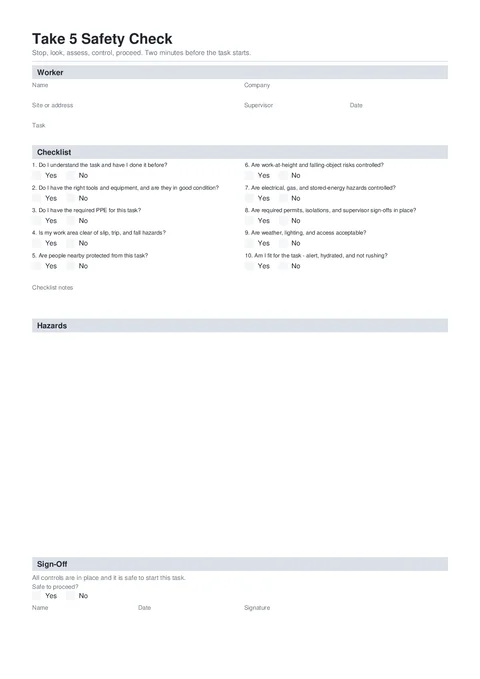
A Take 5 is a short pre-task safety check: stop, look, assess, control, then proceed. One worker fills it for the task they are about to start, answers ten yes or no questions, notes any hazards that still need a control, and downloads a signed PDF before tools come out. It is a personal pause for this start, not a full job analysis or a substitute for high risk construction planning.
This is a Tradie Forms designed record, not a government form. There is no official layout to match, so the PDF is a clean pre-task record that grows extra pages as you add hazard rows.
Breaking the whole job into steps with hazards and crew sign-on rather than a two-minute pre-start? Use JSA
The form only works if you fill it standing at the work face, not later from the ute. Have these ready.
The task about to start
The specific step you will do next, not the whole project name.
Where you are standing
Building, floor, room, riser, or lot so a stranger can place the check later.
Two minutes before tools come out
A Take 5 written after the work is a diary note, not a pre-task check.
Site conditions as they are now
Work area, plant, weather, access, permits, and people nearby for this start, not yesterday's job.
Whether a SWMS or JSA already covers the method
High risk construction work still needs its planning document. Take 5 sits on top, not instead.
Seven fields gate the download on an empty form: Name, Site or Address, Date, Task, Safe to Proceed?, the sign-off Name, and the sign-off Date. Answer every checklist question and complete any hazard row you add so the PDF is usable when a supervisor asks for it.
Who is doing the task and where. These values identify the check in the site file and on the PDF header.
Business Logo (Shown top right on the downloaded record)PhotoOptional
Upload your logo if you want it on the finished PDF. It lands top right on the downloaded record.
NameTextRequired
The person filling this Take 5, usually the same name used for site induction. One worker per form. Three people on the same step need three checks, not one name with extra signatures later.
CompanyTextOptional
Employer or trading name when the site file or principal wants it on the record. Leave blank rather than inventing a company the induction does not know.
Site or AddressTextRequired
Where you are standing for this task. A full postal address is not required. Use the building, floor, room, riser, or lot the principal already uses so the PDF can be matched to attendance later. Example: Level 2 riser cupboard, 12 Wharf Road.
SupervisorTextOptional
Who is looking after the crew on the day when the pack wants a named contact on the pre-start. Useful when the check later needs escalation for an isolation or permit.
DateDateRequired
The day of this check. Use Today on site. The form will not accept a future date. Do not reuse yesterday's date for a fresh start after conditions change.
TaskTextRequired
The step you are about to start, specific enough that a supervisor can place it without the job file. Name the work, the location on site, and any access detail that matters for this start.
Useful
Replace the 100 A main switch in the tenancy distribution board
Too vague
Electrical
Save this section as Worker to prefill it on your next Take 5.
Ten fixed yes or no questions about this start. Work them at the work face so the answers match the ground, not last week's job.
Pre-task ChecksChecklistItemsOptional
The checklist itself does not block download if left blank, but a usable Take 5 answers every item. Each row is Yes or No. When the answer is No, add a short note on what is wrong. Those notes print together under Checklist notes on the PDF.
The ten items are: understand the task and whether you have done it before; right tools and equipment in good condition; required PPE; work area clear of slip, trip, and fall hazards; people nearby protected; work-at-height and falling-object risks controlled; electrical, gas, and stored-energy hazards controlled; required permits, isolations, and supervisor sign-offs in place; weather, lighting, and access acceptable; fit for the task (alert, hydrated, not rushing).
Bulk pass marks remaining unanswered questions as Yes when they apply. Use it only after you have walked the face, not as a shortcut for questions you never looked at.
A No is not a fail of the form. It is a flag that something needs a note and a control before you mark safe to proceed. Do not flip a No to Yes just to finish. Put the control in place, then answer based on the condition after the control. Use the hazards table for the written control that fixes the problem.
Optional table for hazards that need a control before you start. Empty is fine when every check is Yes and nothing else needs recording.
HazardsTableRowsOptional
Add a row with Add hazard when a check is No, or when you see a risk that still needs a written control even if every check is Yes. Up to 50 rows. Leave unused rows out rather than adding blanks. Long lists continue onto extra pages on the PDF.
What one row is. One hazard for this start, with its risk rating and the control you will use today.
Hazard - the thing or situation that could cause harm, in plain language. Write the hazard, not the injury. Incoming supply conductors remain live until upstream isolation beats injury or electrics.
Risk - Low, Medium, High, or Extreme for that hazard as it stands before the control.
Control - what you will put in place and can check before start. Make it specific enough that another trade could verify it. Set a 2 m exclusion zone with cones and electrical work signage beats be careful.
Useful
Incoming supply live until isolation; High; obtain isolation permit, isolate upstream, lock out and prove de-energised
Too vague
Electrical risk; Medium; take care
Writing a control on the form does not put the control in place. Implement first, then record.
Confirm it is safe to start after the checks and any controls match the ground.
Safe to Proceed?RadioGroupRequired
Yes, controls in place or No, do not start. Choose Yes only when every open No is closed and any hazard controls are real on the ground. Choosing Yes while scaffold is incomplete, isolation is unproven, or a permit is missing is the worst kind of complete form.
What needs to happen first?TextRequired when you choose No, do not start
What must change before work can begin, for example Wait for isolation permit from supervisor or Builder to complete west edge protection before access. Required when safe to proceed is No. It tells the next person reading the PDF why the start did not happen.
NameTextRequired
Who is signing this check. Use Same as worker above when the signatory is the worker named in Worker.
Same as worker aboveToggleOptional
Copies the worker Name into sign-off Name and locks the name field while it is on. Turn it off if someone else is signing.
DateDateRequired
The date you sign. Use Today on site. No future date is accepted. Match the day of the check, not a backfill after tools are packed.
SignatureSignatureOptional
Sign on screen, upload an image, or use your saved signature after the checks and safe-to-proceed answer match the ground. The signature attests that this worker stopped, checked, and made the proceed call for this start.
A Take 5 filled at smoko is a diary note. Auditors match dates against attendance and photos. Open the form before the first tool comes out.
Tick and flick every answer to Yes.
Ten Yes answers with no notes look efficient and often mean nobody looked. Walk the work face. Mark No when something is wrong, write the note, and fix it before safe to proceed.
Safe to proceed while a No is still open.
The signature says go while the site still says stop. Leave the form on No, do not start until the control is real, or escalate so the crew is not standing around after a false start.
Task line that never changes.
Building works, plumbing, or the client name cannot be tied to a moment on site. Name the step, location, and access detail for this start.
Reusing yesterday's answers with a new date only.
Conditions move. Copy only as a draft, then change site, task, checklist answers, and hazards for this start and re-sign for this day.
Handing over a Take 5 when the pack asked for a SWMS.
Longer hazard text does not convert a Take 5 into a Safe Work Method Statement. High risk construction work still needs the planning document the law and the pack require.
Vague controls that nobody can check.
Be careful and use PPE do not prove a control is in place. Write something another person can verify on the ground, then put it in place before you sign.
There is no national lodgement for a Take 5. Keep the finished PDF where your business or site process requires it, and give a copy to the principal, site manager, or safety advisor when the pack asks for pre-task evidence.
Name the file so site, task, and date are obvious.Take 5 - 12 Wharf Rd - main switch - 2026-07-14.pdf is easier to find after a near miss than a generic download name.
File it with the related safety pack for the job. Keep it with the SWMS, JSA, permits, and photos for the same task so the short check meets a clean trail rather than a reconstruction.
Start a new Take 5 when conditions change. Weather, plant, other trades, access, or method changes mid-shift need a fresh pause. Do not stretch yesterday's PDF across a different start.
Send only the scoped set when someone asks for records. After a near miss or audit, send the dated PDFs for the people and times named, not the whole company history.