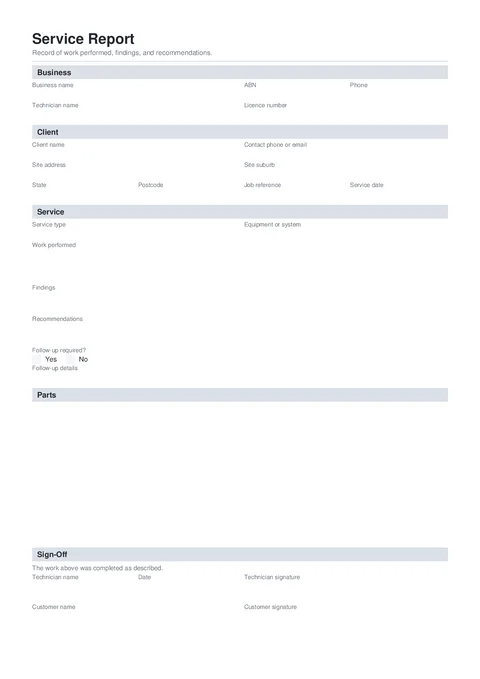
A service report is a customer-facing record of the visit: what you did, what you found, and what should happen next. Fill it on site, sign as the technician, optionally capture the customer signature, and download a clean PDF before you leave. It is handover paperwork, not a compliance certificate, commissioning record, or regulator form for the work.
This is a Tradie Forms designed record, not a government form. There is no official layout to match, so the PDF is a clean service report that grows extra pages as you add parts rows and photo appendices.
Vague work notes and a client name copied from last week's job are how most weak reports start. Have these ready before you open the form.
Client and site for this visit
The customer name, contact, and worksite the invoice and job file already use, not last suburb's draft.
What you actually completed
The work done on this visit, written so the client can see what they paid for without a phone call.
Equipment or system details
Make, model, or system type when you worked on plant, a board, or a fixed installation.
Findings and recommendations
Condition notes, test results, and the next action with a timeframe when something still needs attention.
Parts fitted on this visit
Item names and quantities from the van stock or supplier docket if materials went into the job.
Before and after photos
Shots that show the condition you found and the finished work when a photo will explain more than text alone.
Nine fields gate the download on an empty form: Business Name, Technician Name, Client Name, Service Date, Service Type, Work Performed, Follow-up Required, sign-off Technician Name, and Date. Follow-up Details is required when follow-up is Yes.
Your business and who attended. These fill the report header on the finished PDF.
Business Logo (Shown top right on the downloaded report)PhotoOptional
Upload your logo if you want it on the finished PDF. It lands top right on the downloaded report.
Business NameTextRequired
Your trading name as the client should recognise it on the invoice and the report. Use ABN lookup to fill the business name and ABN together when you have either value.
ABNTextOptional
Optional trading number. ABN lookup fills the matching business name when you enter a valid ABN.
Technician NameTextRequired
The person who did the work on this visit, for example Alex Smith. This is the name the sign-off section can mirror later with Same as technician above.
Licence NumberTextOptional
Licence, registration, or competency number when the client or site expects it on the report, for example ARC AU12345 or a state licence number.
PhoneTelOptional
Contact number for follow-up quotes, access, or questions about the visit. Use the number the client should actually call.
Save this section as Business to prefill it on your next service report.
Who you did the work for, where, and when. Keep this tied to today's job so a duplicated draft cannot keep last suburb's address.
Client NameTextRequired
The customer, body corporate, or site contact the report is for, for example Harbourview Apartments. Match the name on the work order or invoice so the PDF files with the right account.
Contact Phone or EmailTextOptional
How to reach the client about findings or follow-up, for example Priya Nair, 02 4955 0100. Fill it when recommendations or a quote will need a reply.
Job ReferenceTextOptional
Work order, purchase order, or internal job number such as HV-SVC-8841. Use the same reference you put on the invoice and other records for this visit.
Street addressAddressOptional
The worksite, not the accounts office. Address search is Australia-wide and fills the street line, suburb, state, and postcode. Confirm the result against the work order when the postal address differs from the site name, or when you duplicated last week's report.
StateAddressOptional
Filled by address search. Confirm it when you type the address by hand.
PostcodeAddressOptional
Filled by address search. Confirm it against the job record when typing manually.
Service DateDateRequired
The day the visit happened. Use Today or Yesterday on site. The field does not accept a future date.
What you did, what you found, and what the client should do next. Keep Work Performed factual; put unresolved conditions in Findings and the next action in Recommendations.
Service TypeComboboxRequired
Choose Maintenance, Repair, Installation, Inspection, or Fault callout, or type a custom type when none of those fit. This is how the client and your office sort the visit later.
Equipment or SystemComboboxOptional
What you worked on, with make and model when known, for example Ducted split system, Daikin FDYAN160. Pick a common system type from the list or type a custom value. Fill it whenever the plant or system will matter on the next visit.
Work PerformedTextareaRequired
What you completed on this visit, written so a non-tradie can see the scope. Name the tasks and systems, not only the outcome. The PDF holds about 320 characters, so keep it tight and check the preview if the text is long.
Useful
Replaced return air filters, cleaned the indoor coil and condensate tray, checked refrigerant pressures and electrical connections, then ran heating and cooling modes.
Too vague
Serviced unit
FindingsTextareaOptional
Condition observed, faults found, or test results worth recording, for example a capacitor that measured below its rated capacitance. The PDF holds about 220 characters. Leave blank only when there was nothing material to note.
RecommendationsTextareaOptional
What the client should do next, and by when, for example replace a failing part within three months. Match Follow-up Required to this note so the PDF does not say No follow-up while the recommendations still ask for action. The PDF holds about 220 characters.
Before PhotoPhotoOptional
Optional photo of the condition before the work. It is added as a full-page appendix labelled Before photo at the end of the downloaded report. Use a clear, well-lit shot of the relevant plant or area, not a random site selfie.
After PhotoPhotoOptional
Optional photo of the finished work. Same full-page appendix treatment as the before photo, labelled After photo. Check both photos in the PDF preview so they show this job and do not include unrelated personal information.
Follow-up RequiredRadioGroupRequired
Yes or No. Choose Yes whenever a quote, return visit, or client action is still outstanding, even if the work on this visit is finished. Leaving this unset blocks download.
Follow-up DetailsTextRequired when you select Yes
Who will do what next, for example Send Priya a quote for the outdoor fan capacitor replacement. Required when follow-up is Yes; the form blocks download if this line is empty. Leave it hidden when follow-up is No.
Parts or materials fitted on this visit. Leave the list empty when nothing was used.
Use Add item for each line. You can add up to 50 rows; long lists continue onto extra pages on the PDF. Leave unused rows out rather than adding blanks. Each row needs an item name before it counts.
Parts and MaterialsTableRowsOptional
Optional as a block. Columns are Item, Qty, and Notes. Item is the part or material name, for example Return air filter 495x495. Qty is how many, for example 2. Notes is optional context such as Replaced during scheduled service. On the finished PDF the list is a simple table that paginates when it grows.
Technician sign-off before download, plus an optional customer name and signature.
Technician NameTextRequired
Who is signing the report for the business. Often the same person as Technician Name in Business. Use Same as technician above when that is true so the two names cannot drift.
Same as technician aboveMirrorFieldsOptional
Copies the business-section technician name into this field and locks it while the toggle is on. Turn it off if someone else is signing the report.
DateDateRequired
The date of sign-off. Today and Yesterday shortcuts are available. The field does not accept a future date. Check that the service date and sign-off date tell the same story before you sign.
Technician SignatureSignatureOptional
Draw, upload, or use your saved signature. Sign when the work, findings, and follow-up lines are correct for this visit, not as a blank stamp on a draft you still plan to edit. The image lands in the technician signature area on the PDF.
Customer NameTextOptional
Optional. Capture on the spot when the client is available, for example Sam Lee. You can also send a signature request link from the saved draft if they will sign later.
Customer SignatureSignatureOptional
Optional customer sign-off. Capture on the phone when they are present, or leave blank and follow up with a signature request from the saved draft. The image lands in the customer signature area on the PDF when filled.
Keeping last suburb's client or address on a duplicated draft.
Clients cross-check the name and site against the invoice. Wrong suburb or last week's account makes the PDF hard to file and easy to dispute. Change client fields first, then rewrite work and findings for this visit.
Writing work performed as a one-word outcome.
Serviced unit or Fixed leak does not show the client what they paid for, and it is useless on the next visit. Name the tasks and systems you actually completed.
Mixing findings into work performed.
Completed tasks belong in Work Performed. Unresolved conditions and test results belong in Findings, and the next action belongs in Recommendations, so the handover is scannable.
Marking follow-up No while recommendations still ask for action.
A report that recommends a part replacement within three months but says no follow-up confuses the client and your office. Set Follow-up Required to Yes and say who will do what next.
Leaving follow-up details blank after choosing Yes.
The form blocks download until you say what happens next. Write a concrete action such as who gets the quote or when the return visit is planned.
Attaching the wrong before or after photo.
Full-page photo appendices travel with the PDF the client keeps. Check both shots show this job and plant, and that they do not include unrelated personal information, before you download.
Signing before the work and follow-up lines are final.
A signature on a half-finished draft freezes the wrong story for the job file. Finish work, findings, recommendations, and follow-up, then sign.
Give a copy to the client and keep one with the job record. Tradie Forms does not lodge service reports with any regulator. This PDF is a handover record only.
Name the file so the client and date are obvious.Service report - Harbourview Apartments - 2026-07-14.pdf is easier to find than a generic download name when the job is reopened later.
File it with the invoice and photos. Keep the report with the work order, any compliance or commissioning PDFs for the same visit, and the before and after shots so the visit has one trail.
Track outstanding follow-up. When follow-up is Yes, carry the action into your quote or booking list so the recommendation is not lost after the client receives the PDF.
Do not treat this as a compliance certificate. If the work needs a CoC, commissioning record, or regulator form, complete that document as well and file both.
If the job also needs a step-by-step hazard and control record, use the Job Safety Analysis guide linked below.