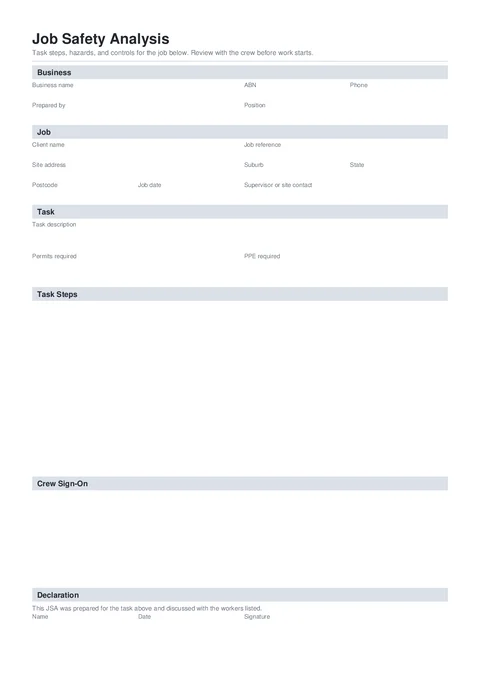
A Job Safety Analysis (JSA) breaks one task into ordered steps and records hazards, risk ratings, and controls before work starts. Prepare it with the people who will do the job, walk the steps, collect crew sign-on, then download the signed PDF for the site pack and job file. Sites often ask for a JSA by that name even when the legal high-risk document is a SWMS, so match what the pack filed.
This is a Tradie Forms designed record, not a government form. There is no official layout to match, so the PDF is a clean job safety analysis that grows extra pages as you add steps and crew sign-on.
Doing a short pre-task stop-look-assess check rather than a full step breakdown? Use Take 5
Preparing a Safe Work Method Statement for high risk construction work on a NSW residential pack job rather than a general JSA? Use NSW WHS SWMS
Generic steps and last week's address are how most JSAs get rejected. Have these ready before you open the form.
The real task for this package
What the crew will actually do today, in enough detail to break into ordered steps.
Client and site identity
The client or principal name and the worksite address the gate or PO already uses, not last suburb's job.
Permits and PPE the site requires
Isolation, hot work, confined space, access, or site-specific permits, plus the PPE list for this package.
Who is supervising on the day
The supervisor or site contact who owns the crew while the task runs.
The people who will do the work
Crew present for the walk-through so sign-on matches attendance, not an old roster.
Whether a SWMS is also required
High risk construction work still needs a SWMS under model WHS rules, even when the pack also asks for a JSA.
Six fields gate the download on an empty form: Business Name, Prepared By, Job Date, Task Description, at least one complete Task Steps row, and declaration Name and Date. Signature is part of the sign-off block but does not block download on its own.
Your business and who prepared this JSA. These fill the record header on the finished PDF.
Business Logo (Shown top right on the downloaded record)PhotoOptional
Upload your logo if you want it on the finished PDF. It lands top right on the downloaded record.
Business NameTextRequired
Your trading name as the principal and site file should recognise it. Use ABN lookup to fill the business name and ABN together when you have either value.
ABNTextOptional
Optional trading number. ABN lookup fills the matching business name when you enter a valid ABN.
Prepared ByTextRequired
The person who wrote this JSA, usually the supervisor, leading hand, or owner responsible for the package. The declaration can mirror this name later with Same as prepared by.
PositionComboboxOptional
Role title such as Licensed electrician, Site Supervisor, Leading Hand, or Foreman. You can type a custom value. Useful when the site pack expects a role next to the preparer name.
PhoneTelOptional
Contact number for the site or office if the principal needs to call about the method or a change on the day.
Save this section as Business to prefill it on your next JSA.
Who and where the task is for. Keep this tied to today's job so a duplicated draft cannot keep last suburb's address.
Client NameTextOptional
The builder, principal contractor, or customer the pack is for. Fill it whenever the PDF will leave your van; without it the JSA is hard to file in a multi-contractor pack.
Job ReferenceTextOptional
Work order, purchase order, or internal job number such as HV-24071. Use the same reference you put on other records for this package.
Street addressAddressOptional
The worksite, not the builder's office. Address search is Australia-wide and fills the street line, suburb, state, and postcode. Confirm the result against the induction address or PO when the postal address differs from the worksite name, or when you duplicated last week's JSA.
StateAddressOptional
Filled by address search. Confirm it when you type the address by hand.
PostcodeAddressOptional
Filled by address search. Confirm it against the job record when typing manually.
Job DateDateRequired
The day this JSA covers. Use Today or Yesterday on site. The field does not accept a future date. Backdating after the first attendance is a common pack reject.
Supervisor or Site ContactTextOptional
Who is looking after the crew on the day, for example Sam Lee. Fill when someone other than the preparer owns the task live on site.
What you are about to do, and what must be in place before the first step starts.
Task DescriptionTextareaRequired
One clear sentence for the work package, specific enough that a new crew member knows which face and system you mean. The PDF holds about 220 characters, so keep it tight.
Useful
Install a new submain and distribution board for the ground-floor tenancy
Too vague
Electrical works
Permits RequiredTextOptional
Permits that must be live before the task starts, for example isolation, hot work, confined space, ceiling access, or a site-specific permit. Leave blank only when none apply. Steps that mention hot work or isolation with a blank permits line are a common reject.
PPE RequiredCheckboxGroupOptional
Tick every item the crew needs for this package: Hard hat, Hi-vis, Safety glasses, Gloves, Hearing protection, Steel-cap boots, Harness, Respirator, and Other. Selected items print as a comma-separated list on the PDF. Match the PPE the step controls assume.
Other PPETextRequired when you tick Other under PPE Required
Say what the extra PPE is, for example Face shield and welding gauntlets. It prints alongside the ticked items. The form blocks download when Other is ticked and this line is empty.
The body of the JSA: one row per job step in the order the work will run. This is what the crew walk through before tools come out.
Use Add step and reorder rows so the list matches how the job will run. You can add up to 50 steps; long lists continue onto extra pages on the PDF. Leave unused rows out rather than adding blanks. At least one full step is required before download.
Safe Work Australia’s risk guidance uses four steps: identify hazards, assess risks, control risks, then review the controls. Prefer elimination and higher-order controls before relying only on procedures or PPE.
Task StepsTableRowsRequired
Each row is one stage of the work. Columns are:
Job Step - what happens in this step, in plain language the crew will follow, for example Set up the work area and position the new distribution board.
Hazards - the thing or situation that could cause harm, not a vague outcome word. Fall from an unprotected edge and Manual handling and other trades entering the work area beat injury.
Risk - Low, Medium, High, or Extreme for that step on this site today. Ratings that never move, or every step rated Low on a plant and height job, look false to a principal.
Controls - how you will manage the hazards, written as something the crew can put in place and check. Install edge protection before access beats take care. Prefer controls that exist on the ground before that step starts.
Who - optional name or role that owns the controls for that step, for example Alex Smith or Leading hand. Fill it on high risk steps so isolation, exclusion zones, and plant interfaces have an owner.
Useful
Step: Isolate the supply and connect the new submain. Hazards: electric shock, arc flash, unexpected re-energisation. Risk: High. Controls: follow approved isolation, lock-out and test-for-dead before touching conductors. Who: Alex Smith.
On the finished PDF each step is a stacked record: step, hazards, risk, and controls on the first line, responsible person on the second when filled. Check the preview when the list is long so pagination still reads cleanly.
Workers who reviewed this JSA before starting. Add each person after the walk-through, not from an old attendance list.
You can add up to 30 sign-on rows. Leave unused rows out. Late starters sign when they arrive and get the briefing before they join the task. A signature records sign-on; it does not replace the conversation about the steps, hazards, and controls.
Crew Sign-OnTableRowsOptional
Optional as a block, but a site pack that expects consultation needs real names. Columns are Name, Company, Date, and Signature. Use Today on the date while people are still at the brief. Signatures can be drawn or use a saved signature. On the PDF the sign-on list is a simple table that continues onto extra pages when the crew is large.
Only list people present for the review who will work the package. Names of workers on leave or on another site undermine the pack when checked against the gate list.
Sign off before download. The declaration text confirms the JSA was prepared for the task and discussed with the workers listed.
NameTextRequired
Who is signing the finished JSA for the business. Often the same person as Prepared By. Use Same as prepared by when that is true so the two names cannot drift.
Same as prepared byMirrorFieldsOptional
Copies Prepared By into Name and locks the name field while it is on. Turn it off if someone else is signing.
DateDateRequired
The date of sign-off. Today and Yesterday shortcuts are available. The field does not accept a future date. Check that preparer, crew, and declaration dates tell the same story before you sign.
SignatureSignatureOptional
Draw, upload, or use your saved signature. Sign when the steps, controls, and crew list are correct for this job, not as a blank stamp on a template you plan to edit later. The image lands in the declaration signature area on the PDF.
Keeping last suburb's address on a duplicated draft.
Principals cross-check the site field against induction and the PO. Wrong suburb is an instant reject even when the steps happen to fit. Change job fields first, then rewrite every step that does not match this package.
Writing one vague step for the whole package.
General construction with hazard injury and control PPE says nothing a supervisor can check. Break the work into ordered steps and name the mechanism of harm and the control that will exist before that step starts.
Rating every step Low, or every step Extreme.
Flat ratings look false on plant, height, and live-services jobs. Rate for this site today, and make High or Extreme steps earn stronger controls.
Writing controls that are not on the ground.
Edge protection installed only counts when it is installed. Walk controls before the related step starts; if a control is not ready, do not start that step, and update the JSA if the method must change.
Collecting sign-on without a real walk-through.
Names that do not match attendance, or signatures collected while people load the truck, undermine the pack. Only sign people present for the review, and add late starters when they arrive.
Uploading a JSA where the pack filed a SWMS.
Detail alone does not convert a JSA into a SWMS for high risk construction work. Prepare the named document the principal filed, and still complete a JSA when that format is required as well.
Backdating the JSA after the first day's work.
Dates that sit after the first attendance train the crew that the document is admin only, and advisors reject them. Date and sign before start; mark mid-job reviews honestly when the method changes.
Give a copy to the site contact if required and keep one with the job record. Tradie Forms does not lodge JSAs with any regulator. A site, client, or principal contractor may have its own JSA layout or retention rules, so check what they expect.
Name the file so the site and task are obvious.JSA - 12 Wharf Rd - submain install - 2026-07-14.pdf is easier to find than a generic download name when the pack is reopened later.
File it with the briefing trail. Keep the JSA with any SWMS, permits, and toolbox notes for the same package so the method and the consultation sit together.
Stop and review when the method changes. If the work method, crew, site conditions, or controls change, stop work as soon as it is safe, update the record, and collect fresh sign-on where the change affects the crew.
Carry late starters into the same record. Add them when they arrive rather than reconstructing attendance at the end of the day.
Check Safe Work Australia’s risk guidance and your state or territory regulator for the SWMS and record requirements that apply to this job.