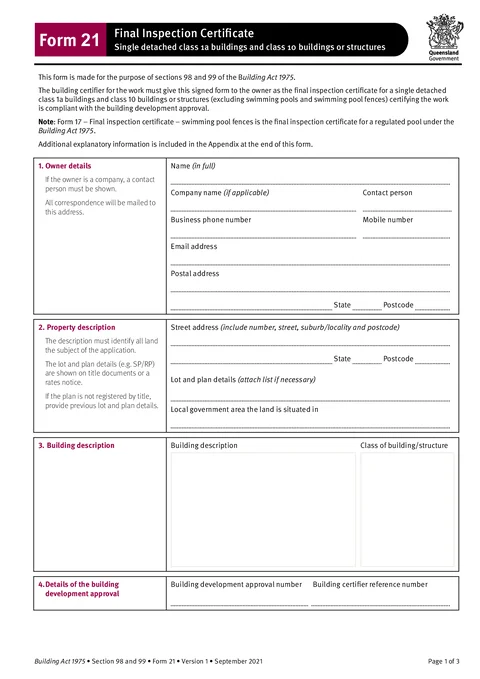
Form 21 is the final inspection certificate for single detached class 1a buildings and class 10 buildings or structures in Queensland. The building certifier for the work issues the signed certificate to the owner when the final stage complies with the building development approval. It does not cover swimming pools or swimming pool fences.
This is the current Queensland Form 21. Tradie Forms follows the official section order and maps your answers onto the official PDF layout.
Certifying plumbing and drainage completion rather than building work? Use QLD Form 19
Identifies who the certificate is issued to and where correspondence is mailed. Do not assume the site contact is the owner. On investor builds, company-owned sheds and family jobs, the person on site is often not the name that belongs on the certificate.
NameTextOptional
The owner as recorded on the approval or title, not the builder, tenant or person who opened the gate. On company-owned work, put the entity name here when that is how the owner is recorded on the approval.
Company Name (if Applicable)TextOptional
Fill when the owner is a company, trust or similar entity. Leave blank for a private individual owner.
Contact PersonTextOptional
Required by the form when the owner is a company. Use the person who should receive correspondence about this certificate.
Business Phone NumberTelOptional
Landline or main office number for the owner. Use Australian format so the finished PDF reads cleanly, for example 07 3222 1100.
Mobile NumberTelOptional
Mobile for the owner or contact person. Prefer the number that will still reach them after handover.
Email AddressEmailOptional
Email used for owner correspondence. Confirm it against the approval file when the job has changed hands.
Postal AddressAddressOptional
Where correspondence is mailed. Address search is limited to Queensland. Check the result against the approval, because the postal address can differ from the site address on investor and company work.
Save this section as Owner to prefill it on your next Form 21 for the same owner.
Identifies all land the subject of the application. A street address alone is not enough when the certificate needs to match the approval and title.
Street AddressAddressOptional
The property street address from the approval. Address search is limited to Queensland and fills the street line, suburb, state and postcode. It can also fill Local Government Area. Check the result against the approval, because search returns the current postal address and a permit or approval can predate a street renaming or subdivision.
Lot and PlanTextareaOptional
The legal land description from the title, rates notice or approval. On new estates the street address may not exist cleanly in every system yet, so lot and plan is the reliable identifier. Fill it whenever the approval carries it.
Useful
Lot 15 RP 812345
Too vague
Lot 15, new estate
Local Government AreaTextOptional
The council area. Address search may fill this. Confirm it near a boundary, because the LGA is part of how the certificate sits against the approval and any later lodgement with council.
Describes what was certified so the finished PDF is not ambiguous about class or structure type.
Building DescriptionTextareaOptional
Name the building or structure in plain job language. Include attached class 10 structures when they are part of the certificate so a shed, carport or garage is not left implied.
Useful
Single-storey class 1a dwelling with attached class 10a carport
Too vague
House
Class of Building/StructureTextareaOptional
The National Construction Code class or classes covered by this final certificate, for example Class 1a or Class 1a and Class 10a. Match the approval, not a shorthand used on the job card.
Links the certificate to the building development approval for this project. Wrong numbers here are the most common way a clean final certificate gets sent back.
Building Development Approval NumberTextOptional
From the current building development approval for this job. Do not take it from an old email subject, a reused office folder, or another lot in the same estate. If you are on site without the approval, the certifier file or the builder's current approval pack is the source, not memory.
Building Certifier Reference NumberTextOptional
Your own job or file reference for this certification, as used on earlier inspection paperwork. Keep it consistent with Form 16 and aspect certificates on the same approval so the trail joins up later.
Records performance requirements only when the work uses a performance-based solution. Leave this section blank when the approval is entirely deemed-to-satisfy.
Performance RequirementsTextareaOptional
List the performance requirements relied on, taken from the approval documents or performance solution documentation. Do not invent wording. If no performance-based solution applies, leave the field empty rather than writing "N/A" unless that is how your certifier file already records it.
Records inspection and certificate dates for each construction stage. These dates connect the final certificate to the inspection trail. Take them from stage and aspect records, not from memory.
The table has fixed rows for Foundation and excavation, Footing/slab, Frame, Final, Other stages, and two Other certificate rows. Leave unused rows blank. Do not invent dates for stages that were never inspected on this approval.
Date of InspectionDateOptional
The date each stage inspection was carried out, taken from the inspection record or stage certificate for that row. Today and Yesterday shortcuts are there for recent work. No date field on this form accepts a future date.
Date of CertificateDateOptional
The date the stage certificate was issued. Often a different day from the inspection. Two identical dates across every row are usually a copy error rather than a same-day pattern for the whole job.
Stage or certificateTextOptional
On the Other certificate rows only. Name the stage or supporting certificate clearly enough that someone reading the PDF without the job file knows what it is, for example a Form 16 or aspect certificate you relied on for waterproofing.
Useful
Form 16 aspect certificate for waterproofing
Too vague
Other
If a previous stage certificate is missing from the file, find it before you sign Form 21. The final certificate is not the place to tidy a broken trail by guessing.
Your details as the building certifier issuing this final inspection certificate. Name and Licence Number block download when empty.
NameTextRequired
Your name as the building certifier for this work. Prefer the same spelling used on earlier certificates for the job. Licence check on the licence number can fill this when the QBCC register returns a match; confirm it still matches the name on your licence card.
Company Name (if Applicable)TextOptional
Your certification practice or company when the certificate is issued under a business name.
Contact PersonTextOptional
Fill when correspondence should go to a named person at the practice rather than only the certifier named above.
Business Phone NumberTelOptional
Main office number for the certifier practice.
Mobile NumberTelOptional
Mobile that can still be reached if the owner or council needs to confirm the certificate later.
Email AddressEmailOptional
Professional email for certificate correspondence.
Postal AddressAddressOptional
Postal address for the certifier. Address search is limited to Queensland. Check the finished PDF when the address is long so it still reads cleanly.
Licence NumberTextRequired
Your building certifier licence number. Use Licence check against the QBCC register to confirm the number and fill your name when the register returns a match. Do not work from an old job PDF that may carry a superseded number.
Save this section as Certifier to prefill it on your next Form 21 you issue.
Sign and date as the building certifier for this work. The signature attests that you are issuing the final inspection certificate for the work described on the form.
SignatureSignatureOptional
Sign when owner, property, approval, stage dates and certifier details match the file. You can use a saved signature; check the preview so the stamp sits cleanly in the signature box on page 2.
DateDateRequired
The date you sign the certificate. Today and Yesterday shortcuts are available. The field does not accept a future date. This is the certificate date for Form 21, not a stage inspection date from earlier rows.
The person on site is often the builder, tenant or project manager. Confirm the owner name against the approval or title before the certificate goes out.
Leaving lot and plan blank.
A street address alone may not identify the land. Take lot and plan from the title, rates notice or approval whenever the approval carries it.
Entering stage dates from memory.
Use the inspection and certificate records for each stage. If a Form 16 or aspect certificate is missing, find it before you sign the final.
Copying the approval number from another lot.
Estate and multi-job offices reuse folder names and email subjects. Take the building development approval number from the current approval for this lot.
Using Form 21 for pool or pool fence finals.
Form 21 excludes swimming pools and swimming pool fences. Keep pool finals on the pathway the official forms require rather than folding them into the class 1a or class 10 certificate.
Labelling an Other certificate row as Other.
A future reader of the PDF cannot tell which supporting certificate you relied on. Name the stage or certificate type clearly.
Signing while supporting certificates are still missing.
Form 21 sits on top of the inspection trail. If stage or aspect records are incomplete, resolve that before the owner copy leaves.
Give the signed PDF to the owner. Keep it with the building development approval and the inspection documentation you relied on, such as Form 16 stage certificates, Form 12 or Form 43 aspect certificates, photos, notices and correspondence.
Name the file so it stays findable. Include Form 21, the property address and the certificate date, for example Form 21 - 12 Jacaranda Drive - 2026-06-02.pdf.
File the supporting trail with it. A final certificate alone does not show which stage and aspect records sat under the decision. Keep that pack together for sales, warranty and later questions.
Log when and how the owner copy went out. The office should be able to answer that without rebuilding the send trail from inboxes.
Keep pool paperwork separate. Do not file a regulated pool final under the same close-out name as this Form 21.
Check the current Business Queensland and local government requirements for your job. Lodgement and retention expectations sit with the building certifier role and the approval pathway that applies.