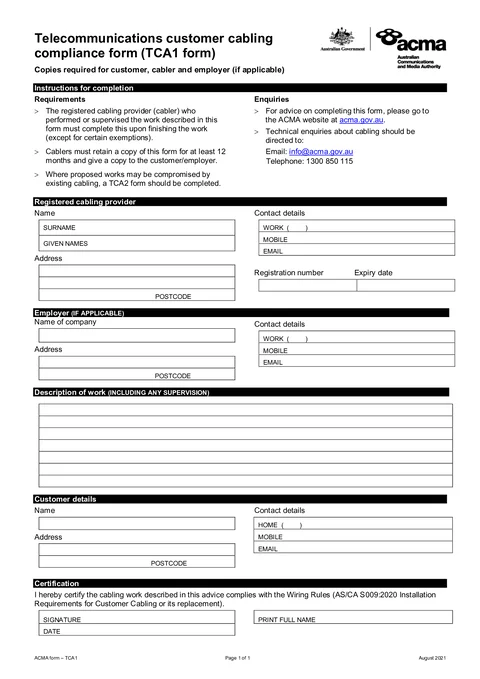
TCA1 is the ACMA-approved written certification statement for customer cabling work you performed or supervised. A registered cabler prepares it as soon as practicable after finishing the job, then gives copies to the customer and, where relevant, the employer or contractor, and keeps a copy for at least 12 months. ACMA cabling advice guidance also allows another format if it carries the required details; this form produces the official TCA1 Attach A layout (August 2021).
This is the current ACMA TCA1 Attach A. Tradie Forms follows the official section order and maps your answers onto the official PDF layout.
Recording non-compliant cabling you noticed outside the work you completed? Use ACMA TCA2
Almost every TCA1 problem comes from filling it later from memory instead of at the job. Have these in front of you.
Your current cabler registration card or record
Surname, given names, registration number and expiry must match this job, not last week's PDF.
What you installed, altered, tested or supervised
Enough detail to name the work and where it sits in the building.
Where the work was done
Room, floor, tenancy, rack or building section, as ACMA's location examples describe.
Who the customer actually is
The party who engaged you, not only the person who let you in.
Employer or contractor details when they apply
Company name and contact for the copy your business or head contractor needs.
A decision on TCA2
Whether any non-compliant cabling outside this scope still needs its own advice.
Given names, surname, work description, customer name, print full name and date gate the download. Signature should still go on the certification line so the customer gets a finished statement.
Your details as the registered cabling provider who performed or supervised the work. Use the same spelling and registration details you use on other cabling records for this job.
Given NamesTextRequired
As shown on your cabler registration. Match the person who actually performed or supervised this work, not a colleague whose details are still saved from the last job.
SurnameTextRequired
As shown on the same registration record. A mismatched name and registration number is the first thing that looks wrong if the record is reviewed later.
MobileTelOptional
Your contact number for follow-up on this advice. Prefer the number that still works when the customer rings next week. Work Phone sits beside this field for a landline with area code when you use one.
EmailEmailOptional
Useful when the customer or office will receive the finished PDF by email. Use an address that reaches you or the business, not a personal inbox you do not check for job files.
Registration NumberTextOptional
Your current cabler registration number. Take it from the live registration record, not an old PDF on the phone. ACMA expects the statement to identify the registered provider, so leave this blank only if you truly do not have the number on site and will complete it before handover.
Expiry DateDateOptional
The expiry on that same registration. The field does not accept a date before today, so a lapsed registration cannot be entered as current. Check both number and expiry together whenever registration has renewed or a provider arrangement has changed.
Street addressAddressOptional
Your business or postal street line. Address search is Australia-wide and fills the street line, suburb, state and postcode. Confirm the result against how you appear on other cabling paperwork for this business.
SuburbAddressOptional
Filled by address search with the street line. Confirm it when typing by hand so the provider block matches the rest of your records.
StateAddressOptional
Filled by address search. Confirm when typing manually.
PostcodeAddressOptional
Filled by address search. Confirm against your business record when typing manually.
Save this section as Cabling Provider to prefill it on your next TCA1 for the same registered cabler.
Prefill restores the provider block. Still check registration number and expiry before download whenever anything about your registration or business has changed.
Fill this when you work for a company or contractor that must receive a copy of the certification statement. Leave the section blank only when it does not apply to this job.
Company NameTextOptional
Trading or legal name of the employer or head contractor who needs a copy. On subcontracted work this is often the business on the purchase order, not the site supervisor's company nickname.
MobileTelOptional
Employer contact number for the office copy trail. Work Phone is available beside it for a landline with area code.
EmailEmailOptional
Where the employer or contractor should receive the finished PDF. Prefer a job or office inbox the business actually files against, not a personal phone email.
Street addressAddressOptional
Employer business address when it differs from yours. Address search is Australia-wide. Confirm the result against the letterhead or contract so the copy path matches the business on the job.
StateAddressOptional
Filled by address search. Confirm when typing by hand.
PostcodeAddressOptional
Filled by address search. Confirm against the employer record when typing manually.
Save this section as Employer to prefill it on your next TCA1 for the same employer or contractor.
Records what cabling work you completed and where it was done. This is the section the customer and any later reader use to understand what the advice covers.
Work DescriptionTextareaRequired
Name the type of work and its location in enough detail that someone who was not on site can identify it later. ACMA guidance gives location examples such as room, floor, section, department and building. Include whether you installed, altered, repaired, relocated, tested or supervised, and note supervision when a trainee or apprentice did part of the work under your oversight. The finished PDF has seven single lines; long text wraps across them and the soft length matches those lines, so check the preview if the description is long.
Useful
Install two CAT6 outlets in office 3, terminate to rack U12, test and label both points to AS/CA S009:2020
Who receives the cabling advice. Use the customer who engaged you for this job, not only the person who met you at the door.
NameTextRequired
Customer or site contact as the party engaged for the work. On a fit-out that is often the builder rather than the tenant standing next to you. Confirm before you leave, because a wrong customer name is hard to match to the job months later. When a job system is connected, you can import name, phone, email and address from supported jobs, contacts or projects, then check the import against who actually engaged you.
MobileTelOptional
Customer mobile for handover and follow-up. At least one working phone helps on site. Home Phone sits beside this field for a landline with area code when you have one.
EmailEmailOptional
Where the finished advice should be sent. Prefer an inbox that reaches the engaging party, not only an accounts payable address that never reaches the site owner.
Street addressAddressOptional
Customer postal or site address as required for your records. Address search is Australia-wide and fills the street line, suburb, state and postcode. On commercial jobs make the address clear enough that the form can be matched back to the work order later.
StateAddressOptional
Filled by address search. Confirm when typing by hand.
PostcodeAddressOptional
Filled by address search. Confirm against the job file when typing manually.
Signs and dates the compliance declaration on the TCA1. Read the certification wording on the form before you sign: it is the statement that the cabling work complies with the relevant wiring rules.
SignatureSignatureOptional
The registered cabler making the declaration. Sign when the work description, customer and provider details are final, not as a blank stamp for later. You can use a saved signature; check the preview so the stamp sits cleanly in the signature box on page one of the PDF.
Print Full NameTextRequired
The name of the registered cabler making the declaration, matching the provider block. Do not put an office admin name here when a different person performed or supervised the work.
DateDateRequired
The date of this certification statement. Today and Yesterday shortcuts are there because ACMA expects the statement as soon as practicable after the work. The field does not accept a future date. Do not copy a date from an old PDF.
Renewals and provider changes leave stale numbers on phones and templates. Take surname, given names, registration number and expiry from the current registration record for this job.
Describing the work as office data or as quoted.
That tells a customer or auditor nothing a year later. Name what was installed, altered or tested and where it sits in the building.
Naming the tenant when the builder engaged you.
The customer is who engaged your business. A wrong name makes the customer copy and the retained file hard to match to the work order.
Leaving employer blank on subcontracted work.
ACMA says the employer or contractor also gets a copy when you have one. Blank employer details break that copy trail.
Using TCA1 to cover unfixed non-compliant cabling.
TCA1 certifies the work you completed or supervised. Outstanding or pre-existing non-compliant cabling needs a TCA2 so the customer or building manager has a clear record.
Signing before the work description is final.
The signature sits against the description you just wrote. Change the wording first, then sign, then download.
Dating the form from last week's job.
A copied date is the first thing that looks careless if the record is reviewed. Use the day you prepare this statement for this work.
ACMA guidance says once the certification statement is prepared, give a copy to the customer who engaged you and to your employer or contractor if you have one, and keep a copy for one year after preparing it.
Name the file so the job is obvious. Include the customer and site or suburb, for example TCA1 - Jordan Lee - Parramatta - 2026-06-05.pdf.
File it with the job record. Keep the PDF with photos, test notes and the work order so the office can find it without digging through sent email.
Hand over while the customer is still available. The statement belongs with the finished work, not at the end of the week from memory.
Open a TCA2 when outstanding matters remain. Do not let known non-compliant cabling sit only in a verbal handover.
Check the current ACMA cabling advice requirements for your job, including the limited exemption for small cabling tasks. Tradie Forms is not affiliated with the ACMA.