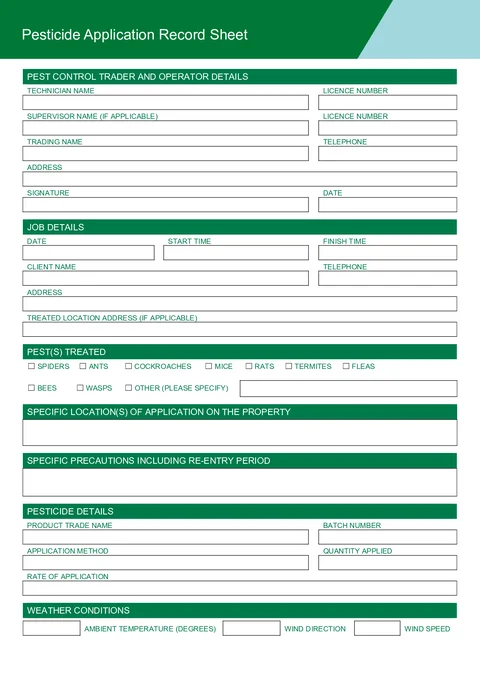
The Pesticide Application Record Sheet records each pesticide product applied on a Victorian pest control job: who applied it, the client and property, pests treated, product and batch, where it went, precautions, and weather for outdoor work. Licensed pest controllers make and keep that record for every application; the finished PDF is the official Health Victoria layout for the job file. Health Victoria's record-keeping guidance expects the required details for each pesticide used, so use a separate record when you put down a second product on the same job.
This is the current Victorian Department of Health Pesticide Application Record Sheet. Tradie Forms follows the official section order and maps your answers onto the official PDF layout.
Almost every weak pesticide record comes from writing it after the run, when batch numbers, rooms and wind have already blurred. Have these in front of you while you are still on site.
Your pest control licence
Technician name and licence number as on the card, plus supervisor name and licence when a trainee worked under supervision.
The product container and label
Trade name, batch number, application method, quantity, and rate while the container is still in hand.
The job booking
Client name, phone, and address of the person the application was carried out for, not only the site contact who opened the door.
Treated areas as you move through the property
Rooms, voids, perimeters or outdoor lines actually treated, not a later guess of house or outside.
Precautions and re-entry for this product
Label advice and any site notes on pets, children, food areas or access restrictions the client needs after you leave.
Weather for outdoor work
Ambient temperature, wind direction and wind speed during the application, before the ute leaves the street.
A decision on product count
One record per pesticide. If the job used two products, plan a second form before you pack up.
Identifies who applied the pesticide, the business, and the date of this record. Fill it from the licence card and trading details for the person who did the work, not from a colleague's saved block.
Technician NameTextRequired
The person who applied the pesticide on this job, as it appears on their Victorian pest control licence. Match the card spelling so a later check lines up with the licence register.
Licence NumberTextRequired
The technician's licence number from the same card, such as PC12345. The form will not download without it on the technician line. When a trainee worked under supervision, use the second Licence Number field for the supervisor's number from their card.
Supervisor Name (If Applicable)TextOptional
Fill when a trainee licence holder applied the pesticide under supervision. Leave blank on a fully licensed technician job rather than copying a usual supervisor by habit.
Trading NameTextOptional
The business name you trade under for this work, as clients and inspectors know it, for example Metro Pest Control Pty Ltd.
TelephoneTelOptional
A business number that reaches the operator or office, such as 03 9123 4567. Prefer the number published on your paperwork, not a personal mobile that changes with the ute.
Street addressAddressOptional
The pest control business address, not the job site. Address search is limited to Victoria and fills the street line, suburb, state and postcode. Check the result against your letterhead or registration if the business has moved.
StateAddressOptional
Defaults to VIC. Confirm it stays VIC when you type the address by hand.
PostcodeAddressOptional
Filled by address search. Confirm it against the business record when typing manually.
SignatureSignatureRequired
The technician or supervised person completing this record. Sign when the application details are correct for this job, not as a blank stamp for later. You can use a saved signature; check the preview so the stamp sits cleanly in the signature box on the official PDF.
DateDateRequired
The date this record is completed. Today and Yesterday shortcuts are there for on-site finish. The field does not accept a future date.
Save this section as Operator to prefill it on your next pesticide record.
Records when the application happened, who it was for, and where. Take client details from the booking for the person the work was carried out for; on rental, strata and commercial jobs that is often not the person who opened the door.
DateDateRequired
The date the pesticide was applied. Use the job day, not the day you caught up on paperwork. Today and Yesterday shortcuts are there when you finish on site. The field does not accept a future date.
Start TimeTimeOptional
When the application started, in 24-hour form such as 08:30. Useful when more than one treatment or visit is logged for the same client on the same day.
Finish TimeTimeOptional
When the application finished, such as 10:15. Keep it consistent with the start time so the duration of the treatment is clear on the record.
Client NameTextRequired
The person or business the application was carried out for, from the booking, not only the tenant or site contact. On facility-managed or body-corporate work, use the party the job is booked under.
TelephoneTelOptional
Client phone from the booking, such as 0412 345 678. Prefer a number that still reaches them after you leave, not only a site reception line that closes at 4pm.
Street addressAddressOptional
The client address for this job. Address search is limited to Victoria and fills the street line, suburb, state and postcode. Check it against the booking; billing contacts are often a different street from the property treated.
StateAddressOptional
Defaults to VIC. Confirm it stays VIC when you type the address by hand.
PostcodeAddressOptional
Filled by address search. Confirm it against the booking when typing manually.
When the treated property is not the same as the client address, fill Treated Location Address (If Applicable) in the separate address block below the client address. Address search is limited to Victoria. Leave that block blank when client address and treated property are the same so the PDF does not show a second, conflicting site.
Save this section as Client to prefill it on your next pesticide record for the same customer.
Ticks which pests were treated on this job. Match the pests you actually treated and the product label, not every pest the client mentioned on the phone.
Pest(s) TreatedCheckboxGroupOptional
Tick each listed pest that applies: Spiders, Ants, Cockroaches, Mice, Rats, Termites, Fleas, Bees, Wasps, or Other. Leave pests you did not treat unticked so the record does not claim a broader treatment than the job.
OtherTextRequired when Other is selected
Describe the pest clearly enough that the office or an inspector understands it without photos, for example German cockroaches in the commercial kitchen. Do not leave a bare Other tick with no description.
Names where on the property the pesticide went. The client address only says which site; this field says which rooms, voids or outdoor lines were treated.
Specific Location(s) of Application on the PropertyTextareaOptional
Name the rooms, voids, perimeters or outdoor areas actually treated so a later reader does not have to guess. Include tenancy, level or plant area on multi-tenancy sites. Health Victoria's Technical Note 3 lists both the location of the application and the specific location within the property.
Useful
Kitchen skirting, pantry, laundry wet areas and external south fence line
Records precautions and re-entry advice the client or site contact can act on after you leave. Write from this product's label and this site's conditions, not from the last job's wording.
Specific Precautions Including Re-Entry PeriodTextareaOptional
Plain language the client can follow: re-entry timing, pets, children, food areas, wet surfaces, or access restrictions that apply to this treatment. Include enough that the site contact does not need to call you back for the basics.
Useful shape: Keep pets inside for 4 hours. Re-entry after 2 hours. Do not wipe treated skirting until dry. Too vague: Take care or a blank field when outdoor or indoor residual work needs a re-entry note.
Records the product applied on this sheet. Capture trade name and batch while the container is still out; one product per record is what forces a second form when a second pesticide goes down.
Product Trade NameTextRequired
The trade name on the product label, such as Cislin 25. Use the name on the container for this application, not a house brand shorthand or a product from a different job on the same run.
Batch NumberTextOptional
From the same container, such as BATCH-2026-041. Read it before the pack goes back on the truck; batch numbers are hard to reconstruct from a blurry photo later.
Application MethodComboboxRequired
How the product was applied. Choose Spray, Bait, Dust, Granular, Foam, Injection, or Fog / mist, or type another method when none of those fit. Match what you actually did on site.
Quantity AppliedTextOptional
How much product was used for this application. The field shows a L suffix; enter the figure as mixed or applied for this job, such as 2.
Rate of ApplicationTextOptional
The rate used, or enough detail to determine the rate from the label. The field shows a mL per linear metre suffix as a common unit; enter the figure that matches how you applied the product, such as 5.
Records conditions at the time of application. For outdoor work, Health Victoria's Technical Note 3 lists ambient temperature, wind direction and wind speed among the details to keep; fill these during the job, not from memory after the ute has moved.
Ambient TemperatureTextOptional
Temperature at the time of application in degrees Celsius. The field shows a °C suffix; enter the reading such as 18.
Wind DirectionComboboxOptional
Direction at the time of application. Choose N, NE, E, SE, S, SW, W, NW, or Calm, or type another value when needed. Calm is a direction choice here; still record wind speed when there is measurable wind.
Wind SpeedTextOptional
Wind speed during application. The field shows a km/h suffix; enter the figure such as 5. Where you have no instrument, Technical Note 3 allows the Beaufort Wind Scale as a guide for outdoor applications. Note significant changes during the application in your job notes if conditions shift.
Indoor-only work with no outdoor application can leave weather blank. Do not invent outdoor weather for a fully internal treatment.
Batch numbers, rooms and wind blur across similar jobs by evening. Capture product, locations and outdoor weather while you are still at the property.
Using the property address instead of specific treated locations.
The street address only says which site. Name kitchen skirting, roof void, south fence line or the tenancy and room so a later reader knows where the product went.
Squeezing two pesticide products onto one sheet.
Health Victoria expects the required details for each pesticide used. Download a second record for the second product rather than a vague combined note.
Leaving product trade name or batch blank until later.
The container is the source while it is in hand. Photos in a camera roll are a backup, not a substitute for the trade name and batch on the record.
Copying precautions from the previous job without checking the label.
Re-entry and pet advice must match this product and these treated areas. Wrong advice on the record is what the client may follow after you leave.
Guessing outdoor weather once the ute has moved.
Temperature, wind direction and wind speed for outdoor work belong to the job site at application time. Record them before you leave the street.
Putting the site contact as the client on rental or commercial work.
Technical Note 3 includes the person for whom the application was carried out. Use the booking party, not only the tenant who opened the door.
Ticking Other without describing the pest.
An empty other line is a dead end for the next reader. Name the pest when it is not on the printed list.
Health Victoria says electronic records must be kept securely and be available for inspection when required. Attach the finished PDF to the job rather than leaving it in a downloads folder, a message thread or a camera roll.
Name the file so the job is obvious. Date, client, suburb and form name works for most small teams, for example 2026-06-10 - Sam Nguyen - Oakleigh - VIC pesticide record.pdf.
File it with the job trail. Keep the record with the booking, photos, label notes and any risk notes so the PDF meets a clean trail rather than a reconstruction.
Start a second form for a second product. Do not overwrite the first record when another pesticide went down on the same visit.