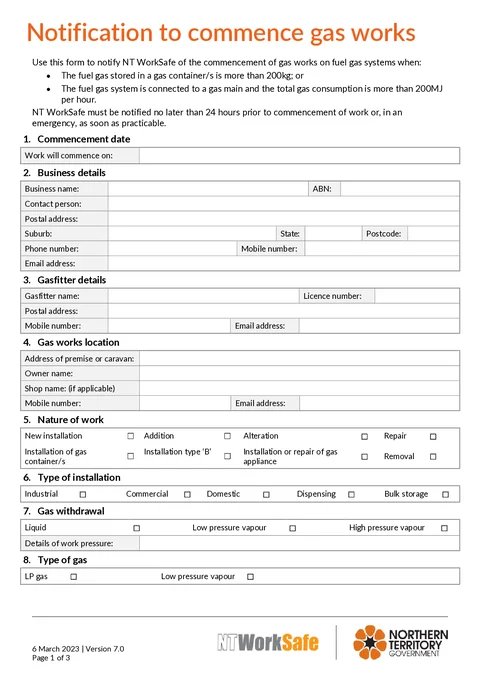
Notifies NT WorkSafe before eligible fuel gas work starts. You end up with the official commencement PDF ready to lodge or keep with the job. NT WorkSafe requires this notice when fuel gas stored in containers is more than 200 kg, or a system connected to a gas main has total gas consumption above 200 MJ per hour. Notify at least 24 hours before work starts, or as soon as practicable in an emergency.
This is the current NT WorkSafe Notification to Commence Gas Works. Tradie Forms follows the official section order and maps your answers onto the official PDF layout.
Five fields gate the download: commencement date, gasfitter name, premise street address, notifier declaration, and declaration date. Have the rest ready so the notice matches the job you are about to start.
A threshold decision
Confirm the job is above 200 kg stored fuel gas, or above 200 MJ/h on a gas main. Near either line, check the design and container quantities rather than guessing from an older job.
Planned start date
The date work will actually commence on site, not the day you fill the form. Leave enough room for the 24-hour notice on scheduled work.
Business and gasfitter records
Legal or trading name, ABN, postal address, contact person, licensed gasfitter name, licence number, and current contact details.
Site identity
Premise or caravan address, owner or site contact, and any shop, bay, compound, or building name needed to find the work.
System and gas details
Nature of work, installation type, gas withdrawal and work pressure, gas type and source, system purpose, and piping sizing notes from design or measurement.
Tank or container plates
Capacity, manufacturer or manufacture detail, serial or ID, plant item number, and expiry or test dates when storage tanks or gas containers are part of the notice.
Compliance answers and a site plan
Which Dangerous Goods checklist items you have verified, plus a written plan, diagram, or photo that shows clearances and ignition sources.
A lodgement method
Online notification or downloadable form by email, as shown on the current NT WorkSafe page, so the electronic-submission and signature choices match how you lodge.
Work on a gas main has a separate NT WorkSafe pathway with different timing. Do not use this form as a substitute for that notice.
Sets the date the eligible gas work will start on site. This is the date the 24-hour timing rule runs from for scheduled work.
Work Will Commence OnDateRequired
The planned start date from the job booking or crew schedule, not the day you prepare the form. The field only accepts today or a future date. Use the Today shortcut only when work really starts today. If the program moves after you lodge, check whether the notice still matches before starting.
Who is notifying: the business or notifier details NT WorkSafe can use to follow up.
Business NameTextOptional
Legal or trading name of the business responsible for the notification. Use ABN lookup from either the name or ABN field to fill the matching pair when the record is found.
ABNTextOptional
Australian Business Number when the entity has one. Confirm it matches the same entity as the business name, not a related company that is not the notifier.
Contact PersonTextOptional
Person NT WorkSafe or the owner can reach about this notice, for example Sam Reid.
Phone NumberTelOptional
Business landline when you use one. Mobile is the better primary contact for site follow-up.
Postal address is a separate address block with street line, suburb, state, and postcode. Use address search limited to the Northern Territory. State starts as NT; confirm it after search. If lookup or search does not return the right record, type the details manually.
Save this section as Business to prefill it on your next NT gas works notification.
The licensed gasfitter carrying out the work. This can differ from the person preparing the notice.
Gasfitter NameTextRequired
Full name of the licensed gasfitter who will do the work, from the licence card or registration record. Do not put the office contact here if they are not the person on the tools.
Licence NumberTextOptional
Licence or registration number used for the work, for example GF12345. Take it from the current licence, not an old quote or job sheet that may still show a previous number.
Mobile NumberTelOptional
Best number to reach the gasfitter about this job.
Email AddressEmailOptional
Contact email for follow-up on the notice or the installation.
Postal address is its own address block (street, suburb, state, postcode). Use address search and check the result against the gasfitter's records.
Save this section as Gasfitter to prefill it on your next NT gas works notification.
Where the gas work will be carried out. The premise address must identify the installation for NT WorkSafe and the owner.
Street addressAddressRequired
Address of the premise or caravan where the work will happen. Address search is limited to the Northern Territory and fills the street line, suburb, state, and postcode. Check rural properties, caravan parks, lot details, and postcode after selecting a suggestion. On multi-building or remote sites, add enough later in shop name or the site plan so the work location is not just a street number.
Owner NameTextOptional
Owner or site contact when known, for example Jordan Lee.
Shop Name (if Applicable)TextOptional
Tenancy, shop, or trading name on multi-tenancy or commercial sites, for example Lee's Commercial Kitchen. Without it, a notice for one tenancy can be read as covering the whole building.
Mobile NumberTelOptional
Site contact mobile for access or follow-up on the day.
Records every work type and installation category that applies to this job. Nothing in this section blocks download, so empty ticks are easy to miss and still go out on the PDF.
Tick every Nature of Work option that applies: New Installation, Addition, Alteration, Repair, Installation of Gas Container/s, Installation Type ‘B’, Installation or Repair of Gas Appliance, and Removal. Tick every Type of Installation that matches the site use: Industrial, Commercial, Domestic, Dispensing, and Bulk Storage.
If the job has more than one kind of work, tick every applicable option rather than the closest single label. Match installation type to how the site is used and what is being notified, not to the client's preferred marketing label.
How gas is withdrawn from the supply, the gas type, the source, and work pressure. These answers connect to the threshold question and to the tank or container sections later.
Tick every Gas Withdrawal method that applies: Liquid, Low Pressure Vapour, and High Pressure Vapour.
Details of Work PressureTextOptional
Appliance or system work pressure from design or site measurement, with units, for example 2.75 kPa at appliance.
Type of GasRadioGroupOptional
LPG or Natural Gas. Match the supply, appliance data plate, and site paperwork. A wrong type misdescribes the whole system on the notice.
Gas SourceRadioGroupOptional
Cylinder or Bulk Tank. When bulk storage or containers are part of the job, complete the storage tank or gas container rows as well rather than relying on this choice alone.
What the gas system serves and what it is connected to, in plain language a person reading the PDF can understand without the job file.
What Is the Gas System Being Used For and Connected To?TextareaOptional
Name the appliances, plant, or process and the site context. Include any hard limit to the notified scope so the notice is not read wider than the work.
Useful
Commercial cooktop, deep fryer and hot-water unit in Lee's kitchen tenancy only
Gas usage, pressure drop, main run, and the sizing table you used. If you used formulae, include the calculations on the site plan, attached image, or supporting paperwork the job needs.
Gas usageTextOptional
Connected load in MJ/h, for example 420. Entering a value marks the metric as selected on the PDF.
Pressure dropTextOptional
Design or calculated pressure drop in kPa, for example 0.5.
Main runTextOptional
Main run length in metres, for example 24.
HP 1st stageTextOptional
High-pressure first stage value in kPa when the installation uses one, for example 800. Leave blank when it does not apply.
Table NumberTextOptional
Sizing table or standard reference used, for example AS/NZS 5601.1 Table 3.3.
Add a row for each storage tank that belongs on this notice. Leave the section empty when the job has none.
gasStorageTank.rowsCardRowsOptional
Up to 3 storage tanks. One row is one tank. Leave unused rows out rather than adding blanks. Take every value from the tank plate, inspection record, or site documentation.
Columns: Capacity (L), Manufacture, Serial Number, Plant Item No., and Expiry Date. Expiry only accepts today or a future date.
Containers other than cylinders filled on the premises. Do not invent rows for containers that are not part of this notification.
gasContainers.rowsCardRowsOptional
Up to 3 gas containers. One row is one container. Columns: Capacity (kg), Manufacturer, ID Number, Manufacture Date, and Test Date or Last Retest. Manufacture and test dates do not accept a future date. Check ID numbers and dates from the container marking or records.
Dangerous Goods Regulations checklist items (including AS1596, AS5601, AS3814, AS4645). Tick only what you have verified for this installation.
Compliance ChecklistCheckboxGroupOptional
Items cover compound compliance, ignition sources, drains, valves, protection, signs, pipework, safety controls, and related installation checks. Use Check All only after you have confirmed every item is true for this job. Untick anything you have not verified on site or from the design. Put distances, clearances, and locations that the ticks depend on into the site plan section.
Installation plan particulars: public places, protected works, ignition sources near the gas container, clearances, and distances.
Site plan formatTabbedPanelsOptional
Starts on Written. Choose Written, Diagram, or Photo. Only the selected type is included in the download; the others are cleared. Written is free text. Diagram is a simple plan drawn in the app. Photo is an uploaded scan or site photo. Open the PDF preview and check the plan is readable and placed correctly before download.
Example detail that helps a reader find the installation: Two 45 kg cylinders beside the eastern wall, 1.5 m from the doorway and 3 m from the air-conditioning intake.
Declaration, signature, and date after every other section is checked. Signing attests that the notification and attachments are true and correct, and that installation, operation and maintenance of the fuel gas system complies with the applicable Australian Standard.
Notifier DeclarationLegalDeclarationRequired
Tick to accept the full declaration wording on the form. Download will not complete without it.
I Have Submitted This Form Electronically (Signature Is Not Required)CheckboxOptional
Tick only when that matches how you are lodging. Leave it clear if you are emailing a signed PDF or otherwise need the signature field.
Notifier SignatureSignatureOptional
Draw, upload, or use a saved signature when the lodgement path needs one. Sign after the technical sections and checklist are correct, not as a blank stamp before the plan is finished.
DateDateRequired
Date of the declaration. Today and Yesterday shortcuts are available. The field does not accept a future date. This is the day you make the declaration, not the commencement date.
Scheduled eligible work needs at least 24 hours' notice. Start the form when the job is booked so travel, access, and crew changes do not squeeze the window.
Guessing the 200 kg or 200 MJ/h threshold.
Near either line, check container quantities and connected load from the design rather than from memory of a similar job.
Using the form date as the commencement date.
The commencement field is when work starts on site. A notice that no longer matches the program is not a usable notice.
Putting the office contact in Gasfitter Name.
The field is for the licensed person on the tools. Office contacts belong under business contact person.
Vague premise identity on multi-building or remote sites.
A street address alone may not identify the installation. Add shop or tenancy name and put compound, bay, or plant-room detail in the site plan.
Ticking Check All without verifying each item.
Untick anything you have not confirmed. Supporting distances and ignition sources belong on the site plan, not as assumed ticks.
Using this form for gas mains construction or repair.
Gas mains work has a separate NT WorkSafe pathway and timing. Confirm which pathway applies before filling the PDF.
Treating download as lodgement.
The finished PDF still has to go through the method NT WorkSafe currently shows. Keep a copy with any email receipt or portal reference.
Preview every page, then download the PDF. NT WorkSafe offers an online notification or a downloadable form to complete and email. Follow the current method shown on that page.
Name the file with the site and start date. For example NT gas works notice - 88 Smith St - 2026-08-12.pdf, so the job folder is searchable later.
Keep the PDF with the submission record. File any email receipt, portal reference, or submission note beside the finished notice.
Keep the supporting pack with it. Plans, tank or container details, work order, photos, and later compliance paperwork should sit in the same job folder.
If the job moves or the scope changes, check whether the notice still describes the work before you start. Correct or replace it rather than relying on a stale PDF.
Check the current NT WorkSafe requirements for your job. Retention and lodgement expectations sit with the authority.