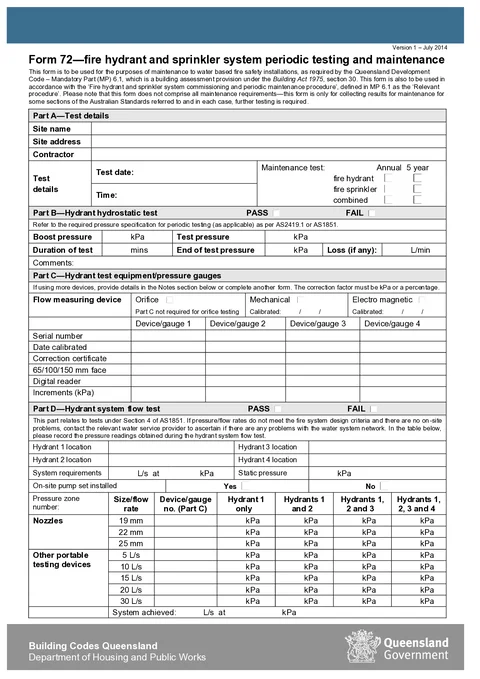
Form 72 records periodic testing and maintenance for fire hydrant and sprinkler systems under Queensland Development Code MP 6.1. You fill it after an annual or five-year maintenance test on a system already in service, then give a copy to the building occupier. The official PDF collects hydrostatic, flow, booster, equipment, compliance, and licensee sign-off for the systems tested.
This is the current Queensland Form 72. Tradie Forms follows the official section order and maps your answers onto the official PDF layout.
Commissioning a new hydrant or sprinkler system, or an extension to an existing one, rather than periodic maintenance? Use QLD Form 71
Form 72 is hardest to reconstruct after you leave site. Gather the readings and identity details while the gauges, test points, and block plan are still in front of you.
Site identity and contractor
Site name, site address, and the contractor or company name that will appear on the occupier copy.
Maintenance test type and systems covered
Annual or 5 year, and fire hydrant, fire sprinkler, or combined. Match the maintenance schedule and what you actually tested.
Hydrostatic and flow readings
Boost, test, end pressures, duration, loss, hydrant locations, system requirements, and achieved results from the instruments on site.
Pump booster figures when a booster was tested
Highest hydrant height, inlet and discharge pressures, boost pressure, and calculated frictional loss.
Equipment identity and calibration
Flow measuring device type, gauge serial numbers, calibration dates, correction certificates, face size, and increments.
Sprinkler test points and block plan notes
System specification, each test location with required and actual flow and pressure, and any running-test gauge pressure.
Compliance decisions and licensee details
Critical defects, repairs or corrective actions, overall system outcome, licensee name, licence number, report number, and signature.
Fill only the hydrant, sprinkler, or combined sections that match this visit. Leaving an untested section blank is correct; marking it Pass is not.
Identifies the site, who carried out the work, when the maintenance test ran, the annual or five-year cycle, and which systems it covers.
Site NameTextOptional
The building or project name the occupier will recognise on the file, for example Harbour View Apartments. Prefer the name on the block plan or maintenance schedule over a marketing name that will not match later service records.
Street addressAddressOptional
Site street line. Address search is limited to Queensland and fills the street line, suburb, state, and postcode. Check the result against the job sheet, because search returns the current postal address and a site can predate a street rename or subdivision.
StateAddressOptional
Defaults to QLD if left alone. Confirm it when typing the address by hand so the record stays Queensland-scoped.
PostcodeAddressOptional
Filled by address search. Confirm against the job sheet when typing manually.
ContractorTextOptional
Trading name of the contractor or company that carried out the maintenance, for example Coastal Fire Protection Pty Ltd. This is what the occupier sees as the service provider on the finished PDF.
Test DateDateOptional
Date the maintenance tests were done. Today and Yesterday shortcuts are available. Future dates are not accepted, so you cannot date the record ahead of the tests.
TimeTimeOptional
Time the test run started or was recorded on site, for example 09:30. Take it from the site notes rather than guessing later in the office.
Maintenance Test is the annual or 5 year matrix across fire hydrant, fire sprinkler, and combined. Tick only the systems and cycle that were part of this visit. Combined means hydrant and sprinkler were tested together as one run, not that every later section must be filled. The wrong cycle confuses the building manager and the next contractor.
Save this section as Contractor to prefill it on your next Form 72 maintenance job for the same company.
Records the hydrant hydrostatic test against the pressure specification in AS2419.1 or AS1851. Complete this section when a hydrant hydrostatic test was part of the visit.
Test OutcomeChoiceOptional
Pass or Fail for the hydrostatic test. Match the instruments and the standard you tested to, not a target you hoped to meet.
Boost PressureTextOptional
Boost pressure in kPa from the test setup, for example 1200. Read it from the gauge used for the test, not from a design schedule alone.
Test PressureTextOptional
Held test pressure in kPa, for example 1400. The pressure the system was taken to for the hold period.
Duration of TestTextOptional
Hold duration in minutes, for example 120. Use the timed hold from the test, not a rounded estimate from memory.
End of Test PressureTextOptional
Pressure in kPa at the end of the hold, for example 1395. Needed so any drop is visible next to the start test pressure.
Loss (if Any)TextOptional
Measured loss in L/min, for example 0 when none was observed. Enter the measured figure rather than leaving a fail outcome unexplained.
CommentsTextOptional
Defects, limitations, or follow-up the occupier should see with the hydrostatic result, for example Hydrostatic test completed with no visible leaks. Leave blank only when the readings stand alone.
Documents the flow measuring device and pressure gauges used for the hydrant tests. If a reading depends on a device, identify it on the record.
Flow Measuring DeviceChoiceOptional
Orifice, Mechanical, or Electro Magnetic. Part C gauge detail is not required for orifice testing. For mechanical or electro magnetic, fill the calibrated date that expands under that option from the device certificate or sticker.
Add up to four Device/Gauge rows for the gauges used on this test. Each row takes serial number, date calibrated, correction certificate, face size (mm), digital reader yes or no, and increments in kPa. Leave unused rows out rather than adding blanks. If you used more than four devices, note the extras in comments or complete another Form 72.
Records hydrant system flow test results under Section 4 of AS1851. Use hydrant location wording that still makes sense without the block plan open.
Test OutcomeChoiceOptional
Pass or Fail for the hydrant flow test as a whole. Align it with the readings and the system achieved figures, not with a separate verbal summary.
Hydrant 1 LocationTextOptional
Where hydrant 1 sits on the site, written so an occupier or later contractor can find it.
Useful
Basement car park NE riser
Too vague
H1
Hydrant 2 LocationTextOptional
Location for hydrant 2 in the same plain language as hydrant 1, for example Ground floor loading dock.
Hydrant 3 LocationTextOptional
Location for hydrant 3 when a third hydrant was used in the flow test, for example Level 3 east stair.
Hydrant 4 LocationTextOptional
Location for hydrant 4 when a fourth hydrant was used, for example Roof plant room.
Flow RateTextOptional
System required flow rate in L/s from the design or block plan, for example 20. This is the requirement, not the achieved result.
PressureTextOptional
System required pressure in kPa, for example 200. Take it from the design criteria you tested against.
Static PressureTextOptional
Static pressure in kPa recorded for the system, for example 450.
On-Site Pump Set InstalledChoiceOptional
Yes or No. Answer from what is installed on this site; it changes how a reader interprets low network pressure.
System Achieved Flow RateTextOptional
Achieved flow rate in L/s, for example 22. Enter what the instruments showed, not the design target again.
System Achieved PressureTextOptional
Achieved pressure in kPa, for example 210. Enter what the instruments showed, not the design target again.
The flow reading table records pressure by nozzle size or portable device flow rate against hydrant combinations, with a device or gauge number that points back to Part C. Fill only the rows and hydrant columns you actually tested. If pressure or flow rates do not meet design criteria and there are no on-site faults, contact the relevant water service provider.
Records pump appliance booster test results under sections 10.4 and 10.5 of AS2419.1 and Section 4 of AS1851 when a booster test was part of this visit.
Test OutcomeChoiceOptional
Pass or Fail for the booster test. Match the inlet, discharge, and boost figures you recorded on site.
Hydrant LocationsTextOptional
The hydrant path used for the booster test, written for someone without the block plan, for example Basement booster to roof hydrant ring.
Height of Highest Hydrant Above BoosterTextOptional
Height in metres of the highest hydrant above the booster, for example 32. Take it from the design or a measured site figure, not a guess.
Flow RateTextOptional
Required flow rate in L/s for the booster test, for example 20.
PressureTextOptional
Required pressure in kPa for the booster test, for example 200.
Static PressureTextOptional
Static pressure in kPa for the booster test setup, for example 450.
Pump Inlet PressureTextOptional
Pump inlet pressure in kPa, for example 380. Read from the inlet gauge during the test.
Pump Discharge PressureTextOptional
Pump discharge pressure in kPa, for example 1200.
Boost PressureTextOptional
Boost pressure in kPa delivered by the pump set, for example 820.
Calculated Frictional LossTextOptional
Calculated frictional loss in kPa, for example 45. Use the calculated figure from the test method you applied.
CommentsTextOptional
Limits, defects, or follow-up that belong with the booster result, for example Booster test completed within design criteria.
If pressure or flow rates do not meet design criteria and there are no on-site problems, contact the relevant water service provider.
Records sprinkler system flow test results for AS2118.1, AS2118.6, AS2118.4, and section 2 of AS1851. Multiple testing points may be required on larger systems. For some AS2118.4 systems without a flow measuring device, a simulated running test may apply.
System Specifications (Block Plan)TextOptional
Short description of the system as shown on the block plan, for example Wet pipe system to AS2118.1. Keep it specific enough that a later reader knows which system was tested.
Test ResultsTextOptional
Overall summary of the sprinkler flow test, for example Test point 1 and 2 within specification. This sits above the individual test point rows on the PDF.
Running Test - Installation Gauge PressureTextOptional
Installation gauge pressure in kPa for a running test, for example 195. Fill when a running or simulated running test was done.
CommentsTextOptional
Extra test points, limitations, or follow-up. If more than two locations were tested, list the extras here because the form holds two test point rows.
Add up to two Test Point rows when multiple testing points are required. Each row has test location, required and actual flow (L/min), required and actual pressure (kPa), and pass or fail for flow and pressure. Leave unused rows out. Use location wording that stands without the block plan.
Declares critical defects, repairs or corrective actions, and the overall system outcome after the maintenance tests for this visit.
Critical Defects IdentifiedChoiceOptional
Yes or No. If Yes, the form notes that the owner or occupier is given a critical defect notice. Keep that notice with the job file so the PDF is not the only record of the defect.
Repairs/Corrective Actions TakenChoiceOptional
Yes or No. If Yes, attach action and date details as part of the licensee report. A Yes without supporting detail in the job file is the usual gap later readers hit.
System OutcomeChoiceOptional
Overall Pass or Fail for the systems covered by this Form 72. It has to agree with the section outcomes and any critical defects recorded above, not with a separate verbal handover.
Licensee declaration for Form 72. By signing, the licensee confirms the information is correct to the best of their knowledge given the available information, and that the form has been completed in accordance with the relevant standards, codes, and regulations. Sign after the readings and compliance answers match what you are prepared to put on the occupier copy. Name and signature gate the download.
Licensee NameTextRequired
Name of the appropriately qualified licensee signing the record, for example Jordan Lee. Match the person who takes responsibility for the maintenance record.
Licensee SignatureSignatureOptional
Signature of that licensee. Capture it on site when you can. You can use a saved signature. It lands on page 2 of the official PDF in the licensee block.
Licence No. (QBCC/PIC)TextOptional
QBCC or PIC licence number as printed on the card, for example QBCC1234567. Licence check can look up the QBCC register and prefill the licensee name; confirm the name still matches the person signing.
Licensee Report No.TextOptional
Your report number for this maintenance job, for example F72-2026-0612. Use a number that ties the PDF back to your internal job file.
Save this section as Licensee to prefill it on your next Form 72 maintenance job for the same licensee.
Using Form 72 for commissioning a new system or extension.
Form 72 is for periodic testing and maintenance on a system already in service. Commissioning a new install or an extension belongs on Form 71. The job moment decides the form, not how similar the reading tables look.
Ticking the wrong annual or five-year cycle.
The maintenance schedule and what you actually tested have to match. The wrong cycle confuses the building manager and the next contractor who opens the file.
Treating the finished PDF as the whole maintenance file.
The official form says it does not cover all maintenance testing requirements. Keep service sheets, gauge references, block plans, and defect notices with the PDF so the occupier copy has a trail behind it.
Leaving gauge serial and calibration details blank.
If a reading depends on a device, identify the device. Missing serial numbers or calibration dates make the record harder to trust when a later contractor or occupier opens the file.
Writing hydrant locations as H1 or Stage 2 only.
Codes that only make sense with the block plan open fail as soon as the plan is filed separately. Name the floor, riser, or dock so the location stands alone.
Marking Pass on sections that were not tested.
Tick only the systems maintained on this visit and complete only those sections. An untested section left blank is honest; a Pass without readings is not.
Recording critical defects or repairs without the supporting notice.
A Yes on critical defects or corrective actions needs the notice, action, date, and any photos in the job file. The PDF alone does not carry that detail.
Signing before the system outcome and report number are checked.
The signature block is the last chance to catch a wrong report number, licence number, or overall pass or fail that does not match the section results.
QDC MP 6.1 says the appropriately qualified person who carries out maintenance completes the relevant form and gives a copy within 10 business days after completing the work. For maintenance, that copy goes to the building occupier. MP 6.1 also says the person must keep a record of the form for at least five years.
Name the file so the site, cycle, and date are obvious. Prefer Form 72 - Harbour View Apartments - annual hydrant - 2026-06-01.pdf over a generic contractor-only name when you service multiple buildings.
File the PDF with the supporting trail. Keep raw readings, gauge references, block plans, test point locations, critical defect notices, corrective action details, and useful photos in the same job folder.
Do not claim the PDF alone proves every maintenance requirement. The form states further testing is required in each case. Hand over the supporting pack with the form.
Track defects and repairs separately. When critical defects or corrective actions are recorded, follow the notice process that applies and keep those papers with the Form 72 copy.
Check the current Queensland Development Code and Business Queensland requirements for your job. Retention and handover sit with MP 6.1 and the authority's current guidance.