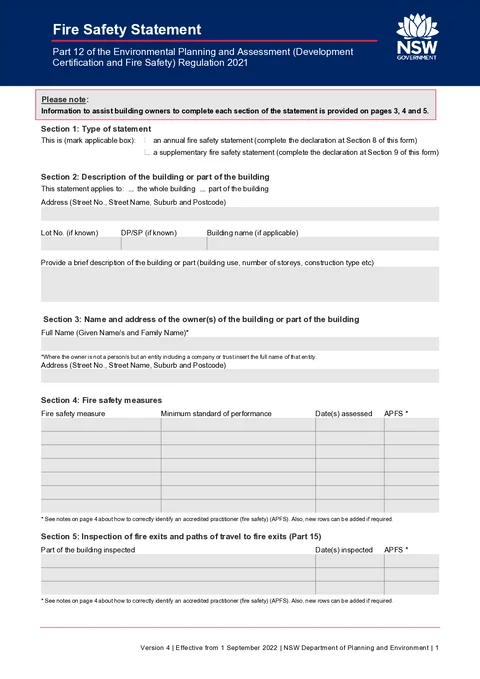
The NSW Fire Safety Statement is the owner's confirmation that essential (or critical) fire safety measures on the current fire safety schedule have been assessed by an accredited practitioner (fire safety) and can perform to the schedule standard. The owner or an authorised agent issues it for an existing building and downloads the official Version 4 PDF for council, Fire and Rescue NSW, and building display. NSW Planning describes annual statements for essential measures each year and supplementary statements for critical measures at the shorter intervals set by the schedule.
This is the current NSW Fire Safety Statement (Version 4). Tradie Forms follows the official section order and maps your answers onto the official PDF layout.
Certifying completion of new building work rather than the yearly owner statement for an existing building? Use NSW Fire Safety Certificate
Almost every AFSS problem comes from filling from last year's PDF instead of from the current schedule and practitioner reports. Have these in front of you.
The current fire safety schedule
The source for which measures apply, essential versus critical, minimum standards, and any supplementary intervals.
A decision on annual or supplementary
Annual for the yearly essential-measures cycle; supplementary only when the schedule requires critical measures on a shorter interval.
APFS assessment reports
Measure names, standards, assessment dates, and accreditation numbers for every measure on this statement.
Exit inspection records (annual only)
Parts of the building inspected under the annual exit path rules, dates, and the inspecting APFS.
Owner or agent authority
Who issues the statement, plus authority paperwork if an agent signs for the owner.
Building identity and previous statement
Address, lot or DP/SP where known, and the last issue date so due dates and scope stay consistent.
Statement type, building scope, the building and owner street addresses, the declarant street address, and the matching declaration name, role, signature, and date issued gate the download. Pages 3 to 5 of the finished PDF are owner guidance only; you do not fill those pages in the app.
Chooses which obligation this PDF is for. Only the matching declaration section is shown while you fill, and fire exit inspections appear only for annual statements.
Statement TypeChoiceRequired
Annual fire safety statement covers all essential measures on the schedule for the yearly cycle and includes the fire exit inspection rows. Supplementary fire safety statement covers critical measures at the shorter intervals set by the schedule. Pick from the current schedule and due obligation, not from last year's PDF filename.
Identifies the building or part this statement covers. The building address is copied into the footer on every page of the downloaded PDF.
This Statement Applies ToChoiceRequired
The whole building when the schedule covers the entire building. Part of the building for a tenancy, stage, wing, or other defined part of a mixed-use or staged site. Wrong scope is how a future reader misreads what was covered.
Street addressAddressRequired
The building the schedule applies to, not the owner's postal address. Address search is limited to New South Wales and fills the street line, suburb, state and postcode. Check the result against the schedule or rates notice; new estates can lag search, and the finished PDF reprints this address in the footer on every page.
StateAddressRequired
Filled by address search. Confirm NSW when typing by hand.
PostcodeAddressRequired
Filled by address search. Confirm against the schedule or rates notice when typing manually.
Lot No. (if Known)TextOptional
From the title, rates notice, or schedule when the street address alone is ambiguous, for example 12.
DP/SP (if Known)TextOptional
Deposited plan or strata plan reference from the same source, for example DP123456 or SP98765.
Building Name (if Applicable)TextOptional
Named buildings on multi-building sites, for example Harbour Offices or Building B.
Provide a Brief Description of the Building or Part (Building Use, Number of Storeys, Construction Type Etc.)TextareaOptional
Building use, storeys, and construction so a council or FRNSW reader can identify the property without opening the schedule. When the statement is for part of a building, name the part clearly.
Useful
Commercial office building, 8 storeys, concrete construction. Part covered: Building B, levels 1 to 3, retail tenancies 4 to 9.
Records the owner or entity responsible for the building. This can differ from the site address and from the person who signs as agent.
Full nameTextOptional
Full legal name of each owner. For a company, trust, or owners corporation, use the full entity name as it should appear on the statement, for example Harbour Holdings Pty Ltd, not a trading nickname.
Street addressAddressRequired
Owner postal address shown on the official PDF. Address search is limited to New South Wales and fills the street line, suburb, state and postcode. It often differs from the building address in the Building section.
StateAddressRequired
Filled by address search. Confirm it when typing by hand.
PostcodeAddressRequired
Filled by address search. Confirm against the owner's records when typing manually.
Lists each essential or critical fire safety measure from the current fire safety schedule. One row is one measure. Add up to seven rows to match the official PDF table; leave unused rows out rather than adding blanks. Rows beyond seven are not written to the PDF.
Copy measure names and minimum standards from the current schedule, not from last year's statement. Last year's PDF is a reference only; a reissued schedule, building work, or fire safety order can change the table.
Each row uses Fire Safety Measure, Minimum Standard of Performance, Date(s) Assessed, and APFS. Measure and standard offer common options and accept free text when the schedule uses a different wording. Assessment dates accept multiple dates (up to six) and cannot be future dates.
The Regulation limits how old supporting assessments can be when the statement is issued: within the previous three months for an annual statement, and within the previous month for a supplementary statement. Check every assessment date against the issue date before you sign. Put the APFS accreditation number of the practitioner who assessed that measure in the APFS column, for example FPAS-12345.
Part 15 fire exit inspections for annual statements only. The section is hidden when statement type is supplementary. One row is one inspected part of the building. Add up to three rows to match the official PDF table; leave unused rows out.
Each row uses Part of the Building Inspected, APFS, and Date(s) Inspected. Name the area checked so a later reader can find it, for example Ground floor fire-isolated stairway rather than exits. Dates accept multiple values (up to six) and cannot be future dates. Put the accreditation number of the practitioner who inspected that part in the APFS column.
The Regulation requires the annual assessment and inspection work to fall within the previous three months before issue. Check inspection dates against the annual issue date before you sign.
Records each accredited practitioner (fire safety) who assessed measures or inspected fire exits for this statement. One row is one practitioner. Add up to five rows to match the official PDF table; leave unused rows out.
NSW Planning material and the FPA Australia register are the usual sources for who holds which accreditation categories. One person may not cover every measure on a large building.
Each row uses Full Name, Address, Phone, APFS, and Signature. Address search is available on the address column and is limited to New South Wales. Use the accreditation number as on the register, for example FPAS-12345. Each practitioner can sign in the app; the signature stamps onto the official PDF line for that row. Names alone are not enough: keep accreditation numbers and signatures (or separate signed documents) with the job.
Save this section as Accredited Practitioners to prefill it on your next statement that uses the same APFS practitioners.
Contact details for the person who will sign the annual or supplementary declaration. This person must be the owner or an authorised agent. An accredited practitioner who assessed a measure or inspected exits for this statement must not make the declaration, and that restriction extends to their employer, employee, or direct associate.
Full nameTextOptional
Person who will sign the declaration. Usually matches the declarant full name in the annual or supplementary declaration section.
Organisation (if Applicable)TextOptional
Company or strata management firm when the declarant signs as an agent, for example Lee Property Services.
Title/Position (if Applicable)ComboboxOptional
Role such as Building Manager, Owner, Owner's Agent, Strata Manager, Project Manager, or a custom value that matches how they act on the building.
Street addressAddressRequired
Postal contact address for the declarant. Address search is limited to New South Wales and fills the street line, suburb, state and postcode.
StateAddressRequired
Filled by address search. Confirm it when typing by hand.
PostcodeAddressRequired
Filled by address search. Confirm against the declarant's records when typing manually.
PhoneTelOptional
Number that reaches the declarant if council or the building manager needs to follow up, for example 02 9123 4567.
EmailEmailOptional
Contact email for the same follow-up path.
Save this section as Declarant to prefill it on your next statement where the same person issues for the owner.
Owner or agent declaration for annual statements. Shown only when statement type is annual. This is the issue of the statement, not the APFS assessment.
Declarant full nameTextRequired when statementType is annual
Full name that appears in the declaration sentence. Usually the same person as Person Making the Declaration. Must not be an APFS who assessed measures or inspected exits for this statement.
I Am Signing AsChoiceRequired when statementType is annual
Owner when the building owner signs. Owner's Agent when a properly authorised agent signs. Keep the owner's authority with the building record when an agent signs.
Owner/Agent SignatureSignatureRequired when statementType is annual
Signature of the owner or agent issuing the statement. Add it when the measure table, practitioners, and dates are final, not as a blank placeholder at the start of the job. It stamps onto the declaration line on the official PDF.
Date IssuedDateRequired when statementType is annual
Date the statement is issued. Today and Yesterday shortcuts are available; future dates are not accepted. Assessment and inspection dates must fall within the previous three months relative to this date.
Owner or agent declaration for supplementary statements. Shown only when statement type is supplementary. Covers critical measures on the schedule's shorter interval, not a second name for the yearly AFSS.
Declarant full nameTextRequired when statementType is supplementary
Full name that appears in the declaration sentence. Same role rules as the annual declaration: owner or authorised agent only, never the assessing APFS for this statement.
I Am Signing AsChoiceRequired when statementType is supplementary
Owner or Owner's Agent, matching the authority for this issue.
Owner/Agent SignatureSignatureRequired when statementType is supplementary
Signature of the owner or agent issuing the supplementary statement. Stamp it when the critical-measure rows and dates are final.
Date IssuedDateRequired when statementType is supplementary
Date the supplementary statement is issued. Assessment dates must fall within the previous month relative to this date. Future dates are not accepted.
Picking annual or supplementary from last year's PDF.
The due obligation comes from the current fire safety schedule and the Regulation cycle, not from the filename of the last statement. Annual covers essential measures for the yearly cycle; supplementary is only for critical measures on shorter schedule intervals.
Copying last year's measure table without checking the schedule.
Schedules are reissued, corrected after works, or changed by orders. Copy measure names and minimum standards from the current schedule, then fill assessment dates and APFS numbers from this cycle's reports.
Assessment or inspection dates outside the allowed window.
An annual statement must not be issued unless the relevant assessments and exit inspection fall within the previous three months. A supplementary statement needs assessments within the previous month. If a report is old, refresh the assessment before issuing.
Leaving APFS numbers or practitioner signatures incomplete.
The form needs the details and signature of each accredited practitioner who assessed measures or inspected exits, or a separate signed document from each practitioner. Names alone are not enough for a clean lodgement pack.
The assessing practitioner signing the owner declaration.
The owner or an authorised agent issues the statement. An APFS who assessed a measure or inspected exits for this statement must not make the declaration, and that restriction extends to their employer, employee, or direct associate.
Vague part-building scope.
On mixed-use, staged, or multi-tenancy sites, "the building" does not tell a future reader what is covered. Select part of the building and describe level, tenancy, wing, or stage so coverage is obvious without the schedule file.
Skipping the PDF preview before download.
The form catches empty required fields, but wrong addresses, mistyped APFS numbers, and out-of-window dates still print. Preview the official layout as council, FRNSW, and the building manager will see it.
Sections 89 and 91 of the Regulation require the relevant annual or supplementary statement to go to council. As soon as practicable after issue, the owner must also give the Fire Commissioner a copy with the current fire safety schedule and ensure both documents are prominently displayed in the building.
Lodge with the council for the building. Use that council's current portal, email, or counter process and fees. Confirm the pathway for this LGA, not the owner's postal council.
Submit a copy to Fire and Rescue NSW. Follow the current FRNSW lodgement guidance and online statement form. Keep the submission confirmation with the job.
Display the statement and current schedule in the building. Replace the previous display copy so the posted documents match the lodged set.
File the full pack. Keep the signed PDF, current schedule, APFS reports and signatures, owner or agent authority, council receipt, FRNSW confirmation, and a note that the display copy is in place.
Name the file so the cycle is obvious. Include the building and year or interval, for example AFSS - 42 George St - 2026 annual.pdf, so next year's pack does not open the wrong PDF first.
Tradie Forms prepares the official PDF. It does not lodge the statement, choose the council, or replace the owner's responsibility to complete every required step. Check the current NSW Planning and Fire and Rescue NSW requirements for your building.